The History of Crokinole in Canada and How It Spread8 min read
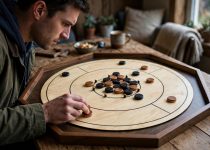
Every game has an origin story, but few are as specific as this one. The history of crokinole begins in 1876, in a farm workshop in Perth County, Ontario, with a birthday gift a father built for his five-year-old son. That single handmade board is the oldest crokinole board known to survive.
From that workshop, the game spread the slow way: neighbour to neighbour, farm to farm, church hall to church hall. It never had a big commercial launch or a famous promoter behind it. It simply kept getting played, winter after winter, until it became a fixture of Canadian game nights.
This article traces that path, from homemade boards to factory production to a world championship. If it leaves you wanting a board of your own, our roundup of the best crokinole boards shows how today’s makers build them.
The History of Crokinole at a Glance
The whole history of crokinole fits on one short timeline. Each era on the table below gets its own section after it.
| Era | What Happened |
|---|---|
| 1876 | Eckhardt Wettlaufer crafts the earliest known crokinole board in Perth County, Ontario, as a birthday gift for his son |
| Late 1800s | Homemade boards spread across Ontario as families copy the game from farm to farm |
| Early 1900s | Factory-made boards and printed rules standardize dimensions and scoring |
| Mid-1900s | Crokinole holds on as a stronghold game in Mennonite and rural Ontario communities |
| 1970s-2000s | Organized tournaments grow, capped by the World Crokinole Championship in Tavistock, first held in 1999 |
| Today | Clubs, board makers and online play carry the game to players around the world |
1876: Eckhardt Wettlaufer Builds the First Known Board
Eckhardt Wettlaufer was a German-born craftsman who settled in Perth County, in southwestern Ontario. He worked as a wagon maker and carpenter, the kind of tradesman who could build almost anything from wood. In 1876, by the widely told account, he made a crokinole board as a birthday gift for his son Adam. That board still exists. It is preserved today in a museum collection in Kitchener, Ontario, and it looks remarkably familiar: a round playing surface, a centre hole, a surrounding ditch, and pegs guarding the middle.
For anyone tracing the history of crokinole, that board is where the trail starts, because the design was essentially complete from the beginning. Wettlaufer did not invent flicking games from nothing. Disc-flicking games existed in several cultures, and crokinole likely borrowed ideas from games like carrom. What he produced, though, was the first recognizably modern crokinole board, and every board since descends from that pattern.
Homemade Boards Spread Across Ontario
For its first few decades, crokinole had no factories and no rulebook. Boards were homemade, built by local carpenters or copied from a neighbour’s board. Dimensions varied from township to township, and so did the house rules.
The game suited rural Ontario life. It needed no electricity, no teams, and no good weather. A board on the kitchen table could entertain a family through a long winter evening, and relatives of any age could join in within minutes.
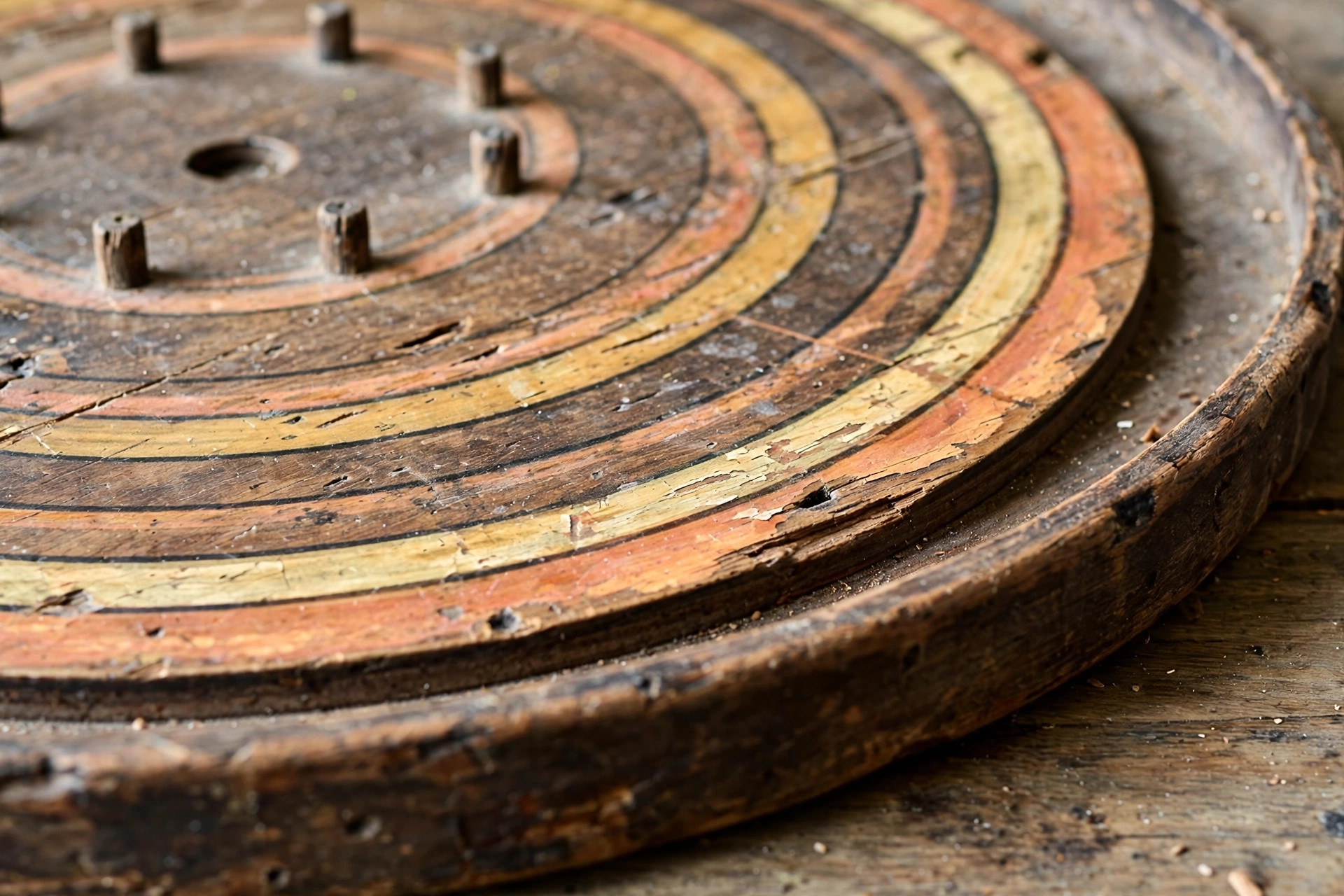
Because boards were copied rather than bought, the game travelled along family and community lines. When families moved within Ontario, their boards and their version of the rules moved with them.
Factory Boards and Printed Rules in the Early 1900s
By the early 1900s, demand had grown enough that manufacturers began producing crokinole boards commercially. Factory boards brought consistent dimensions: the same diameter, the same centre hole, the same peg layout, no matter where you bought one.
Printed rules started appearing in the box alongside the boards. That mattered more than it sounds. A shared rule set meant strangers could sit down and play the same game, which is the moment a folk pastime starts becoming a sport. Standard scoring settled in during this era too: 20 for a disc sunk in the centre hole, then 15, 10 and 5 by ring, with rounds scored by the difference between players. Those numbers are still the backbone of the game today.
The name travelled with the boards. Most writers trace the word crokinole to the French croquignole, a term for a flick of the finger, which is exactly the motion the game is built around. Whatever its precise route into English, the name was in common use by the time factory boards reached general stores across the province.
A Rural Stronghold: Mennonite Communities Keep the Game Alive
By the middle of the 1900s, crokinole had faded in many places. Television and new pastimes pushed parlour games aside across much of North America. Crokinole survived because it held on where it had always been strongest: rural Ontario. Mennonite communities in the southwest of the province were central to that survival. Crokinole fit community life there: it was inexpensive, social, and suitable for all ages, and boards lived in homes and church halls. Generations learned the game from grandparents, and boards were maintained rather than replaced.
That continuity mattered. When interest revived later in the century, the game had living teachers, working boards, and an unbroken tradition to build on, instead of only antiques and memories.
Tournaments and the World Crokinole Championship
Organized competition grew through the later 1900s, as clubs and regional tournaments brought standardized boards and rules together. Players who had only ever faced family suddenly met opponents who had been flicking discs for fifty years. The capstone arrived in 1999, when the first World Crokinole Championship was held in Tavistock, Ontario. Tavistock is a small village in the same southwestern Ontario region where the game began, and the championship has been held there ever since, drawing players from across Canada and beyond.
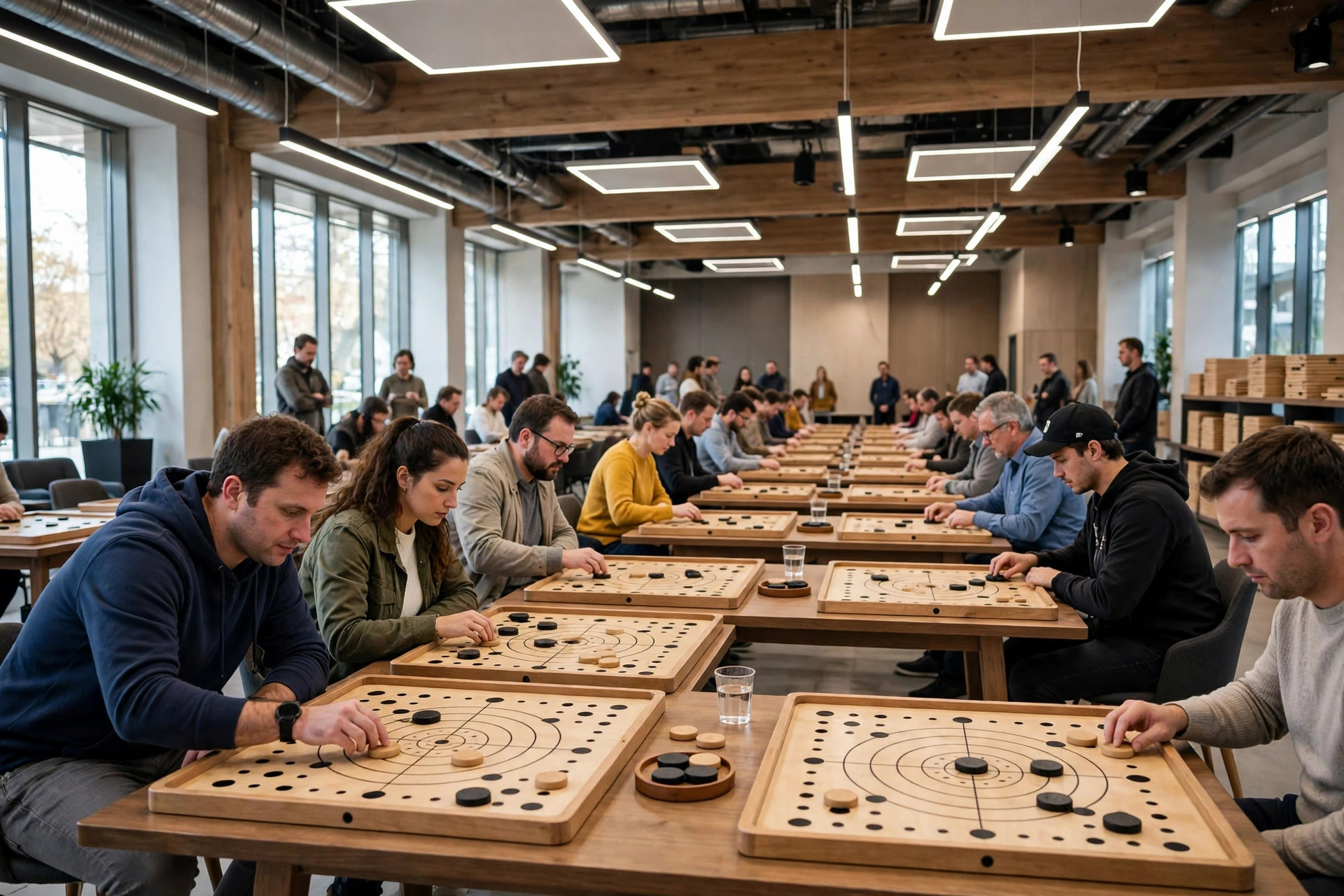
Tournament play also sharpened the game’s shared understanding of itself. Official rulings on lines, hanging discs and pegs replaced table-by-table arguments, the same rulings we walk through in our guide to crokinole scoring disputes.
Crokinole Today: Clubs, Makers and Online Play
Today the history of crokinole is still being written. Clubs run leagues in Canadian and American cities, and players further afield have taken up the game. Online videos of championship matches and improbable 20s have introduced crokinole to people who have never seen a board in person. Board making has revived with it. Small workshops produce boards to tournament dimensions, with the fast, waxed playing surfaces competitive players expect.
If you are shopping, our guide to the best crokinole boards explains what separates an heirloom board from a toy. For a game that began as one father’s birthday gift, the reach is remarkable. The board has changed less than almost any game of its age, which might be the point: Wettlaufer’s design did not need improving.
Frequently Asked Questions
Who invented crokinole?
The earliest known crokinole board was made by Eckhardt Wettlaufer, a German-born wagon maker and carpenter in Perth County, Ontario. He built it in 1876 as a birthday gift for his son Adam. The board survives today in a museum collection in Kitchener, Ontario.
Where does the name crokinole come from?
The name is widely believed to come from the French word croquignole, which can mean a flick of the finger. That fits the game’s central action: discs are flicked across the board with a fingertip. The exact path from the French word to the game’s name is not documented.
How old is crokinole?
Crokinole is about 150 years old. The earliest surviving board dates to 1876, and the game spread across Ontario in the decades that followed. Because homemade boards came first and left few records, informal versions of the game may be slightly older than the surviving board suggests.
Where is the World Crokinole Championship held?
The World Crokinole Championship is held in Tavistock, a village in southwestern Ontario, close to the region where the game began. The first championship took place in 1999, and the event has returned to Tavistock ever since, drawing competitive players from across Canada and other countries.
Is crokinole only played in Canada?
No. Canada is the game’s home, and Ontario remains its heartland, but crokinole is now played in the United States and in clubs and tournaments in other countries. Online videos, travelling players and modern board makers have carried the game well beyond the farm communities where it started.
Final Thoughts
The history of crokinole is a story of a good design and the communities that refused to let it go. One handmade board in 1876 became a regional pastime, then a standardized game, then a world championship sport. Pick up a disc, and you are playing it almost exactly as Adam Wettlaufer did.

Best Crokinole Board Recommendations and Buying Guide
Crokinole Disc Size and Wax Guide for Beginners