Crokinole Disc Size and Wax Guide for Beginners9 min read
Buy a set of discs that is even slightly wrong for your board and crokinole quietly stops working. Discs that are too big will not drop into the centre hole for a 20, and discs that are too small rattle around the pegs and slide unpredictably. Getting crokinole disc size right is the first setup decision every beginner should make. The good news is that the sizing system is simple: one tournament standard, one smaller size for compact boards, and one choice of playing face. Add a little wax and the same discs play noticeably faster. If you are still shopping for the board itself, our roundup of the best crokinole boards explains which board sizes each disc size pairs with, so you can match the two before you spend anything.
Crokinole Disc Size at a Glance
Here is the whole sizing picture in one table. Match your board first, then read the sections below for the detail behind each row.
| Disc Type | Diameter | Used On |
|---|---|---|
| Standard tournament discs | 32 mm | Tournament boards with a 26-inch (660 mm) playing surface |
| Smaller discs | 28 mm | Compact boards, including 26-inch overall-diameter boards with a smaller playing surface |
| Concave vs convex faces | Same disc, two faces | Most discs have one concave face and one convex face; you choose which side faces down. |
One measurement explains most of the system: the centre 20 hole is 35 mm across. A standard 32 mm disc drops through it cleanly, with just enough clearance to reward a well-centred shot. Everything about crokinole disc size flows from that relationship.
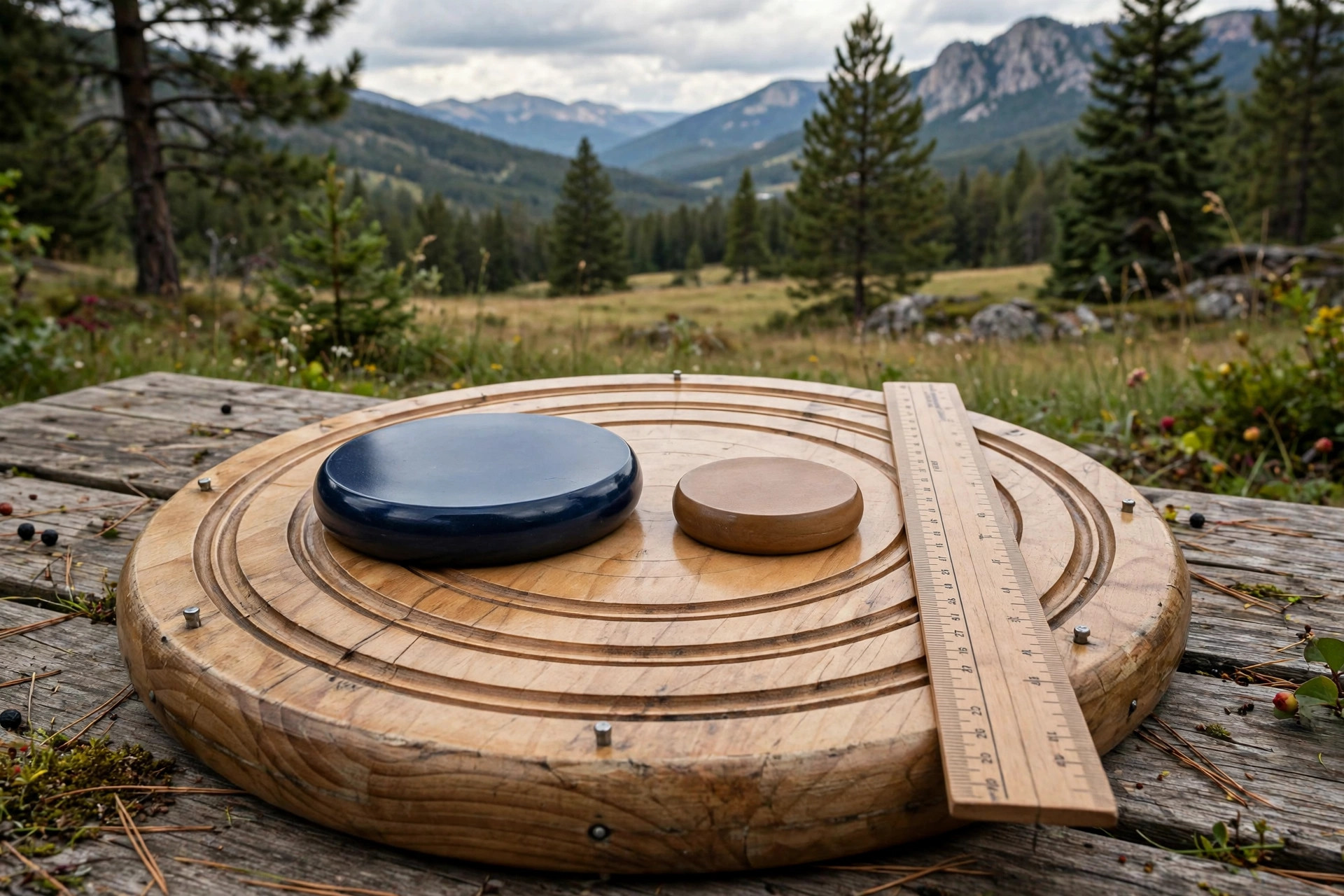
Why Disc Size Matters More Than You Think
Crokinole is a game of small margins, and disc size sets several of them at once. A disc that fits the 20 hole properly scores the shots it should. One that is too large catches the rim and hangs half in, turning a 20 into an argument. One that is too small drops too easily and takes the skill out of the centre shot. Size also changes how discs interact. Discs meet each other and the eight pegs around the centre hole constantly, and a disc that is undersized for the board slips through gaps the game was not designed to allow. Oversized discs crowd the centre circle and change how combination shots play. Finally, there is feel. Players develop a flick tuned to one disc weight and diameter, so every disc in a game should be identical, or the game stops being fair.
Tournament Crokinole Discs: The 32 mm Standard
Tournament crokinole discs measure 32 mm in diameter, and this is the size to buy if your board has the standard 26-inch playing surface used in organised play. Discs come in sets of 24, twelve per side, traditionally black against natural wood, though coloured sets exist. If your board came from a tournament-style maker, 32 mm is almost certainly your size, and our earlier guide on choosing the right size crokinole discs for your board walks through how to confirm it against your specific board model. When in doubt, measure. A disc that reads 32 mm across with a ruler or calipers is the standard disc, whatever the packaging called it.
Smaller Discs for Compact and Travel Boards
Not every board is built to tournament dimensions. Compact and travel boards, including many sold as 26-inch boards by overall diameter, have a smaller playing surface and a smaller centre hole to match. Those boards use discs of about 28 mm. The trap for beginners is assuming the headline board size tells you the disc size. It does not. A 26-inch board might mean a 26-inch playing surface, which takes 32 mm discs, or a 26-inch total diameter with a playing surface several inches smaller, which takes the 28 mm size. Check the centre hole before you order. If the hole measures about 35 mm, buy 32 mm discs. If it is noticeably smaller, measure it and match the disc to the hole with roughly 3 mm of clearance. That check prevents nearly every wrong-disc purchase.
Concave vs Convex: Which Face Goes Down?
Look closely at a crokinole disc and you will see it is not flat on both sides. One face is slightly concave, dished inward, and the other is slightly convex, crowned outward. This is deliberate, and players have strong opinions about it. Played concave side down, a disc contacts the board mostly on its rim. That means less friction, a faster and longer slide, and a disc that glides over small surface imperfections. Most players who wax their discs play concave down, because the two speed advantages stack. Played convex side down, the disc contacts near its centre and grips a little more. The slide is slower and stops sooner, which some players prefer for delicate shots that need to die near the centre. Neither face is against the rules; the choice is a genuine playing preference, and it is worth trying both for a few games before you settle.
Crokinole Disc Wax: Making Your Discs Slide Faster
Crokinole disc wax is the cheapest performance upgrade in the game. A thin coat of paste wax on the playing face of each disc cuts friction, so shots carry further with the same flick and discs glance off each other more cleanly. Apply it sparingly. Rub a small amount of paste wax onto the face of the disc, let it dry to a haze, then buff it off with a soft cloth until the wood shines and feels slick but dry. Wax left thick or tacky does the opposite of its job and picks up dust from the board. Re-wax when discs start to feel grabby, which for regular players is every few weeks of play. It takes ten minutes to do a full set, and the difference on the first shot afterwards is obvious.

Wax on the Board: A Light Touch Only
Discs are only half of the friction equation. The board surface matters too, and many players keep it slick with an occasional coat of paste wax, buffed hard, or a light dusting of powdered shuffleboard wax in the playing area. Keep board wax thin and fully buffed, and keep it out of the ditch, where discs are supposed to stop. A board that is waxed on top of old wax builds up unevenly and plays worse than a clean one, so if the surface feels patchy, clean it back and start fresh rather than adding another coat. Whichever combination you use, change one thing at a time: wax the discs or the board, play a few games, then adjust the other.
Replacing Worn or Lost Discs
Discs are wear items. Edges round over, faces cup or scratch, and a disc that has taken a hard drop onto a floor can chip. A single damaged disc in a set changes how it plays compared with its partners, which is why serious players replace discs in matched sets rather than one at a time. When you replace, match three things: diameter, so the new discs fit your 20 hole; weight, so the flick feels the same; and face profile, so the whole set slides alike. If you cannot match the old set exactly, replace all 24 and keep the old discs as spares. The boards in our guide to the best crokinole boards list their playing surface and hole dimensions clearly, which makes matching a replacement set of discs straightforward.
Frequently Asked Questions
What size are standard crokinole discs?
Standard crokinole disc size for tournament play is 32 mm in diameter. That size pairs with boards that have a 26-inch (660 mm) playing surface and a 35 mm centre hole. Discs come in sets of 24, twelve per side, and every disc in a game should be the same size.
How do I measure my crokinole disc dimensions at home?
Lay a ruler or calipers across the widest part of the disc face and read the diameter in millimetres. A reading of 32 mm means the standard tournament disc; around 28 mm means the smaller size for compact boards. Also measure your centre hole, since the disc needs roughly 3 mm of clearance to drop cleanly.
Should I play with concave crokinole discs facing down?
Most players do, because the concave face contacts the board only at its rim, which reduces friction and produces a faster, longer slide. Playing convex side down grips more and stops sooner, which suits delicate shots. Both are legal, so try each face for a few games and keep the one that suits your flick.
How often should I wax my crokinole discs?
Wax them when the slide starts to feel grabby rather than on a fixed schedule. For most home players that works out to every few weeks of regular play. Apply paste wax thinly, let it haze, and buff it completely off; a slick, dry finish is the goal, not a visible layer of wax.
Can I use 32 mm discs on a smaller board?
Only if the centre hole is the full 35 mm. On a compact board with a smaller hole, a 32 mm disc will not drop for a 20 and will crowd the pegs. Match the disc to the hole with about 3 mm of clearance, which usually means 28 mm discs on compact boards.
Final Thoughts
Crokinole disc size comes down to one check: measure your centre hole, then buy the disc that fits it, 32 mm for the tournament standard or 28 mm for compact boards. Choose the face that suits your flick, keep the discs waxed, and the equipment disappears, which is exactly what you want. The game should be about the shots, not the gear.

How to Maintain a Crokinole Board: Waxing, Pegs and Humidity

Crokinole for Kids and Families: House Rules That Keep It Fun