Crokinole Scoring Disputes Solved: Lines, Hanging Discs and 20s8 min read
Crokinole rounds are friendly right up until the last disc stops moving. Then two players lean over the board, one sees a 15 and the other sees a 10, and the game pauses for a ruling. Almost every crokinole scoring argument comes from the same five situations, and each one has a standard answer. None of these rulings is a matter of opinion. Tournament play settled them long ago, and home games run smoother when everyone uses the same answers. Learn the five rulings below and most disputes end in seconds. The board itself matters more than players expect. Wobbly pegs and a worn ditch edge create half the arguments in this article, and the boards in our roundup of the best crokinole boards are built to tournament dimensions so the rulings apply cleanly.
Crokinole Scoring Basics in 60 Seconds
A round ends when every disc has been shot. Discs sitting fully inside the centre hole during play are worth 20 and are removed right away. At the end of the round, each remaining disc scores by the ring it sits in: 15 for the inner circle guarded by the pegs, 10 for the middle ring, and 5 for the outer ring. Discs in the ditch score nothing. Then comes the part new players miss: crokinole scoring is done by difference. Add up each side’s points, and only the higher side scores, keeping the gap between the two totals. If you count 45 and your opponent counts 30, you score 15 for the round, not 45.
The 5 Disputes at a Glance
Here is every ruling in this article on one table. The sections below explain the reasoning behind each one.
| Situation | Ruling | Why |
|---|---|---|
| Disc touching a dividing line | It scores the lower of the two zones it touches | A disc must lie fully inside a zone to earn that zone’s value |
| Disc hanging over the ditch | If it has fallen into the ditch, it is removed and scores zero; if it still rests fully on the playing surface, it scores where it lies | The ditch is out of play, but the outer ring still counts until a disc actually drops |
| Disc in the 20 hole but touching a peg | It counts as 15, not 20, until it falls completely into the hole | A 20 must drop cleanly into the hole; a disc propped by a peg is resting in the 15 zone |
| Disc that bounced out of the ditch or off the board | It is removed from play and scores zero | Any disc that leaves the playing surface is finished for that round |
| Tied round | Nobody scores; the difference is zero | Difference scoring means equal totals cancel each other out completely |
Disc Touching a Line: The Lower Zone Wins
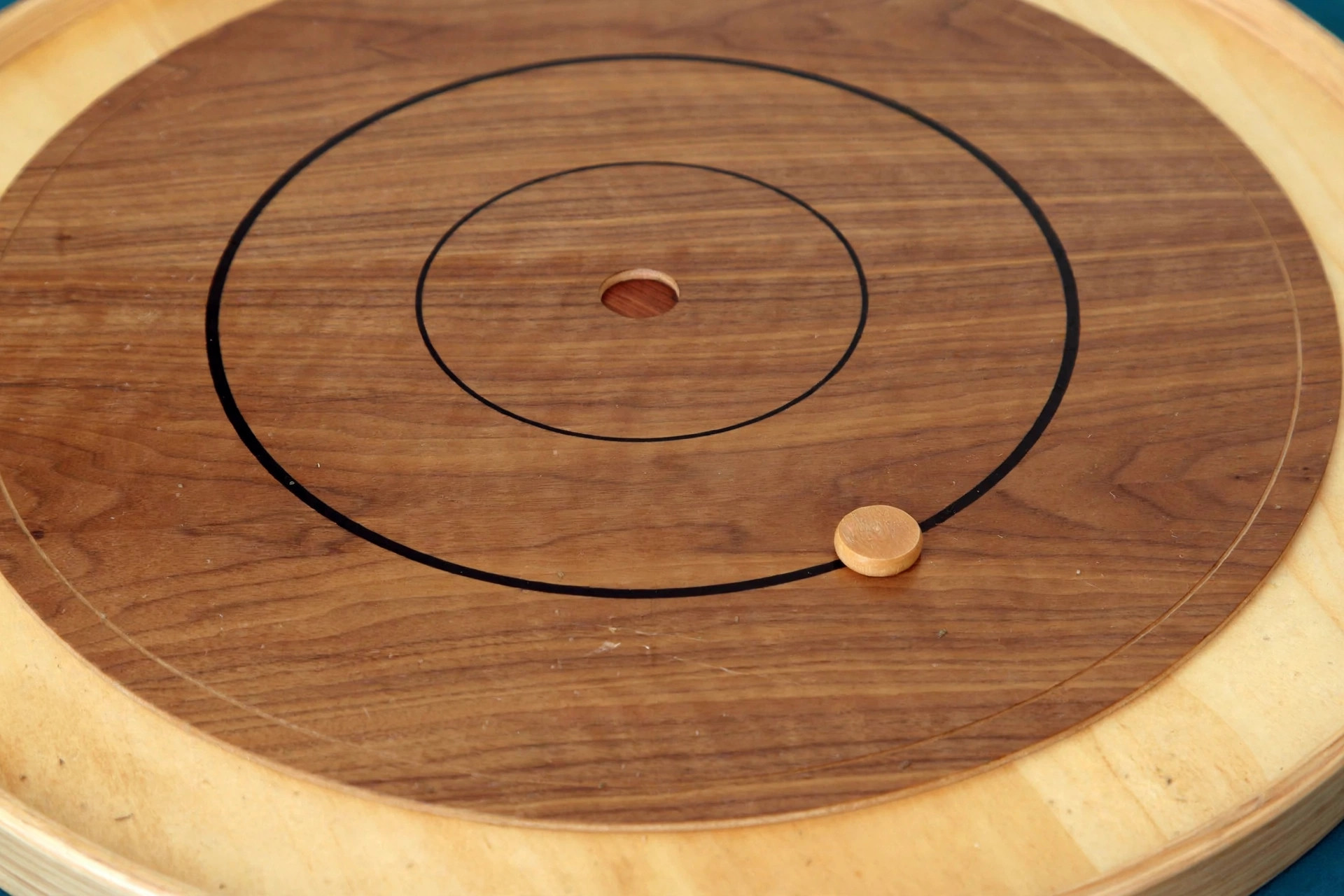
This is the most common dispute in crokinole scoring, and it has the simplest rule: a disc that touches a dividing line scores the value of the lower zone. A disc straddling the line between the 15 circle and the 10 ring is a 10. One touching the line between the 10 ring and the 5 ring is a 5. The logic is consistent everywhere on the board. A disc earns a zone’s points only when it lies completely inside that zone. Any contact with the line, even a sliver of the disc’s edge, breaks the “completely inside” test. Look straight down from directly above the disc, not from your seat. Viewing angles lie, especially across a wide board, and most line arguments disappear once both players look from overhead.
Hanging Discs: The Ditch Edge and the Centre Hole
Hanging discs cause two different arguments, and they have two different answers. At the ditch, the question is whether the disc has actually left play. A disc that has dropped into the ditch is out: remove it, and it scores zero. A disc that is teetering on the rim but still resting on the playing surface has not dropped, so it stays and scores where it lies, which usually means the outer 5 zone. At the centre hole, a disc hanging partway over the hole has not scored a 20 yet. It only becomes a 20 when it falls completely in. Until then it sits in the 15 zone, and a later shot can knock it in for the full 20 or knock it away entirely. Leave hanging discs exactly where they are; nudging the board to help one drop is not a ruling, it is a foul in spirit.
The Peg Problem: In the Crokinole 20 Hole but Touching a Peg
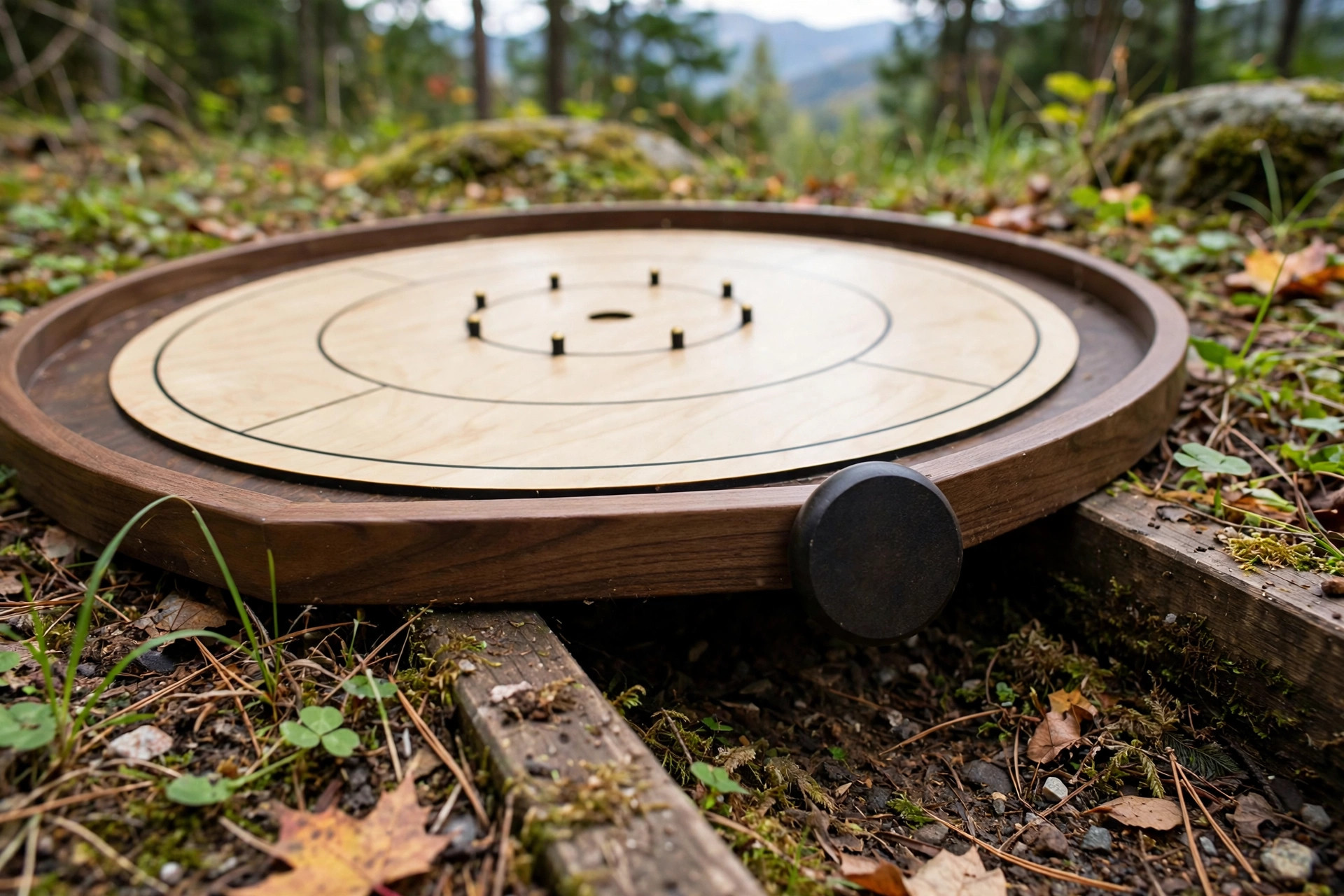
Every so often a disc drops toward the centre hole, catches on one of the rubber pegs, and stops with part of it over the hole. It looks like a 20 and feels like a 20 to the player who shot it. It is a 15. The crokinole 20 hole only pays out when a disc falls completely into it, clear of the playing surface and the pegs. A disc propped up by a peg is resting in the inner circle, so it scores with the rest of the 15 zone and stays in play, where the next shot can finish the job or ruin it. This is also why disc size matters: discs that match your board’s hole and peg spacing drop cleanly instead of catching. Our guide to choosing the right size crokinole discs shows how the measurements work together.
Discs That Bounced Out: Off the Board Means Out
A hard shot sometimes sends a disc skipping across the ditch and onto the table or floor. The ruling is short: any disc that leaves the playing surface and does not come back is removed and scores zero for the round. The same applies to an opponent’s disc that your shot knocked out. It stays out, which is exactly why take-out shots are worth playing. One exception to note: if your shooting disc flies off the board without touching anything, some rule sets also remove one of your other discs as a penalty. Agree on that one before the match, because house rules genuinely differ here.
Tied Rounds: When the Difference Is Zero
A tied round feels wrong to players used to winner-takes-all scoring, because nobody gets anything. That is the correct result. Crokinole scoring awards only the difference between the two totals, and when the totals match, the difference is zero. Ties are more common than players expect once both sides start cancelling each other’s 20s and matching zone for zone. If your group plays to a target score, a tied round simply passes: shuffle the shooting order and start the next round. The crokinole hammer, the advantage of shooting last, moves to the other side as usual.
Crokinole Rules to Agree On Before You Play
Three of the disputes above have a small grey area in casual play, so settle them before the first disc: whether a shooting disc that flies off untouched costs an extra disc, whether a hanging disc over the hole gets counted if it falls in untouched before the round ends, and who gets the final say on a line call. Write the answers on a card and keep it with the board. It takes two minutes, and it protects the part of game night that actually matters, which is the playing. A board with true lines and firm pegs helps too, and the tournament-spec options in our guide to the best crokinole boards remove most borderline calls before they happen.
Frequently Asked Questions
How does crokinole scoring work at the end of a round?
Add up the value of every disc each side has on the board: 15 for the inner circle, 10 for the middle ring, 5 for the outer ring, plus 20 for every disc that dropped into the centre hole during play. Only the higher side scores, and only the difference between the two totals.
What happens if a disc is touching a line between crokinole scoring zones?
It scores the lower value of the two zones it touches. A disc must lie completely inside a zone to earn that zone’s points, so a disc straddling the 15 and 10 boundary counts as 10. Check the call by looking straight down at the disc from directly above it.
Does a disc hanging over the centre hole count as a 20?
Not until it falls completely into the hole. A disc hanging over the edge, or propped against a peg, is resting in the 15 zone and scores 15. It stays in play, so a later shot can knock it in for the full 20 or knock it out of scoring position entirely.
What happens when a round is tied, and who gets the crokinole hammer next?
Nobody scores anything for that round. Because crokinole scoring is based on the difference between the two sides’ totals, equal totals produce a difference of zero. You simply move on to the next round, with the last-shot advantage passing to the other player as normal.
Is a disc in the ditch worth anything in crokinole?
No. A disc that ends up in the ditch scores zero and is removed from the board. The ditch is the penalty area for missed shots and for discs knocked out by an opponent’s take-out shot, which is why clearing an opponent’s disc into the ditch is worth as much as scoring with your own.
Final Thoughts
Every crokinole scoring dispute has a short answer: lines score low, hangers wait, pegs block 20s, bounce-outs are gone, and ties score zero. Agree on those five rulings once, and the arguments at your table will shrink to the only one worth having, which is who played the better round.

2-Player vs 4-Player Crokinole Strategy Explained

How to Maintain a Crokinole Board: Waxing, Pegs and Humidity