
Crokinole for Kids and Families: House Rules That Keep It Fun8 min read
Crokinole looks like a game kids should love: flick a disc, chase the 20 hole, knock your opponent’s discs away. Then a seven-year-old tries to shoot from the official line, the disc stops halfway, and the fun drains out of the room.
Crokinole for kids works beautifully, but only once you bend a few adult rules to fit smaller hands and shorter reaches. None of the adjustments below change what the game is. They change distances, scoring, and handicaps, the same levers every family game uses.
The goal is a match where a child can genuinely score, an adult still has to play well, and nobody is pretending not to try.
Start with a board that suits the room and the players. A full-size board works for mixed ages because the adjustments happen in the rules, not the equipment, and our roundup of the best crokinole boards covers the sizes and finishes that stand up to family use.
Crokinole House Rules at a Glance
Here is the whole system on one table. Pick the rules that match your youngest player, and add the adult rules back as the kids grow.
| House Rule | How It Works | Age It Suits |
|---|---|---|
| Closer shooting line | Kids shoot from the edge of the ditch instead of the outer ring line | Ages 5 to 9, or any first-time player |
| Count every disc | Each side scores all its points; skip difference scoring | Ages 5 to 8, while maths and losing margins are still hard |
| Extra disc per round | The youngest player shoots one extra disc each round | Ages 6 to 10 playing against older kids or adults |
| Family teams | One adult and one child per side, alternating shots | All ages; the default format for mixed family games |
| No takeouts on kids’ discs | Adults may not shoot directly at a child’s disc to remove it | Ages 5 to 8, until the child asks for the real rule |
Introduce one or two rules at a time rather than the whole list. Kids learn the real game faster when each session feels close to the last one.
Shooting Adjustments: Move the Crokinole Shooting Line
The single most effective change is distance. The official crokinole shooting line sits at the edge of the outer ring, a long flick for a small arm. Let young children shoot from the edge of the ditch instead, roughly half the distance to the centre, and the game transforms: discs reach the middle, pegs come into play, and the 20 hole becomes a real target instead of a rumour.
Scale the line to the child. A five-year-old might shoot from the ditch edge with the disc starting in the outer ring; an eight-year-old can usually manage the line between the 10 and 5 zones; by ten or eleven, most kids are ready for the real line. Move the line back a step each time the child starts scoring easily from the current one.
Technique helps too. Show kids a smooth push-flick with the disc flat on the surface, rather than a slap or a throw. A disc that starts sliding stays sliding, and children who learn the flat flick early rarely need the closer line for long.
Scoring Crokinole for Kids: Count Every Disc
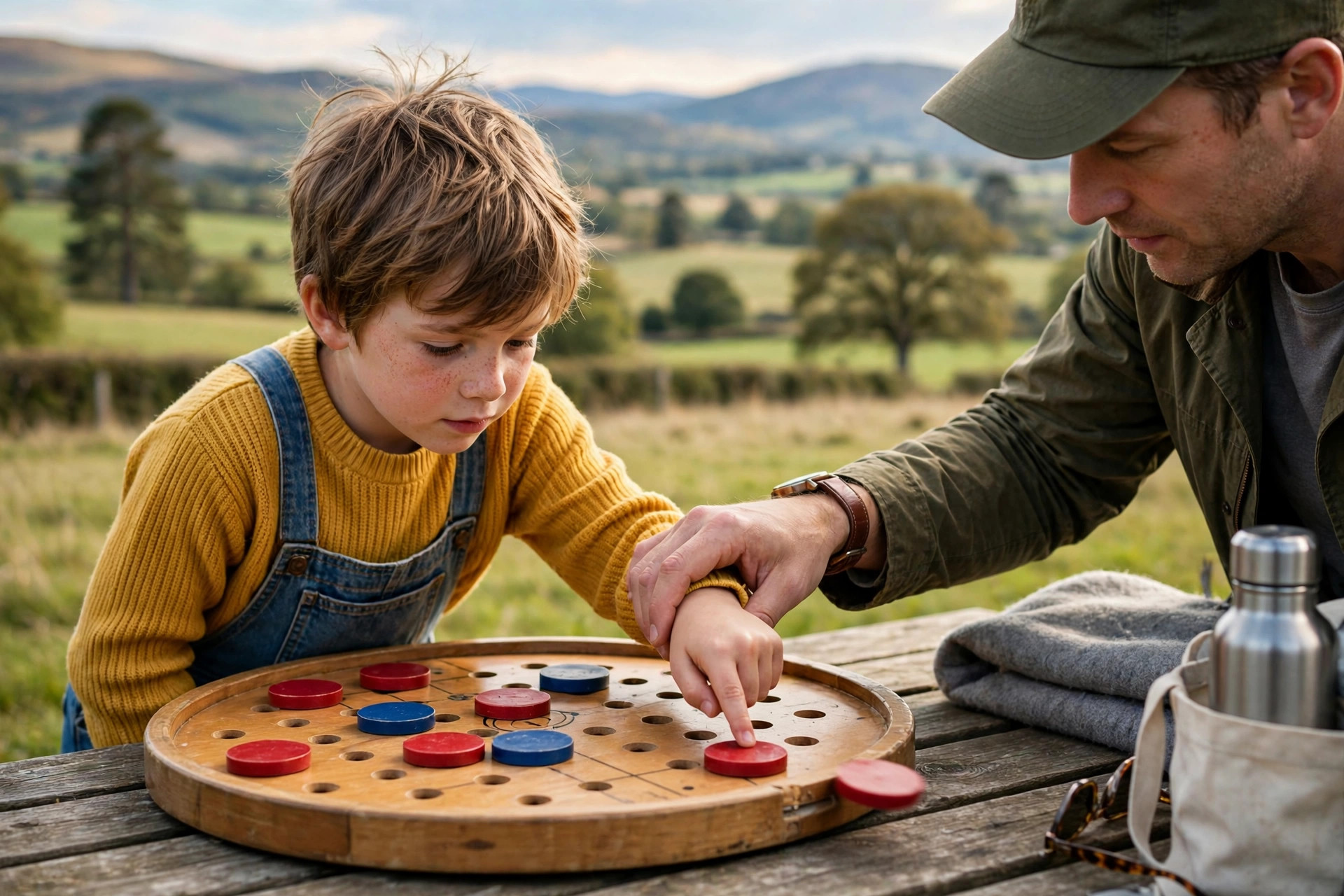
Standard crokinole scoring is by difference: only the higher side scores, and only the gap. That is elegant for adults and brutal for a child who scored 30 points, watched an adult score 45, and received nothing. For young players, count every disc instead. Both sides keep all their points each round, first to an agreed total wins, and every good shot visibly counts.
As kids grow, the scoring questions get more interesting, not less. Line calls and hanging discs still come up in family games, and our guide to settling crokinole scoring disputes gives the standard ruling for each one, which settles most kitchen-table arguments in seconds.
Bring difference scoring back around age nine or ten, framed as the real rule rather than a punishment. Kids who have been counting everything usually adapt in a round or two, and the tactical side of the game, defending a lead, chasing a gap, opens up for them at the same time.
Extra Discs and Other Gentle Handicaps
When ages are far apart in crokinole for kids, distance and scoring changes may not be enough. The simplest handicap in crokinole house rules is an extra disc: the youngest player shoots one additional disc per round. It adds scoring chances without changing any shot, and it is easy to remove later by quietly returning to even numbers.
Variations on the same idea work for different gaps. A child might keep any 20 they score as a bonus that cannot be cancelled, or an adult might play the whole game with their weaker hand, or shoot only from the full line while everyone else moves up. The principle is the same: handicap the situation, never the child’s effort, and let the child see the handicap shrink as they improve. Avoid handicaps that feel like pity. Secretly soft shots and deliberate misses fool nobody past age six, and they teach the wrong lesson about the game. A visible, agreed rule that everyone plays by is far kinder than an adult pretending.
Crokinole Family Teams: Adults and Kids Together
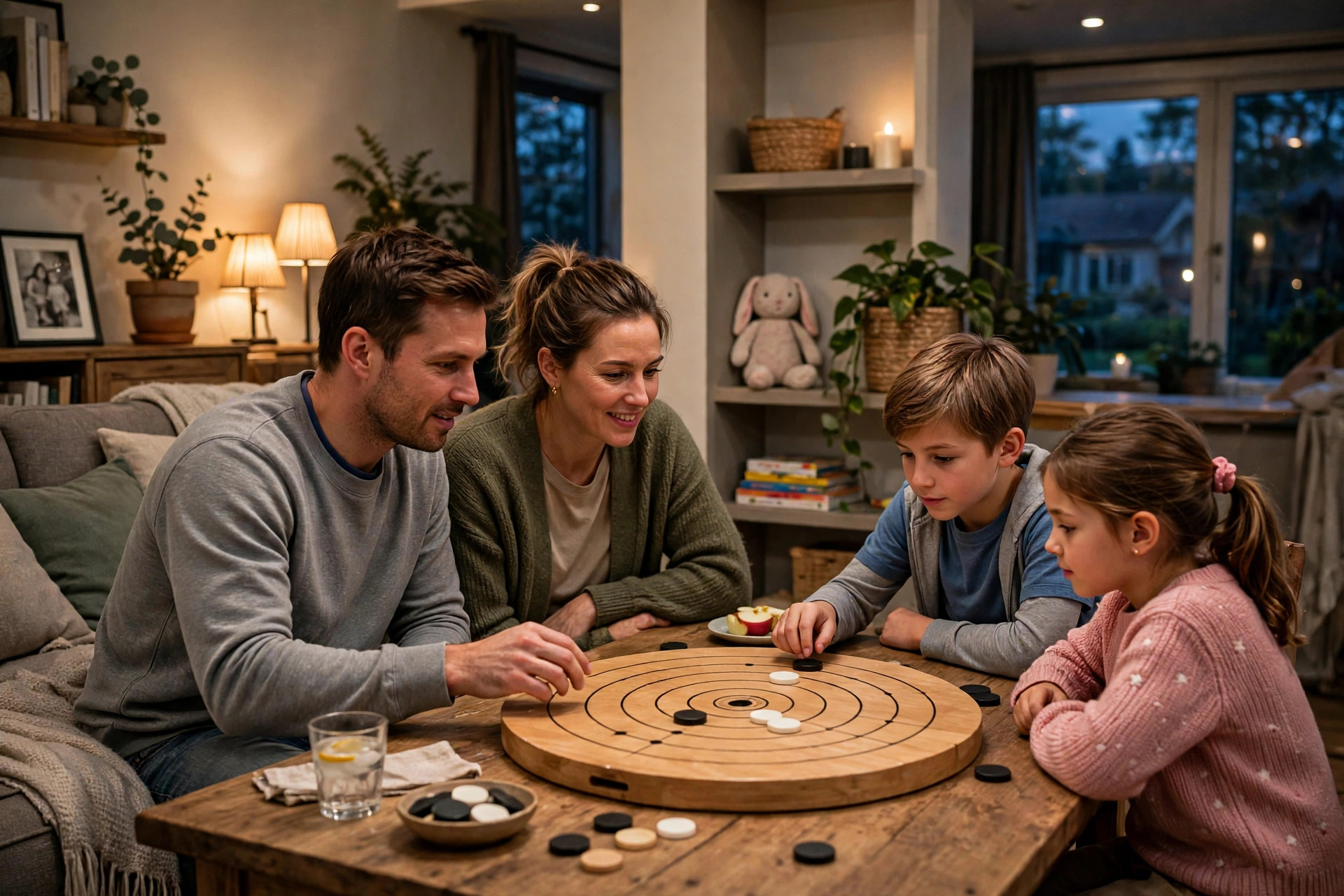
The best default format for a mixed household is crokinole family teams: two players per side, shots alternating, with each team pairing an adult with a child. The child shoots real shots in a real game, the adult covers strategy and the harder takeouts, and both partners stay involved in every round.
Teams also solve the numbers problem. Three players become two teams with one rotating partner, five or six players become a small round-robin, and nobody sits out for long. Rotate the pairings between games so children play with and against every adult across an evening.
Let the child make the decisions on their own shots, even the wrong ones. Suggest, explain, then let them flick. A child who chooses their own shot and misses learns more, and has more fun, than one who becomes the arm for an adult’s instructions.
The No-Takeout Rule, and When to Retire It
Takeout shots, smashing an opponent’s disc into the ditch, are the heart of adult crokinole and the fastest way to make a young child cry. For players under about eight, add a truce rule: adults may not aim directly at a child’s disc. Adults shoot for position and the 20 hole, children shoot at whatever they like, and the game stays a race rather than a demolition.
Retire the rule the moment the child starts aiming at your discs, which usually happens sooner than you expect. The first time a kid knocks your 15 into the ditch and grins, the truce has done its job, and full crokinole for families can begin. Keep one protection even after the truce ends: discs are flicked, never thrown, and a disc that leaves the table means a pause and a reminder. Enthusiasm plus a hardwood disc is a combination worth managing calmly.
Frequently Asked Questions
What age can kids start playing crokinole?
Most children can join a real game from about age five, using a closer shooting line and friendly scoring. Younger children enjoy flicking discs toward the middle without formal rounds. By nine or ten, most kids can move to the official shooting line and standard difference scoring.
How do you make crokinole for kids easier?
Move the shooting line closer, count every disc instead of scoring by difference, and give the youngest player an extra disc per round. Pairing children with adults in family teams also helps, because the child plays real shots while a partner handles strategy and difficult takeouts.
What are the best crokinole house rules for families?
The five that cover most households are a closer shooting line for kids, count-every-disc scoring, an extra disc for the youngest player, adult-and-child teams, and a no-takeouts truce for young children. Add them one at a time and retire each as the child outgrows it.
How many players can play crokinole at once?
A standard game is two players, or four in teams of two. Family teams make larger groups easy: rotate partners between short games so everyone plays often. With six or more people, run a quick round-robin of short matches rather than one long game.
Is crokinole safe for young children?
Yes, with basic supervision. The discs are smooth hardwood with no sharp edges, and the game is played seated or standing at a table. Set two ground rules: discs are flicked along the surface, never thrown, and hands stay clear of the board while another player is shooting.
Final Thoughts
Crokinole for kids is the same game adults love, with the distances shortened, the scoring softened, and a truce on takeouts until the youngest player asks for the real thing. Adjust one rule at a time, retire each as your kids grow, and game night stays competitive for everyone at the table. If your family board is due an upgrade before the next season of matches, the durable, family-friendly options are in our guide to the best crokinole boards.

How to Hang and Store a Crokinole Board Safely

The History of Crokinole in Canada and How It Spread
