Trail Etiquette for Families: Passing, Dogs, Bikes and Horses8 min read
Most trail conflicts are not caused by rude people. They happen because two groups meet on a narrow path and neither is sure who should move. Trail etiquette answers that question in advance. A few shared rules cover almost every encounter a family will have: bikes yield to hikers, everyone yields to horses, and the group that can step aside most safely usually should. For parents, the rules matter twice over, because kids copy what they see. Teach the basics before your first busy trail and your children will handle passing, dogs, bikes, and horses without a negotiation every hundred yards.
Who Has the Right of Way on a Trail?
The standard order is simple. Horses have the right of way over everyone. Hikers have it over bikes. Bikes, the fastest and quietest users on the trail, are expected to slow down, call out, and wait for a safe place to pass. Most land agencies and trail organizations in the United States use this order, including the guidance collected by Leave No Trace.
| You meet | Who moves | Why |
|---|---|---|
| A bike, while you are hiking | The rider yields to you | Riders are faster and quieter, so they slow down, call out, and pass only when safe |
| A horse, on foot or on a bike | Everyone yields to the horse | Horses can shy at sudden movement, and a stopped, calm group is easier to pass |
| An uphill hiker, while you are descending | You yield, by the standard rule | The uphill hiker is working harder and watching a narrower slice of trail, so stopping costs you less |
| Another hiking group on a narrow trail | Whoever has the safer place to step off | Formal rules run out here; a flat shoulder or a wide spot decides it |
Right of way is a default, not a trophy. If your family is standing beside a wide, flat turnout while an uphill hiker picks through loose rock, step aside and wave them through. Local rules override the general order: some trails run bikes in one direction only, some are hiker-only on certain days, and a few are downhill-only for bikes. The trailhead sign wins.
Passing on Narrow Trails
On a wide trail, keep right and pass on the left, as on a sidewalk. Call out before you pass. A simple “on your left” gives the group ahead time to gather themselves instead of being startled. Narrow singletrack works differently. When you meet another party head-on, one group steps off and the other walks past. Families should move as one unit: an adult steps off first, kids tuck in behind that adult on the same side, and nobody walks again until everyone has passed. Count heads before you move. Where you step matters. Step onto rock, gravel, or dry ground rather than crushing the plants at the trail’s edge. Trampling vegetation widens the trail a few inches at a time, and on desert trails it breaks the living soil crust. If the only step-off spot is muddy or fragile, back up a few yards to durable ground instead.
Uphill or Downhill: Who Steps Aside?
The standard rule gives the right of way to the uphill hiker. A climber is breathing hard, often watching the trail a few feet ahead, and stopping breaks a rhythm that is hard to restart on a steep grade. A descending hiker can usually stop and restart at less cost. Real trails complicate this. If you are climbing with three small children strung out behind you and a lone descending hiker reaches a wide spot first, that hiker will often step aside, and that is fine. A group is harder to move than one person. A wave and a quick “go ahead” settle most encounters before the rule is needed.
Dogs on the Trail
Leash rules are set by whoever manages the land, and they vary more than most dog owners expect. National parks generally require a leash of six feet or less, and many national park trails are closed to dogs entirely. National forests often allow dogs under voice control away from developed areas but require leashes at trailheads and campgrounds. State and local parks set their own rules, so check the specific trail before you go. “Dogs allowed” on a listing can still mean “on leash, and not past the lake junction.” A dog that does not come when called is not under control, whatever the rules allow. When you meet another party, shorten the leash, move your dog away from the people passing, and put yourself between your dog and any small children. A friendly jump that an adult shrugs off lands at face height on a five-year-old. Pack out waste, all of it. Bagging dog waste and leaving the bag beside the trail to collect on the way back is littering in practice, because bags get forgotten. Waste bags belong on every dog owner’s packing list, the same way they appear on our family hiking checklist for diapers and trash. Teach your kids the other side: never run up to a trail dog, and ask the owner before petting one. If an unfamiliar dog approaches, stand still, hands at your sides, and let it sniff and move on.
Meeting Horses on the Trail
Everyone yields to horses, and the yield looks specific. Stop walking. Step off the trail on the downhill side if there is one, because a person below trail level looks less threatening to a horse. Then talk in a normal, calm voice, so the horse knows a person is there. A silent figure crouched behind a bush can look like something worth bolting from.
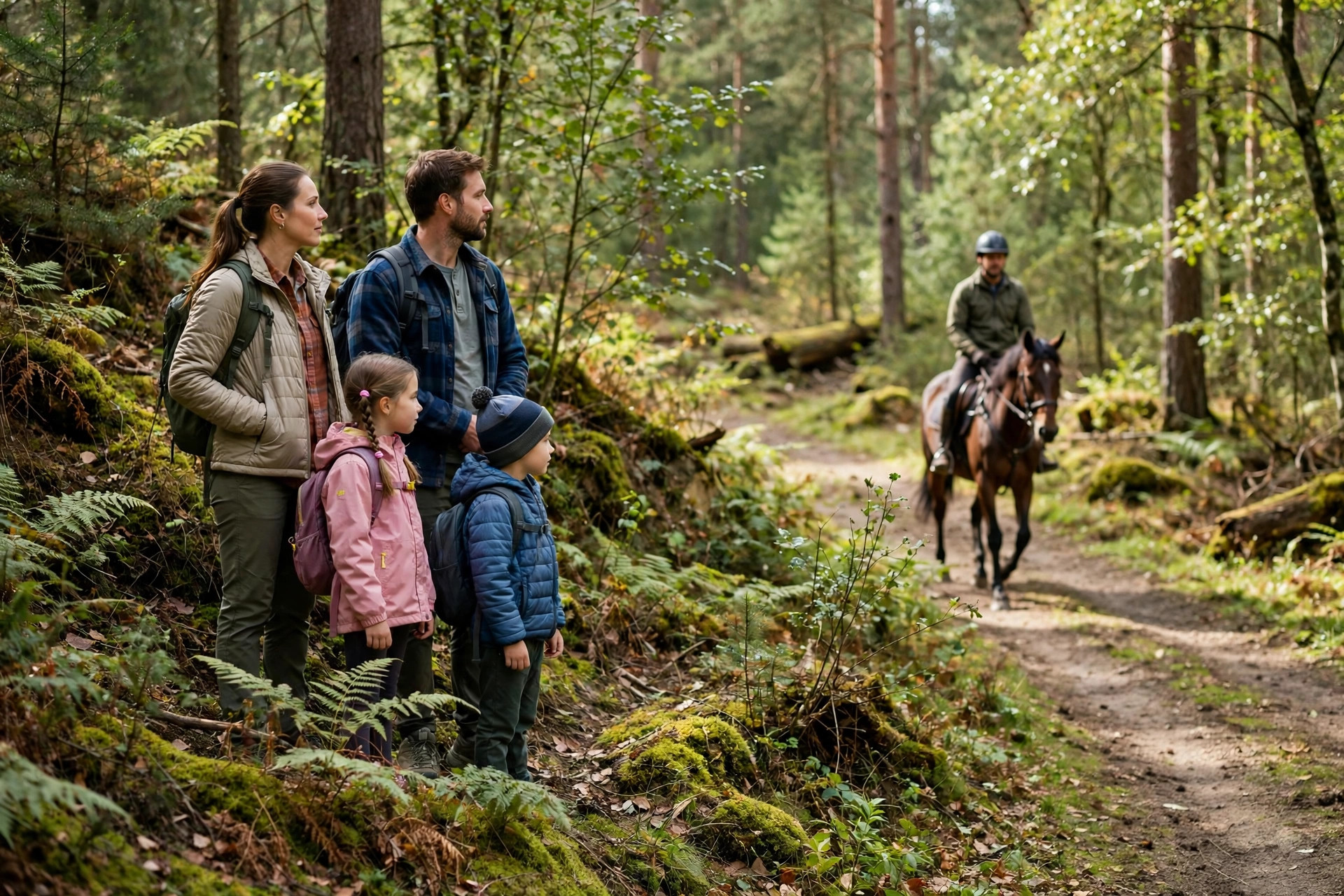
Keep children close, quiet, and still, with an adult between them and the trail. Never step between horses in a string, and never reach out to touch a passing horse. Wait until the last horse is well past, and until the rider says it is clear, before stepping back on the trail.
Teaching Kids Trail Manners
Kids learn trail manners faster when the rules are few and concrete. Three cover most situations: stay right, go single file when someone is passing, and horses always go first. Practice on a quiet trail before a busy one. Many parents make it a spotting game: kids call out what is coming (“bike behind,” “horses ahead”) and name who moves. A child who has rehearsed the pattern does it unprompted.
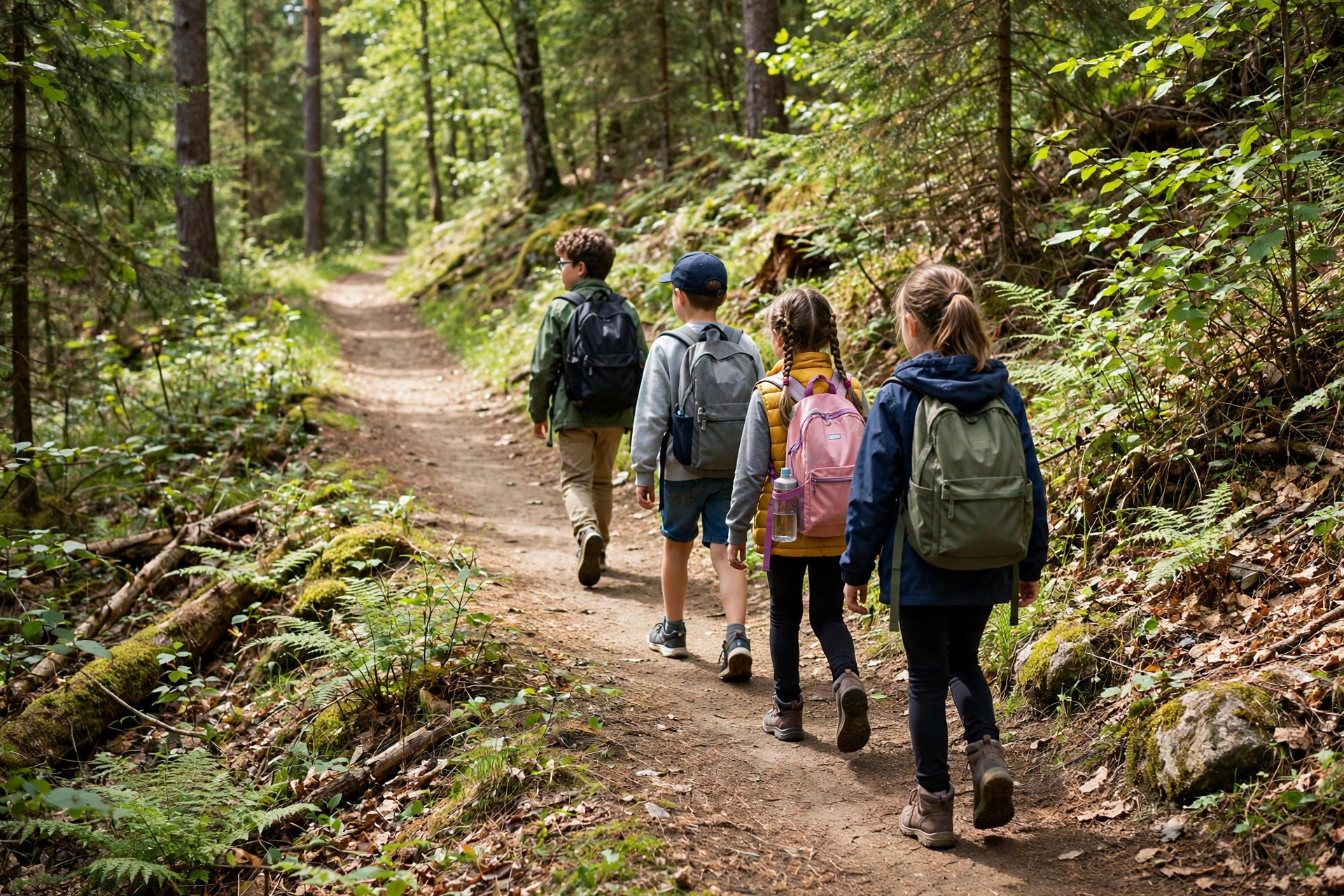
Volume is part of manners too. Voices carry outdoors, and shouting across switchbacks carries furthest of all. Music from a phone speaker carries nearly as far and bothers more people. If your kids want music, one earbud at low volume still lets them hear bikes approaching. Plenty of families skip music and let kids listen for birds and water instead. Pack together the night before, using a hiking checklist for families, and let kids carry their own water and a snack. A child with a small pack walks in a steadier line. For children still in the toddler stage, our guide to hiking with toddlers covers pacing and carriers for that age, and our guide to hiking with kids picks up where the toddler years leave off.
Frequently Asked Questions
What if there is no room for anyone to step aside on a narrow trail?
Back up. Whoever is closer to a wide spot, a junction, or a flat shoulder retreats to it and lets the other party through. On exposed ground, such as a ledge, the group on secure footing should hold still and talk the other party through the safest way past.
What should kids do if an off-leash dog runs up to them?
Stand still with hands at their sides and eyes down, the position many schools teach as “be a tree.” Running, waving arms, and squealing invite a playful dog to jump and chase. An adult should step between the child and the dog and call to the owner.
Do the same right-of-way rules apply on paved rail trails and greenways?
Mostly, yes. Keep right, pass on the left, and announce the pass. Bikes are expected to yield to pedestrians on most shared-use paths, though some greenways post their own rules. Horses are rare on paved paths but keep the right of way where allowed.
Three rules are enough to start: horses first, bikes wait, and step aside where the ground can take it.
How to Choose Kids Hiking Shoes vs Sneakers: When Boots Matter
How to Plan a First Family Hike: Distance and Elevation by Age