Crazy Eights Variations: Power Cards and Regional Rules8 min read
Crazy Eights is one of the first card games most of us learn, and one of the first we start changing. The base game is beautifully simple: match the top card by rank or suit, play an 8 anytime and name a new suit, and be the first to empty your hand. Almost everything else is negotiable, which is why crazy eights variations multiply at every family table.
Some variations add power cards that skip, reverse, or punish the next player. Others change the draw rule, the scoring, or what happens when the stock runs out.
The best crazy eights variations keep the game fast and a little bit mean, without burying new players in exceptions.
Long games with lots of players mean a lot of shuffling, and a good shuffler keeps the cards moving between rounds. Our roundup of the best card shufflers covers the manual and automatic options families use most.
Crazy Eights Variations at a Glance: The Power Card Table
Here is the quick reference most groups need. The standard game gives a special job to the 8 alone; variations hand powers to the court cards and the 2 as well.
| Card | Standard Meaning | Popular Variation Powers |
|---|---|---|
| 8 | Wild: can be played on anything, and the player names the next suit | Still wild, but some groups restrict 8s to a last resort, or play that an 8 can be beaten only by another 8 |
| 2 | Ordinary card that matches by rank or suit only | Draw Two: the next player draws two cards, and stacking lets them play another 2 to pass a bigger penalty along |
| Jack | Ordinary card that matches by rank or suit only | Skip: the next player loses their turn |
| Queen | Ordinary card that matches by rank or suit only | Reverse direction, or skip; the Queen of Spades means draw five in some regional rules |
| Ace | Ordinary card that matches by rank or suit only | Reverse the direction of play |
Pick one power per card at most, and write the set down before you deal. Most arguments about crazy eights variations are really arguments about which version the table agreed to play.
The Standard Game in 60 Seconds
Deal five cards to each player, or seven each in a two-player game. Turn one card face up to start the discard pile and set the rest down as the stock. On your turn, play a card that matches the top card by rank or suit. If you cannot match, draw from the stock until you can play, under classic crazy eights rules. An 8 is wild: it can be played on anything, and the player who plays it names the suit the next player must follow. The first player to empty their hand wins the round. Scoring is based on the cards left in everyone else’s hands: 8s count 50 points, face cards 10, and every other card its face value. Those points count against the players holding them, and low score wins the match, often played to 100 or 500.
Power Cards: What Each Card Can Do
Power cards are the heart of most crazy eights variations, because they turn a gentle matching game into a tactical one. The most widespread is Draw Two: play a 2 and the next player picks up two cards and loses their turn, unless your group plays the stacking rule covered below.
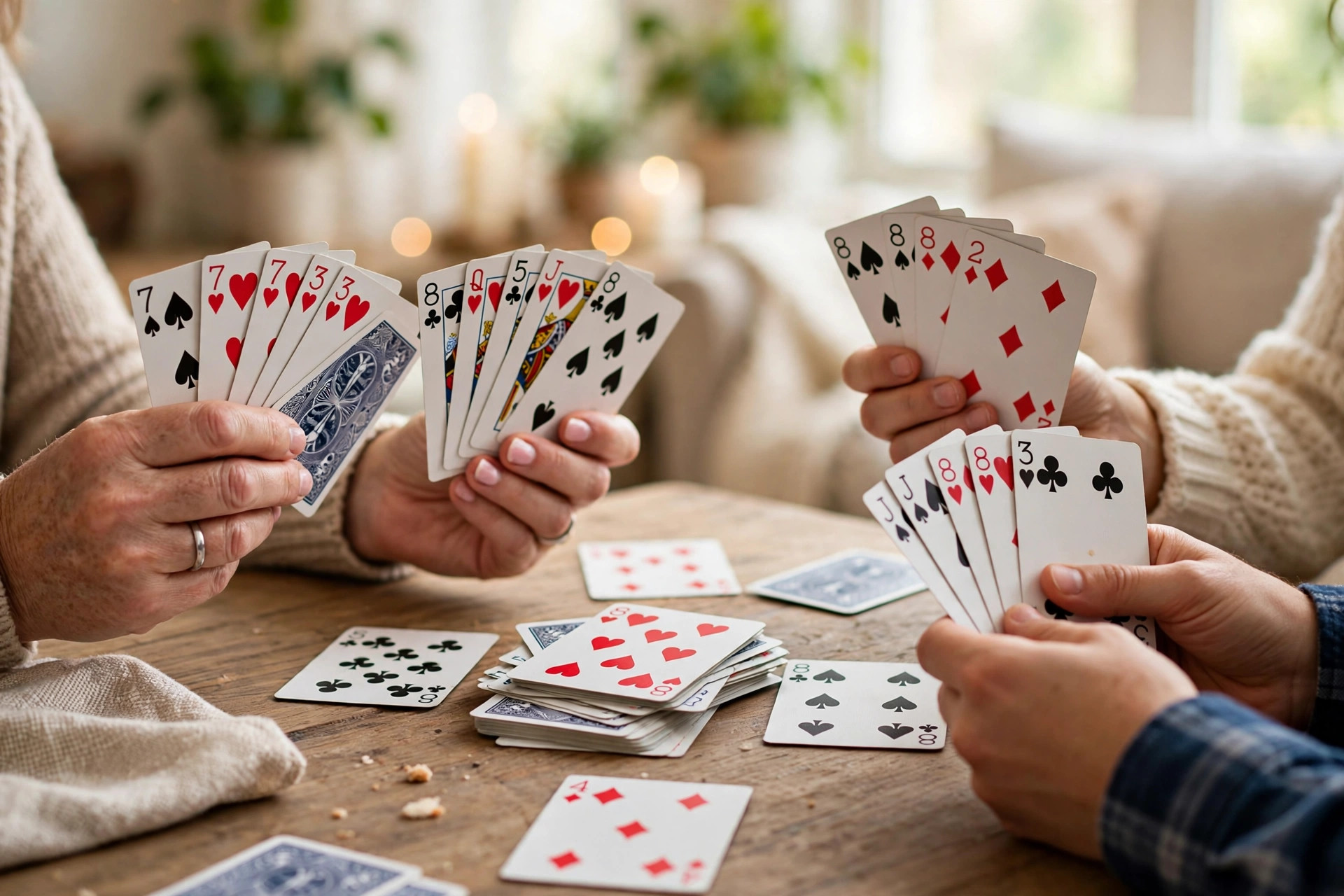
Jacks usually skip the next player, which makes them defensive gold when the player beside you is down to one card. Aces and Queens take the reverse role in most sets, flipping the direction of play so the threat comes from the other side of the table. Some groups give the Queen of Spades a special sting, draw five, borrowed from regional card game rules in parts of North America.
One caution: powers only work if the card can still be played legally by rank or suit. A Jack of hearts does not skip anyone unless it matches the pile or an 8 has just named hearts.
Stacking Draw Twos and Other Chain Rules
Stacking is the variation that changes the temperature of the whole game. When a Draw Two lands on you, instead of drawing two you may play a 2 of your own, passing a four-card penalty to the next player. Chains of three or four 2s are common, and somebody eventually eats eight or ten cards. Groups extend the same logic elsewhere. Some let a skip be answered with a skip, sending the lost turn around the table. Others allow an 8 to be stacked on an 8, with the last player to play one naming the suit.
If you add stacking, settle the endgame question in advance: can a player go out on a power card, leaving the next player to draw after the round has ended? Most tables say the penalty still applies and counts in the scoring. Decide once, and the argument never happens again.
Regional Card Game Rules From Around the Table
Travel a few hundred miles and the house rules travel with you. In parts of Canada, the game shades into “Crazy Eights Countdown,” where a player’s card values drop as they win rounds. In some British and Australian groups the game is called Switch, with Jacks, 2s, and Aces carrying powers much like the table above.

Other regional touches include drawing a single card instead of drawing until you can play, which shortens rounds and softens bad luck, and the rule that a player with one card left must announce it, with a penalty card for forgetting. Many families also ban playing an 8 as your final card, so the last play has to be an honest match.
None of these is the “right” version. Regional rules survive because they suit the group that uses them, and the standard game is strong enough to carry any two or three of them at once.
The Shuffleboard-Table Cousin
Crazy Eights is popular enough that it escaped the card table entirely. This site also covers the shuffleboard-table version in our guide to how to play Crazy Eights on a shuffleboard table, where pucks replace cards and the scoring triangle does the counting. The two games share a name and a family resemblance rather than a rulebook, but groups that enjoy one usually enjoy the other. It is a good reminder that game names travel further than game rules, which is exactly how the card game picked up so many regional versions.
Card Game House Rules: Agree Them Before You Deal
The smoothest card game house rules are the ones written down. Before the first deal, settle five things: which cards hold powers, whether Draw Twos stack, whether you draw one card or draw until you can play, whether an 8 can be a final card, and what score ends the match. With five or six players, consider a second deck shuffled together. It keeps the stock alive in long rounds and spreads the 8s and power cards more evenly.
Frequent shuffling of two decks is where the automatic options in our best card shufflers roundup earn their place on a family game shelf. Keep the written set with the cards. The next time somebody insists their childhood version is the official one, the card on the table settles it, and the game gets back to being about the cards in your hand.
Frequently Asked Questions
What are the basic crazy eights rules?
Each player is dealt five cards, or seven in a two-player game. On your turn, match the top card of the discard pile by rank or suit, or play an 8, which is wild and lets you name the next suit. If you cannot play, draw from the stock. The first player to empty their hand wins the round.
How does scoring work in crazy eights variations?
The round winner scores nothing, and every other player counts the cards left in their hand against themselves: 50 points for each 8, 10 for each face card, and face value for the rest. Points are bad, so the lowest total wins the match. Groups commonly play to 100 or 500 points.
What does stacking mean in crazy eights?
Stacking means a penalty can be passed along and grown. If a Draw Two is played on you, you may play a 2 of your own instead of drawing, and the next player faces four cards. The chain continues until someone cannot answer with a 2 and draws the full accumulated penalty.
Can you play an 8 as your last card?
It depends on the house rules. In the standard game, yes: an 8 can be played on anything, including as your final card to go out. Many families ban it, requiring the last card to match by rank or suit, because going out on a wild card feels too easy. Agree before you deal.
How many cards do you deal in crazy eights?
Five cards each is the standard deal for three or more players, and seven each is the common deal for two players, because the smaller hands make for a longer duel. With five or six players, many groups shuffle two decks together so the stock does not run dry mid-round.
Final Thoughts
Crazy Eights endures because the base game is ten seconds to teach and the variations let every table tune it. Add Draw Twos for bite, stacking for drama, and a skip or reverse to keep the player beside you honest. Whatever set you choose, write it down and keep it with the deck. The best version of the game is the one everyone at the table agrees they are playing.
How Many Cards? Card Game Setup Charts for 2, 4 and 6 Players
Card Game Terms Glossary for Beginners: Trick, Meld, Trump and More