Card Game Terms Glossary for Beginners: Trick, Meld, Trump and More9 min read
Sit down at any card table and you will hear a private language within the first five minutes. Someone takes a trick, somebody else ruffs in, and the new player is still wondering what just happened.
Learning the basic card game terms closes that gap fast, because the same two dozen words power almost every game you will ever play. This glossary keeps every definition in plain English. Read it once before your next game night and you will follow the table talk instead of guessing at it.
One setup note: most of these terms assume a standard 52-card deck and a fair shuffle. Groups that play weekly often speed up dealing with one of the machines in our guide to the best card shufflers, but the vocabulary is the same either way.
Card Game Terms at a Glance: The Full Glossary
Here is the complete list. The sections after the table group the same card game terms by when you use them: setup, play, and scoring.
| Term | What It Means |
|---|---|
| Trick | One round of play within a hand: each player plays one card, and the highest card of the suit led (or a trump) wins the pile |
| Meld | A scoring combination laid face up on the table, such as three of a kind or a run in one suit; most common in rummy games |
| Trump | A suit (or single card) ranked above all other suits for that hand, so a low trump beats a high card of any other suit |
| Hand | The cards one player holds; the word also means one full round of play from deal to final scoring |
| Stock | The undealt cards left face down in the middle of the table, also called the draw pile, drawn from during the game |
| Discard pile | The face-up pile of cards players have thrown away, next to the stock in rummy-style games |
| Suit | One of the four groups of cards in a deck: hearts, diamonds, clubs and spades |
| Rank | The value of a card within its suit: 2 through 10, Jack, Queen, King and Ace |
| Face cards | The Jack, Queen and King of each suit, the cards that show a face; also called court cards |
| Wild card | A card that can stand for any card the player chooses, such as a joker or a designated rank like deuces in Deuces Wild |
| Kitty | A small pile of undealt cards set aside at the start; in Euchre its top card helps set trump |
| Bid | A prediction made before play, usually of how many tricks or points you expect to win, which becomes your contract for the hand |
| Follow suit | To play a card of the same suit as the card led, which most trick-taking games require whenever you are able to |
| Ruff | To play a trump card on a trick when you cannot follow suit, often winning the trick; also called trumping in |
| Deal | Handing out the cards at the start of a hand; also one full distribution of the deck |
| Shuffle | Mixing the deck so the order of the cards is random and unknown before the deal |
| Cut | Splitting the shuffled deck into two piles and restacking them in the opposite order, done by a non-dealer as a fairness check |
| Lead | The first card played to a trick; the suit of that card is the suit everyone else must follow if they can |
| Round | One complete pass of play, such as everyone taking one turn or one full set of tricks, before the next phase |
| Match | A full game made up of several hands or rounds, played to an agreed winning score or number of wins |
| Dummy | In bridge, the declarer’s partner, whose hand is laid face up on the table and played by the declarer for the rest of the hand |
| Revoke | Failing to follow suit when you actually could; a rules violation in trick-taking games that usually carries a penalty |
| Crib | In cribbage, the extra four-card hand dealt face down that belongs to the dealer and is scored at the end of the hand |
| Run | A sequence of cards in consecutive rank order, such as 5, 6, 7; in some games a run must also share one suit |
| Pair | Two cards of the same rank, such as two Kings; three and four of a kind extend the same idea |
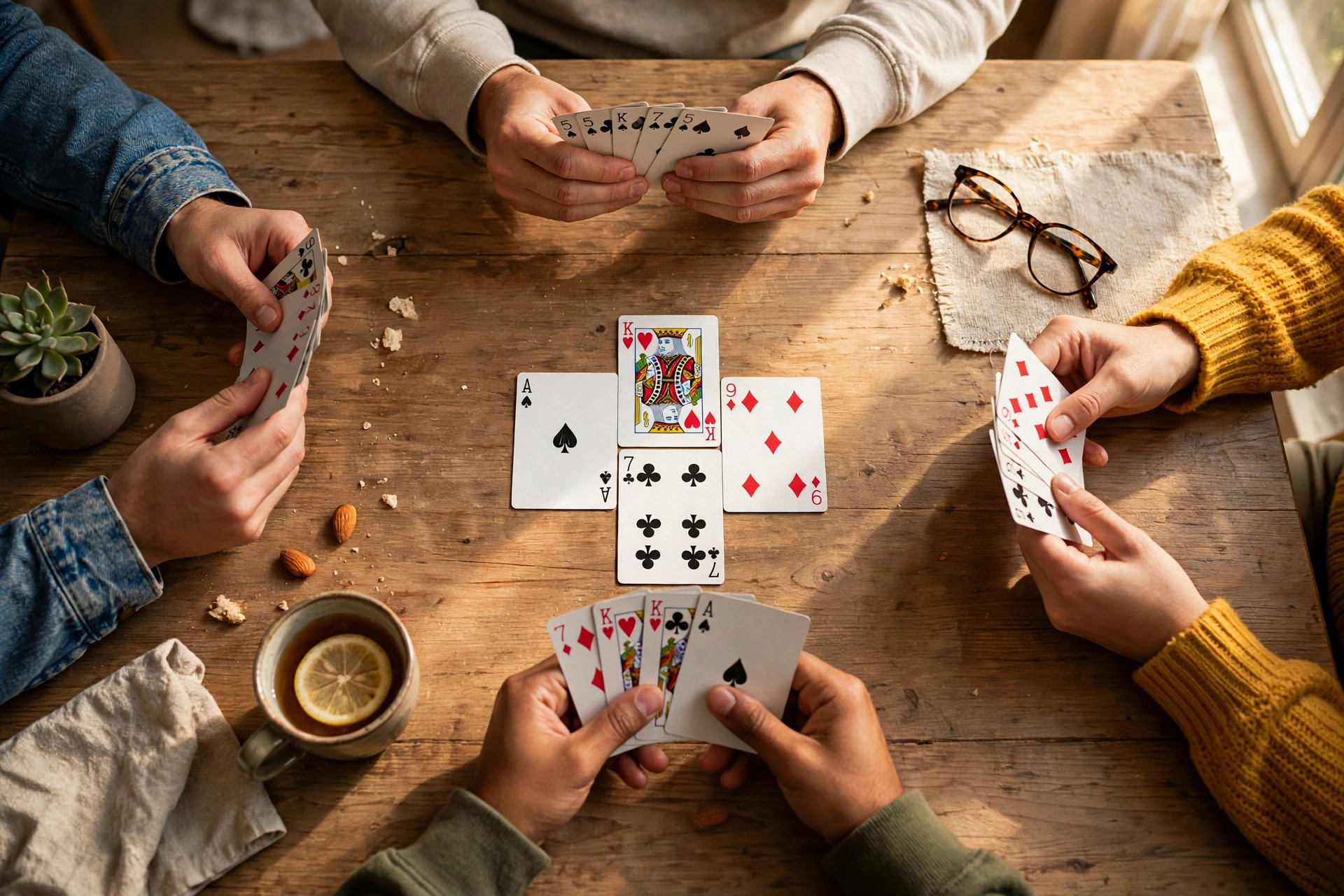
Setup Terms: The Words Before the First Card Is Played
Every hand starts the same way. First the shuffle mixes the deck so nobody knows the order. Then a player who is not dealing usually makes the cut, lifting off part of the deck and restacking it, which proves the dealer did not arrange the cards. Finally comes the deal. After the deal, each player picks up their hand, the cards they hold and keep hidden. Whatever is left undealt becomes the stock, or draw pile, in games like Rummy and Go Fish. Some games set cards aside instead: Euchre builds a kitty, and Cribbage gives the dealer a four-card crib to score later. Bridge adds one more setup idea. After the bidding, the declarer’s partner becomes the dummy and lays their whole hand face up, so one player plays both hands. You will rarely meet a dummy outside bridge.
Playing Terms: Tricks, Trump and Following Suit
Most classic games are built from tricks. The player who leads puts down the first card, and everyone else must follow suit if they can. Whoever plays the highest card of the suit led wins the trick and leads the next one. Trump changes the math. One suit is named trump for the hand, and any trump card beats any card of another suit, no matter the rank. When you hold no cards in the suit led, you may ruff, playing a trump to steal the trick. That is legal and often smart. What is not legal is a revoke: holding a card in the suit led and playing something else anyway. In friendly games a revoke is usually just replayed; in formal play it costs points. In bidding games like Spades and Bridge, play starts with a bid: each side predicts how many tricks it will take, and the scoring rewards keeping that promise.
Scoring Terms: Melds, Runs and Matches
Rummy-family games score with melds instead of tricks. A meld is a matching set laid down for points: a pair extended to three or four of a kind, or a run of three or more cards in order, such as 6, 7, 8 of hearts. A wild card can fill a gap in a meld in most house rules. A round is one full pass of play, and a match strings several hands or rounds together until someone reaches the target score. Hearts is often played as a match to 100 points, where the lowest score wins. Keeping the two straight matters: the round ends at the next deal, but the match could run all evening.
Card Game Terms in a Real Hand
Here is one short hand of Spades using the words above. Dana shuffles, Priya cuts, and Dana deals 13 cards each. Marcus bids four tricks for his partnership, and everyone else bids around the table.

Priya leads the Ace of clubs. Everyone follows suit, so the highest club takes the trick. Two tricks later, Marcus is out of hearts, so when hearts are led he ruffs with a low spade, the trump suit, and wins the trick cheaply. By the end of the hand his side has taken exactly the tricks they bid. If you are unsure how many cards each player should have started with, our card game setup charts list the deal for two, four and six players across the most common games.
Frequently Asked Questions
What is a trick in card games?
A trick is one small round inside a hand. Each player plays one card in turn, and someone wins the set, usually with the highest card of the suit led or with a trump. Games like Hearts, Spades and Bridge are scored by counting tricks or the cards inside them.
What does trump mean in card games?
Trump is a suit chosen for one hand that outranks all the others. Even the lowest trump beats the highest card of a different suit. Some games pick trump by turning up a card, others by bidding, and a few use a fixed trump suit.
What is a meld in rummy games?
A meld is a scoring group of cards laid face up on the table: either three or four cards of the same rank, or a run of three or more cards in sequence in one suit. Melding is how you turn the cards in your hand into points.
What is the kitty in a card game?
The kitty is a small pile of cards set aside during the deal. In Euchre its top card is turned up to propose the trump suit. In some poker games, kitty instead means a shared pot used to pay for fresh decks or refreshments.
What is the difference between a round and a match?
A round is one complete pass of play, such as one deal or one set of tricks. A match is the whole game, made of many rounds, and it ends when a player or side reaches the agreed winning score.
Final Thoughts
Twenty-five words cover nearly everything you will hear at a card table. Master the setup words, then tricks and trump, then melds and scoring, and the rest of the vocabulary will attach itself as you play new games. Keep this glossary open on your phone for your first few game nights.
If your group plays often enough to wear cards out, the automatic options in our guide to the best card shufflers keep games moving while you focus on the words that matter.
How to Store and Replace Board and Card Game Pieces

Family Card Game Night: Rotation Plans for Mixed Ages