Best Card Games for Two Players When You Are Tired of Gin Rummy9 min read
Gin rummy is a fine game, but play it every week for a year and the hands start to blur together. The good news is that two player card games are a much deeper category than most couples and roommates ever explore. One standard deck, and in one case a second deck or a peg board, is all you need to rotate through months of fresh game nights. The five games below cover the full range: a scoring race, a real-time sprint, a relaxed low-score game, a big melding marathon, and a trick-taking duel. Each one was designed for two players or adapts to two cleanly.
Two-player games also cycle through the deck fast, which wears cards out quickly. A deck that shuffles cleanly keeps the pace up, and our roundup of the best card shufflers covers the manual and automatic options that handle a well-loved deck gently.
Two Player Card Games at a Glance
Here is the quick comparison. Five games, five different moods, and only one of them needs anything beyond a standard deck of cards.
| Game | Deck | Round Length | Why It Works for Two |
|---|---|---|---|
| Cribbage | Standard 52 plus a peg board | 15-30 minutes | Built for two from the start: six-card hands, a crib, and scoring on every play |
| Speed | Standard 52 | About 5 minutes | No turns at all; both players play at once onto shared center piles |
| Golf | Standard 52 | 10-15 minutes | Nine short holes of low-score play; easy to learn, quietly strategic |
| Canasta (two-player) | Two decks with jokers, 108 cards | 30-45 minutes | Big hands and big melds for pairs who want a longer, strategic session |
| German Whist | Standard 52 | 15-20 minutes | A trick-taking duel in two halves: first collect good cards, then win tricks with them |
Pick by mood: cribbage or Golf for conversation, Speed for adrenaline, Canasta for a long session, and German Whist for a thinking game. Whichever of these two player card games you try first, give it three sessions before judging it.
Cribbage: The Scoring Race That Never Gets Old
Cribbage is the rare classic that was designed for exactly two players, and it shows. Each player gets six cards and throws two into the crib, a bonus hand that the dealer scores at the end. Points come from everywhere: pairs, runs, combinations making fifteen, a flush, and the right jack, all pegged on the board as they happen.
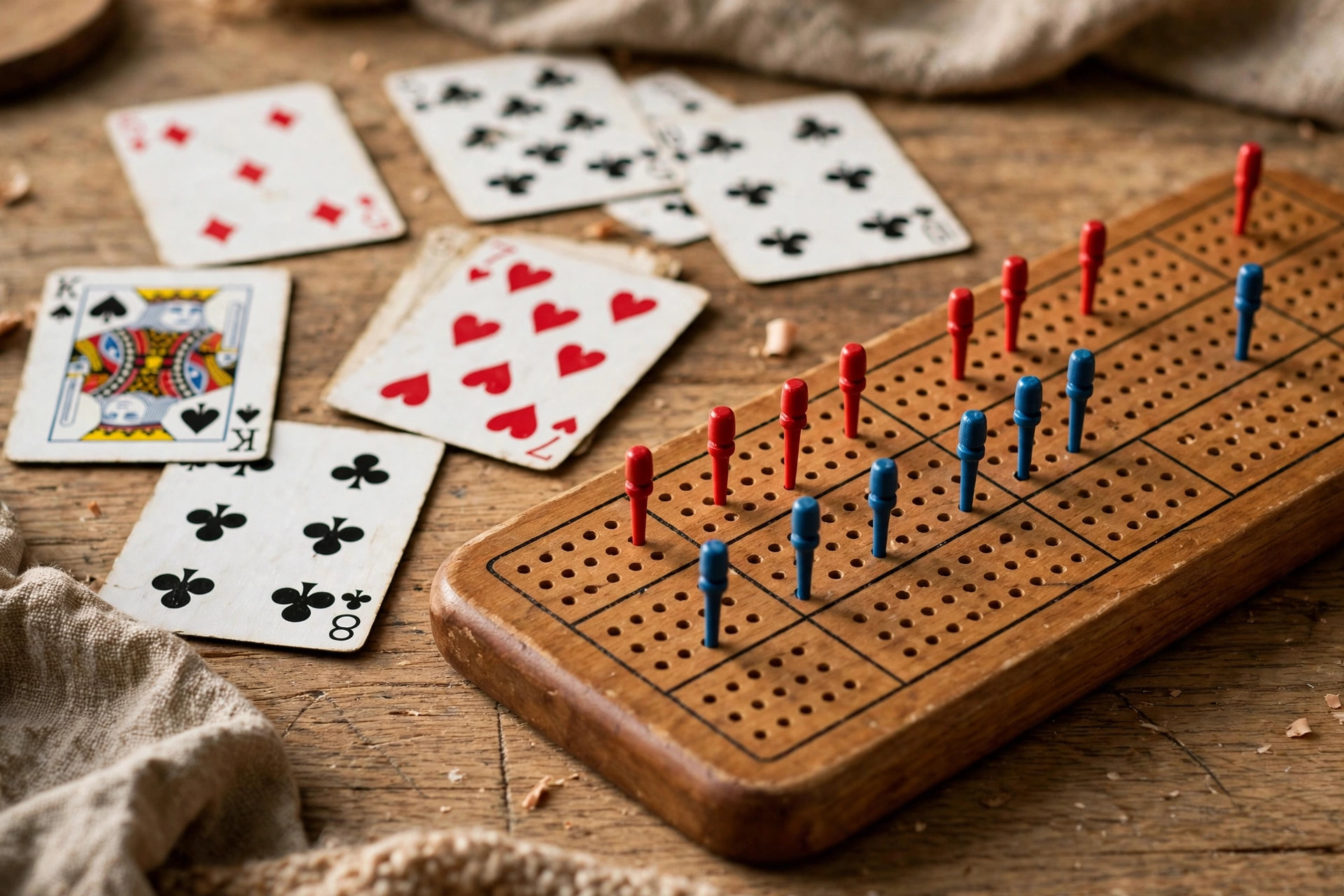
The play itself is a small duel. You lay cards one at a time, calling the running total, and score for making 15 or 31, for pairs and runs formed along the way, and for playing the last card. First to 121 points wins, and a player left below the skunk line at 90 points loses with a little extra shame attached.
Because scoring happens during play and again in the hand and the crib, cribbage never has dead time. It is the strongest all-round pick here if you want one game to learn deeply.
Speed: Five Minutes, No Turns, No Mercy
Speed throws out the oldest rule in card games: waiting for your turn. Both players hold five cards, keep a stock pile, and play at the same time onto two center piles, building up or down by one rank regardless of suit. When neither player can move, both flip a card from the side piles onto the center piles and the scramble restarts. The first player to empty their hand and stock wins. A full round takes about five minutes, which makes Speed the best palate cleanser on this list.
Expect noise. Speed rewards fast eyes and faster hands, and it plays beautifully with kids and adults on level footing, because there is almost no strategy to memorize, just pattern recognition at full sprint.
Golf: Nine Holes, Low Score Wins
Golf borrows its shape from the course. A game is nine holes, and each hole is one dealt hand. In the common four-card version, your cards sit in a two-by-two grid, mostly face down. You flip two to start, then draw from the stock or take the discard to swap high cards out for low ones. When you think your grid beats your opponent’s, you knock, and after their final turn everyone flips and adds up. Face cards count ten, aces count one, and a matched pair in a column cancels to zero, which is where the quiet strategy lives. The low total over nine holes wins.
Golf is the gentlest game here. Hands take a minute or two, the luck is evenly spread, and the grid gives you just enough hidden information to bluff about. Couples who find gin rummy a little too heads-down often settle on Golf instead.
Canasta for Two: The Big-Deck Marathon
Canasta is famous as a four-player partnership game, but the two-player version is a gem in its own right. It uses two full decks shuffled together with the four jokers, 108 cards in all, and deals fifteen cards to each player. The common two-player adjustment is to draw two cards and discard one each turn, which keeps the big hands moving. You score by melding sets of the same rank, and a canasta, a completed meld of seven cards, is the prize that unlocks going out. Red threes are bonus cards, wild cards can help complete a meld but never outnumber the natural cards in it, and the discard pile can be frozen and fought over.
Games run to 5,000 points and take the better part of an hour across several hands. If gin rummy felt too small, this is the opposite direction: more cards, more planning, and a real sense of building something hand after hand.
German Whist: Two Halves, Two Different Games
Most trick-taking games need three or four players. German Whist, sometimes called Honeymoon Whist, is the elegant exception, and it splits neatly into two halves that test different skills. Each player gets thirteen cards, and the rest of the deck forms a stock with its top card turned up to set the trump suit. In the first half you play thirteen tricks, but the real point is collecting: the winner of each trick takes the face-up stock card, and the loser takes the next card face down. Winning a trick over a worthless prize is a blunder you feel later.
In the second half, you play out the thirteen cards you assembled, and now tricks are everything: win more of them than your opponent and you win the game. Few two player card games reward memory this directly, because every card in your second-half hand was chosen in public.
Two Player Card Games for Travel and Small Tables
All five games travel, but they are not equal in a cafe or on a train tray table. Speed and Golf need the least space: two small piles and a grid each. Cribbage needs only its board, and folding travel boards hold the pegs inside. German Whist needs room for a stock pile but no score sheet at all.
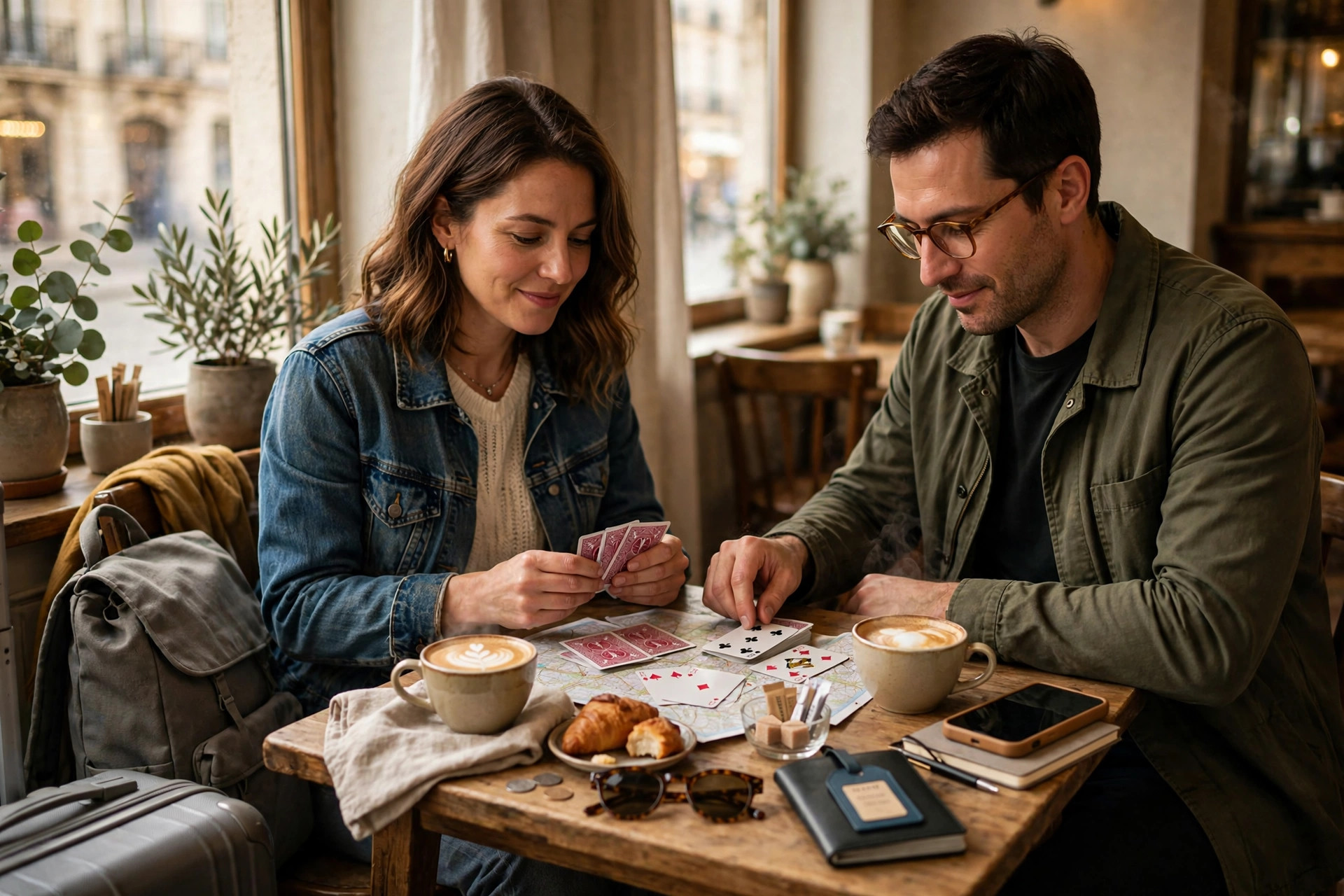
Canasta is the stay-at-home pick of the group, since 108 cards and a growing discard pile want a real table. For trips, pack one standard deck and you still have four of the five games in your bag.
How to Choose Your Next Game Night Staple
Learn one game well before adding the next, and keep a running score across the week; a small rivalry does more for game night than any new rule. Rotation also means constant shuffling, often several times an evening. Worn, sticky cards slow down every game, which is why the advice in our best card shufflers roundup matters more for two-player households than almost anyone: an automatic shuffler keeps inexpensive decks dealing like new and saves your good decks for guests.
Frequently Asked Questions
What is the best two player card game for beginners?
Golf and Speed are the easiest places to start. Golf teaches itself in one hole, because the goal of swapping high cards for low ones is obvious at a glance. Speed has almost no rules at all and no turns to manage. Move on to cribbage once you want scoring with more depth.
How many cards do you need for two player card games?
One standard 52-card deck covers cribbage, Speed, Golf, and German Whist; cribbage also needs a peg board, though a paper score track works in a pinch. Canasta is the exception: it uses two full decks shuffled together with the four jokers, 108 cards in total.
Can you play canasta with two players?
Yes, and it is a well-established version of the game. Deal fifteen cards to each player instead of eleven, draw two cards and discard one on each turn, and play to 5,000 points as usual. The partnership strategy disappears, but the melding, freezing, and canasta-building all survive.
How long does a game of cribbage take?
A full game to 121 points usually takes 15 to 30 minutes. Hands are quick because scoring happens during the play of the cards as well as at the count, and experienced pairs can finish closer to fifteen minutes. Most couples fit a full game inside one coffee break.
What card games can two players play with one deck?
With a single standard deck, two players can play cribbage, Speed, Golf, German Whist, gin rummy itself, and dozens of others. The four games on this list were chosen because none of them needs a third or fourth player to work, and each plays differently enough to earn its place.
Final Thoughts
Gin rummy is not the ceiling for two players; it is the doorway. Cribbage, Speed, Golf, Canasta, and German Whist each ask something different of you, and rotating them keeps a single deck feeling new for months. And when a third or fourth player shows up, the same deck scales up: our guide to crazy eights variations turns a childhood staple into a full-table game with power cards and house rules.
Crazy Eights Variations: Power Cards and Regional Rules

How to Teach Kids a New Card Game in 10 Minutes