
Why Does My Kite Keep Crashing? 8 Fixes for Spinning, Diving and Stalling7 min read
Launch, climb, spin, crash. If that loop sounds familiar, you are not alone in asking why does my kite keep crashing. A crashing kite is almost never a broken kite; it is a kite telling you something specific, and each crash pattern points at a different fix. Watch one full flight, name the symptom, then apply the matching fix below.
One honest exception: some very cheap kites are built so unevenly that no adjustment saves them; the best kites for beginners are balanced at the factory and far easier to learn on.
Our top picks, compared:
Why Does My Kite Keep Crashing? Match the Fix to the Symptom
Random tweaks fail because each symptom has its own cause. Find your pattern in this table first, then jump to that fix.
| Symptom | Likely Cause | Fix |
|---|---|---|
| Spins in circles the same direction every time | Bridle legs uneven, or one side heavier | Check bridle balance (Fix 1) |
| Wobbles, then spins as the wind picks up | Not enough drag at the back of the kite | Add or lengthen the tail (Fix 2) |
| Veers and dives to one side | Bridle point off center or set at the wrong angle | Adjust the bridle point (Fix 3) |
| Climbs well, then dives in gusts | Wind too strong for the kite | Add tail, size down, or wait (Fix 4) |
| Sinks and stalls overhead | Wind too light, or line too heavy | Lighter line, higher launch (Fix 5) |
| Loops over and over without settling | Overpowered and under-tailed | Add drag, shorten line (Fix 6) |
| Nose-dives seconds after launch | Turbulent air or a thrown launch | Open ground, proper launch (Fix 7) |
| Flies fine, then crashes later in the session | Twisted line or a tangled bridle | Untwist and inspect (Fix 8) |
Fix 1: It Spins in Circles, So Check the Bridle Balance
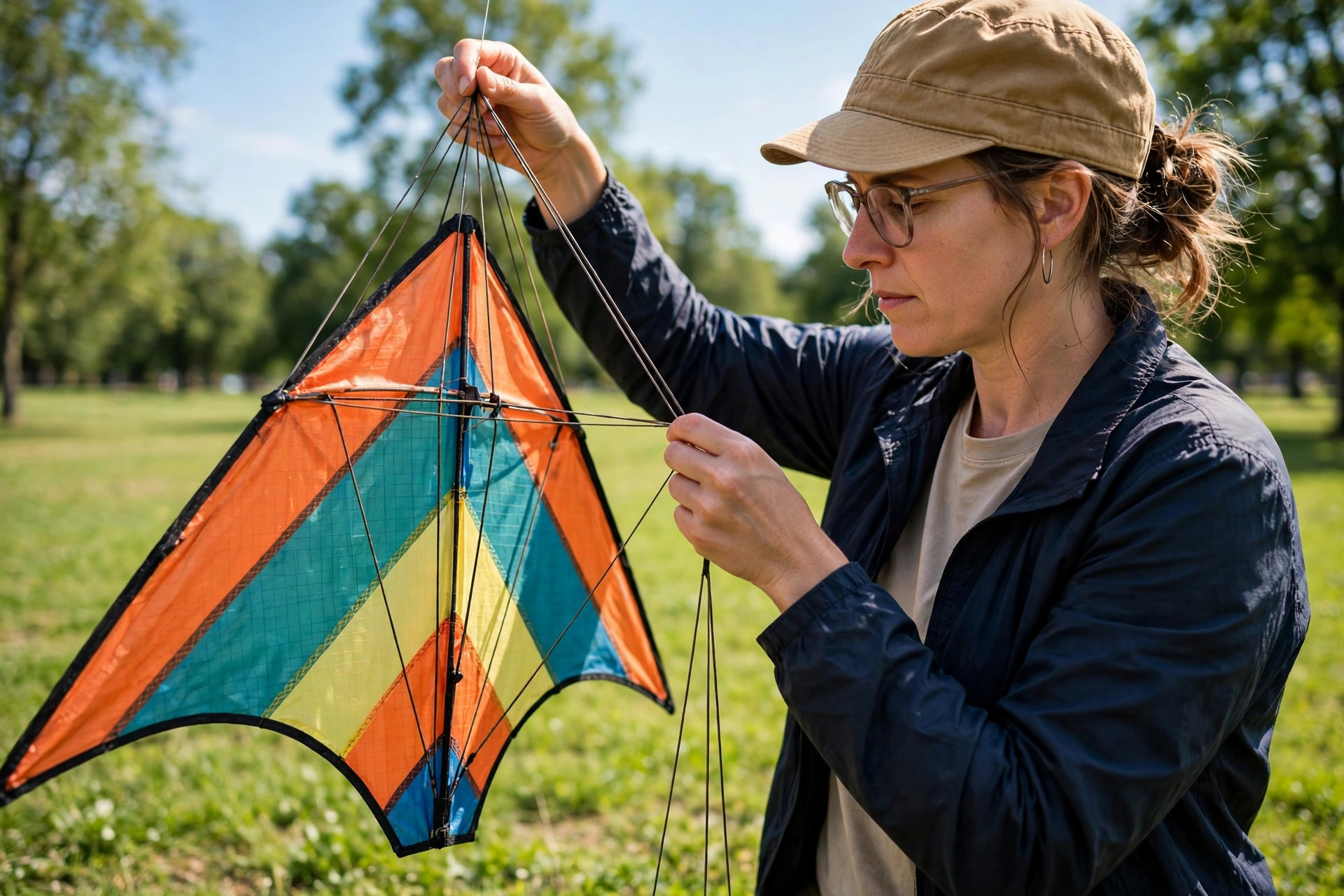
A kite that spins the same way every flight is unbalanced: one side lifts more, so the kite rolls toward the weaker side and keeps rolling. Usual culprits: bridle legs of slightly different lengths, a slipped knot, or a repair patch adding weight to one side. Hold the kite up by the point where the flying line attaches and let it hang; it should hang level. If one wing drops, even up the bridle lines, then check for a bent spar or a heavy tape repair.
Fix 2: It Wobbles and Spins, So Add or Lengthen the Tail
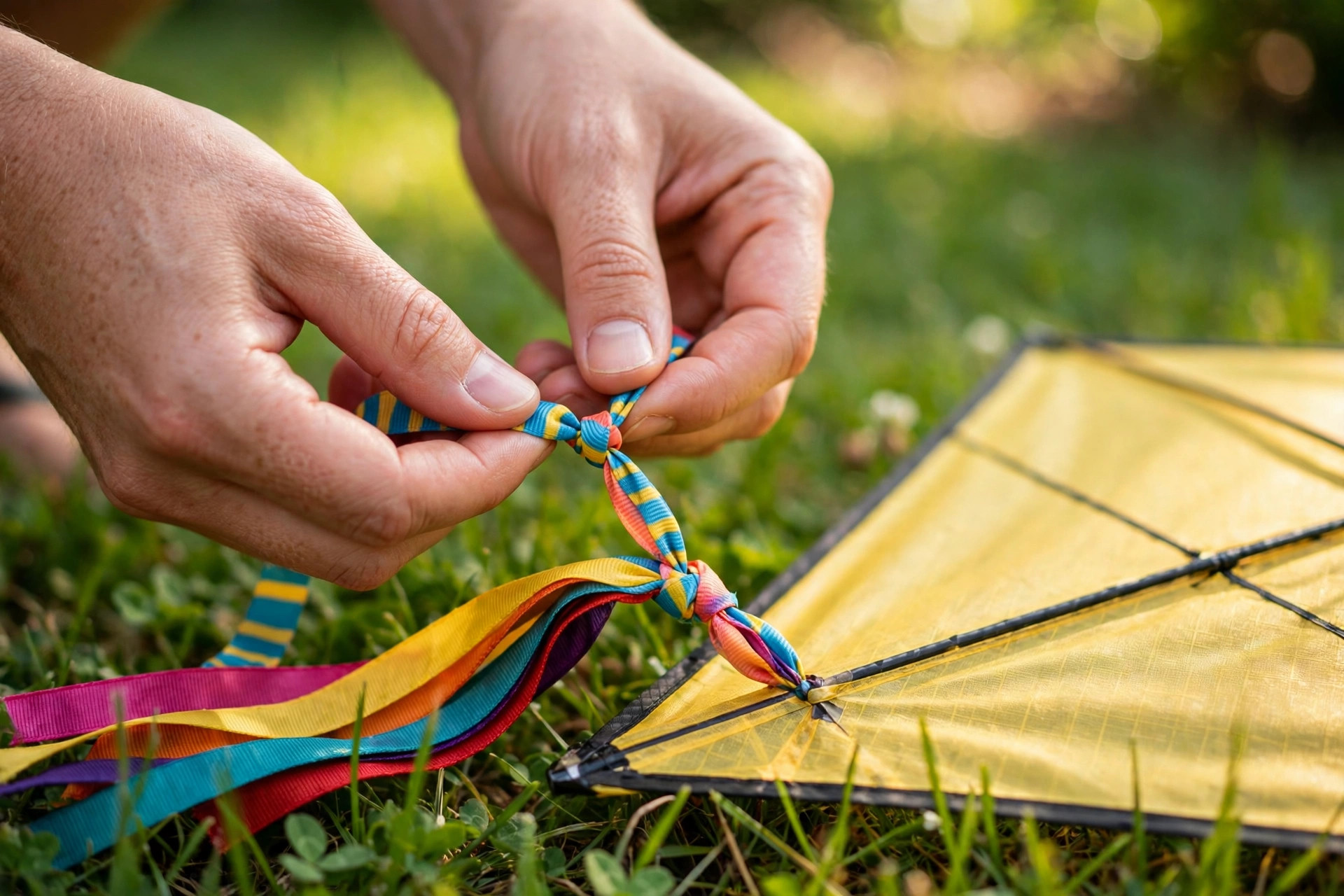
If the kite flies straight in light wind but wobbles and spins when the wind freshens, it needs more drag at the back. A tail works like the feathers on an arrow. Add a tail if the kite has none, or lengthen the one it has: three to five times the kite’s length is a common starting point for diamonds and small deltas. Add length in sections and test between changes.
Fix 3: It Dives to One Side, So Adjust the Bridle Point
A kite that veers and dives to one side often has its bridle point (tow point) in the wrong place. It sets the angle at which the kite meets the wind, and a few millimeters changes everything. Slide the attachment knot a small step at a time, fly, and observe. Check first that the point sits centered, because an off-center knot makes the kite favor one side on every flight.
Fix 4: It Dives in Gusts, Because the Wind Is Too Strong
The kite climbs happily, a gust arrives, the frame flexes, the kite spills its wind or folds, and down it comes. That is an overpowered kite, and no bridle tweak fully fixes it. Add tail for stability, and if the diving continues, the honest answer is a smaller kite or a calmer day. Our kite wind chart matches kite types to wind speeds.
Fix 5: It Stalls and Sinks, Because the Wind Is Too Light
The kite climbs a little, hangs, stalls, and sinks. Down low, the wind is weaker and messier than it feels on your face, and a heavy flying line drags a marginal kite out of the sky. Use the lightest line the kite allows, let out less of it, and launch long into cleaner air. If the leaves are barely moving, the real fix is patience.
Fix 6: It Loops Without Stopping, So Add Drag and Shorten Up
A looping kite tips past vertical, recovers, and tips again. Looping usually means the kite is overpowered for its setup, under-tailed, or flying in swirling air. Add tail drag first, then shorten the line so the kite sits in steadier air. If you are flying near trees or buildings, move: turbulence rolling off obstacles can loop a well-set kite.
Fix 7: It Nose-Dives at Launch, So Fix the Air and the Launch
A nose-dive in the first ten seconds is rarely the kite’s fault. Launches happen in the worst air: low, slow, and churned up by every tree and fence upwind. Stand with your back to the wind, keep the line taut, and let the wind lift the kite. Our guide on how to fly a kite covers the standard launch, and our guide on how to launch a kite solo gives the long-line method for flying alone.
Fix 8: It Crashes Late in the Session, So Check for Twists and Tangles
A kite that flies well for twenty minutes and then misbehaves has usually twisted its flying line; twisted line tangles, shortens unevenly, and can snag the bridle. Spars also work loose. Make a two-minute check part of every flight: walk the line out and let the twists spin out, run the bridle lines through your fingers, and push every spar fully home.
Frequently Asked Questions
Why does my kite keep crashing right after launch?
Launch crashes usually come from turbulent air near the ground and a thrown launch. Trees, fences, and buildings upwind chop the wind into swirls, and a tossed kite has no line tension to steady it. Launch in open space, keep the line taut, and let the wind do the lifting.
Why does my kite keep spinning in circles?
Spinning in the same direction almost always means imbalance: one bridle leg longer than the other, a slipped knot, or one side heavier from a repair or a bent spar. Hang the kite from its bridle point, level the bridle legs, and test again.
How long should a kite tail be?
A tail three to five times the kite’s length is a good starting point for diamonds and small deltas. Add length in sections and fly between changes. Too little tail lets the kite wobble and spin; too much adds weight and drag.
Can a kite simply be too cheap to fly properly?
Yes, sometimes. Very cheap kites are often sewn or framed unevenly, so one side lifts more than the other no matter how you adjust the bridle. If a kite has never flown straight on a good day in an open field, the kite itself is the most likely problem.
How do I stop a kite from crashing once it starts to dive?
Give it line and step toward the kite to reduce tension, which often lets the kite recover its angle. If it goes down anyway, walk to it rather than dragging it back across the grass, which bends spars and tears fabric.
Final Thoughts
Most flyers who ask why does my kite keep crashing are one matched fix away from a good day. Diagnose by symptom, change one thing at a time, and test between changes. And if yours turns out to be the kite rather than the pilot, start again with one of the best kites for beginners, balanced and ready to fly straight out of the bag.

Best Kite Shapes for Beginners: Delta vs Diamond vs Parafoil

How to Fly a Stunt Kite: Your First 5 Tricks
