At-Home Soccer Training for Kids: 15-Minute Plans by Age, No Team Needed7 min read
You do not need a team, a coach or a free evening at the fields to help your child improve at soccer. At-home soccer training works because short, frequent touches on the ball beat one long practice a week, and fifteen focused minutes is enough to deliver hundreds of those touches. The plans below are organised by age, need only a ball and a handful of cones, and fit in a driveway, a backyard or even a cleared living room.
Pick your child’s age band, set a timer, and keep the whole session moving. If you need cones to get started, our roundup of the best sports and soccer cones covers the flat disc cones and taller training cones that survive daily home use.
Our top picks, compared:
At-Home Soccer Training Plans by Age
Every plan follows the same shape: five minutes of dribbling work, five minutes of a skill focus, and five minutes of a game that scores points. What changes with age is the skill focus and how much control you ask for.
| Age Group | Focus | 15-Minute Plan Outline |
|---|---|---|
| Ages 4-6 | Ball familiarity and fun | 5 min free dribbling in a small grid, 5 min cone knockdowns, 5 min freeze dribble game |
| Ages 7-9 | Dribbling control and turns | 5 min cone weave, 5 min sole rolls and pull-backs, 5 min dribbling through gates for points |
| Ages 10-12 | First touch and passing accuracy | 5 min wall passes with both feet, 5 min turn-and-dribble circuit, 5 min target shooting |
| Ages 13+ | Speed of play and weak foot | 5 min two-touch wall work, 5 min weak-foot dribbling circuit, 5 min timed finishing |
Ages 4 to 6: Keep It Silly
At this age the plan is disguised play. Short attention spans are normal, so change the game the moment energy dips. Success means lots of touches, lots of running, and finishing while it is still fun. Skip corrections about technique entirely; a child who loves the ball at five learns technique easily at eight.
Ages 7 to 9: Add Turns and Control
Players this age can handle a simple skill target, like keeping the ball close through a cone weave or stopping it with the sole. Introduce turns early, because a pull-back or a simple outside turn gives a young dribbler an escape move in real games. Keep scores and challenges in every block.
Ages 10 to 12: First Touch and Passing
Now a wall becomes the best training partner available. Passing against a wall and controlling the rebound builds first touch faster than almost any drill, and it needs no partner. Add target shooting at a goal, a bin or a marked section of fence to make finishing competitive.
Ages 13 and Up: Speed and the Weak Foot
Older players should train at game speed and spend real time on the weaker foot. Timed circuits work well: set a course, run it against the clock, then try to beat the time with clean touches. Two-touch wall work, receiving across the body, and weak-foot finishing fill fifteen minutes easily.
What You Need: A Ball, Cones and a Small Space
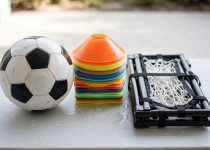
At-home soccer training asks for almost nothing. A ball in the right size for your child’s age, four to eight cones, and a flat space roughly the size of a driveway is a complete setup. A wall or fence for passing rebounds is a bonus, not a requirement. Flat disc cones suit home training best because they stay put when stepped on and do not roll underfoot. The sets in our guide to the best sports and soccer cones include the low-profile discs that work on grass, concrete and indoor floors alike. For the ball, match the size to the age group: size 3 for under 8s, size 4 for ages 8 to 12, and size 5 from 13 up.
Soccer Cone Drills That Fit the Clock
These soccer cone drills are the building blocks inside the plans above. Each one takes under five minutes and needs no explanation longer than a sentence.
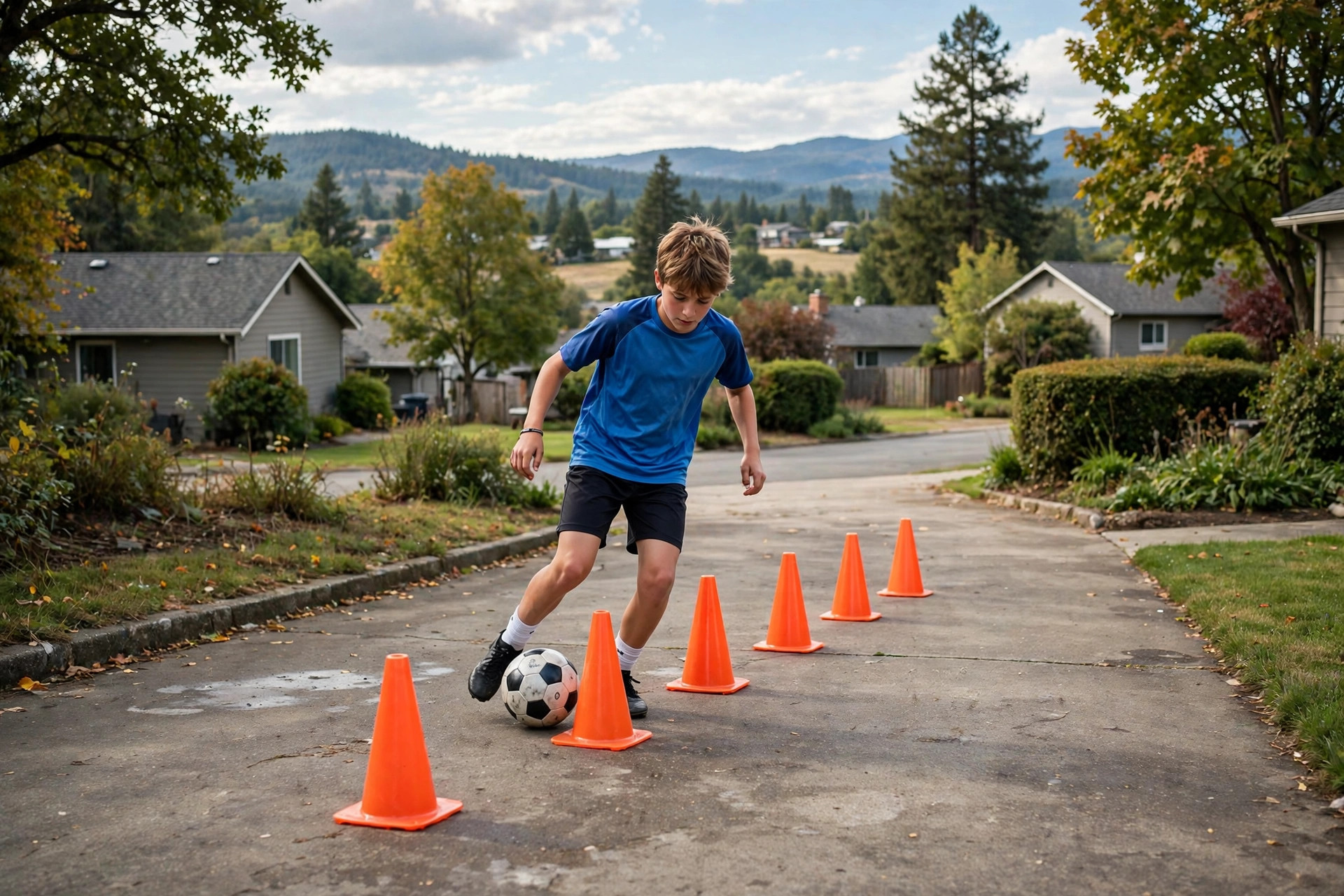
- Cone weave: dribble in and out of a line of cones, keeping touches small. Walk it first, then jog it, then race the clock.
- Gates: scatter pairs of cones as gates around the space. One point for every gate dribbled through in a minute, no gate twice in a row.
- Knockdown: balance cones upright and knock them over with a passed ball from a set distance. Reset and repeat against a timer.
- Figure eight: dribble a figure eight around two cones, using both feet. Smooth beats fast at first; speed comes on its own.
Solo Soccer Training Games Kids Actually Finish
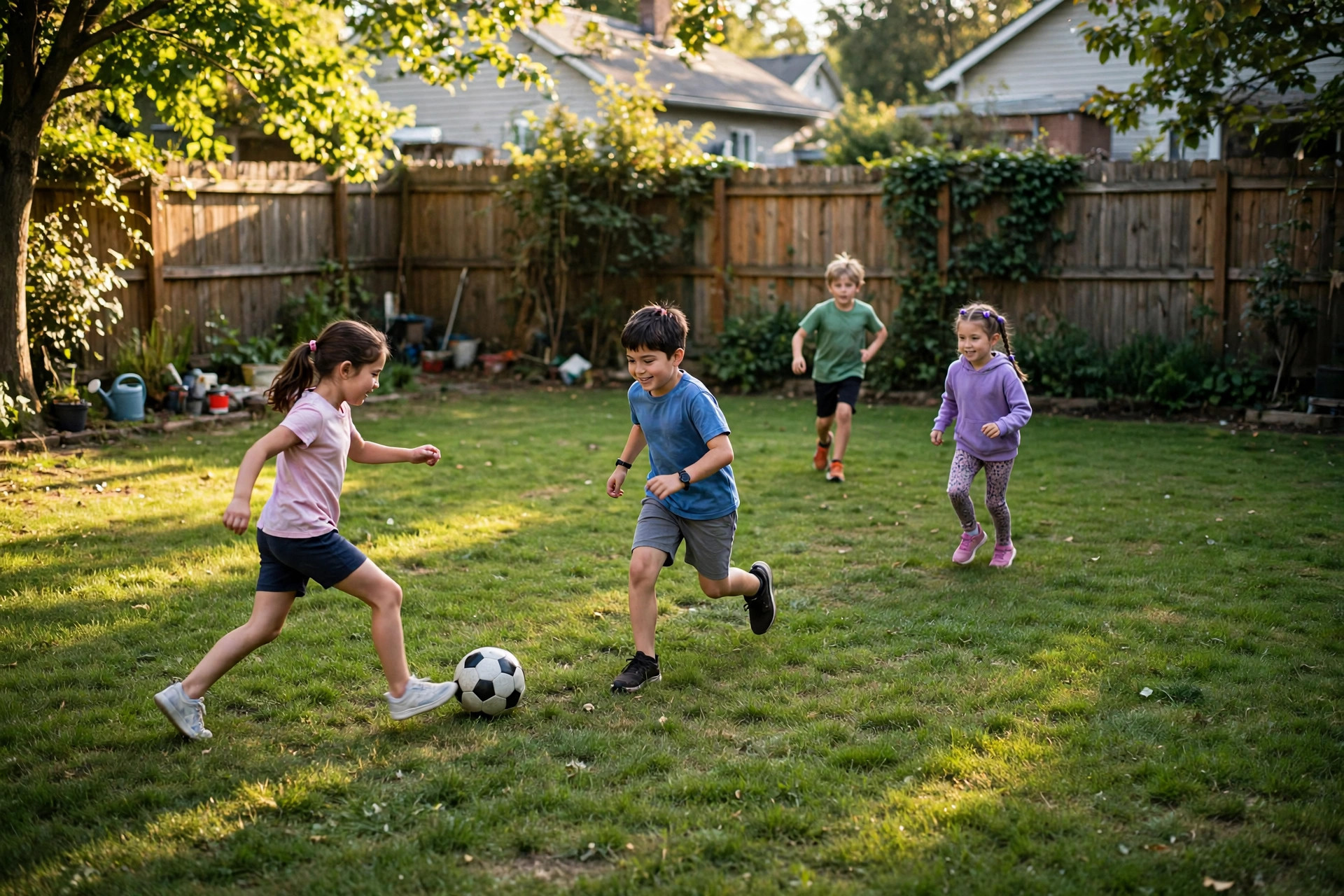
The hardest part of training alone is boredom, so turn the last block into a game with a score. Solo soccer training works when the child is chasing a number, not just repeating a movement. Juggling ladders are a classic: one bounce and catch, then two touches, then three, building a personal record to beat next session. Wall target points work too: chalk or tape a target on a wall, award points by zone, and play to a set total. Cone knockdown against the clock gives younger kids the same chase.
Add a small target and the games get better again. The portable options in our guide to the best portable soccer nets and goals fold away after practice, and shooting at a real goal mouth keeps older kids honest about accuracy.
How Often Should Kids Train at Home?
Three or four short sessions a week is the sweet spot for most kids. That rhythm builds the habit and the touches without turning training into a chore or crowding out team practice and free play. Rest days matter, especially for growing legs, so avoid stacking hard sessions on back-to-back days. Keep the parent’s job simple: set up the space, run the timer, and keep score when asked. Coaching from the sideline of a driveway rarely helps. A child who finishes fifteen minutes wanting to do it again tomorrow is progressing faster than one drilled for an hour.
Frequently Asked Questions
How long should at-home soccer training sessions be for kids?
Fifteen minutes is enough for most ages when the session stays active. Young children often do better with ten focused minutes, while players 13 and up can stretch to twenty or thirty. Short sessions done three or four times a week build more skill than one long session, because touches and attention both stay high.
What is a good backyard soccer practice routine for a beginner?
Start with five minutes of free dribbling in a small area, then five minutes of a simple cone weave, then five minutes of a scoring game like cone knockdown. That shape, dribble, drill, game, is a complete backyard soccer practice for a beginner. Finish while it is still fun and repeat it a few times a week.
What equipment do I need for soccer drills for kids at home?
Very little: a ball in the correct size for your child’s age, four to eight cones, and a flat space such as a driveway or backyard. Flat disc cones are the safest choice because they do not roll when stepped on. A wall for passing rebounds and a small portable goal are useful extras, not essentials.
Can my child improve with solo soccer training only?
Yes, especially at dribbling, first touch and ball control, which are exactly the skills home training targets. Solo soccer training cannot replace the decision-making that comes from playing against opponents, so treat it as a supplement to team play and pickup games rather than a full replacement for either.
How many days a week should kids practise soccer at home?
Three or four short sessions a week is a good target for most children. That is enough to build a habit and rack up touches without overuse or boredom. Leave at least one easy day between harder sessions, and count team practices and matches toward the weekly total.
Final Thoughts
At-home soccer training succeeds when it is short, scored and repeatable. Fifteen minutes, three or four times a week, with a ball, a few cones and a game at the end, will move a young player’s touch further than occasional long sessions. Match the plan to the age, keep the timer visible, and let the scoreboard do the motivating.

Backyard Soccer Games for Small Spaces and Mixed Ages

Dribbling Drills Kids Can Do Alone in a Driveway