
Treadmill vs Outdoor Running: Pace, Effort and When Each Wins8 min read
Every runner eventually faces the same rainy, icy or brutally hot morning and asks the question behind the treadmill vs outdoor running debate: does the belt count the same? The honest answer is that both build fitness, but they do it in slightly different ways, and the differences matter for pacing, effort and race prep. A treadmill gives you total control. An outdoor run gives you the real world. Which one wins depends on the workout on your schedule, the weather outside your door, and what you are training for. This guide compares the two on pace accuracy, effort, impact and motivation, then shows how most runners get the best results by mixing both across the week instead of picking a permanent side.
Our top picks, compared:
Treadmill vs Outdoor Running: The Side-by-Side Numbers
The debate gets clearer when you line the two up factor by factor. Here is the short version before the detail:
| Factor | Treadmill | Outdoor |
|---|---|---|
| Pace accuracy | Belt speed can drift; a footpod or calibrated watch helps | GPS pace jumps with signal; measured routes are exact |
| Effort at same pace | Slightly easier: no wind resistance, belt assists turnover | Harder: wind, terrain changes and heat management |
| Weather control | Total: no rain, ice, heat or darkness | Whatever the day gives you |
| Surface / impact | Softer, uniform belt; one repetitive stride pattern | Varied surfaces; harder pavement but more natural variation |
| Boredom / motivation | Screen-dependent; easy to cut a run short | Scenery and routes; harder to bail mid-run |
| Best use | Intervals, bad-weather miles, controlled comeback runs | Long runs, race-specific prep, group runs |
The pattern underneath the table: the treadmill wins on control and convenience, the outdoors wins on specificity and engagement. Neither wins on fitness. Your heart, lungs and legs adapt to effort, and both surfaces can deliver it.
Pace Accuracy: Why the Belt Number Lies a Little
Treadmill pace is the number the belt is set to, not necessarily the number you ran. Belts slip a little under footstrike, calibration drifts as machines age, and your watch’s indoor estimate is mostly a guess based on arm swing. A footpod or a calibrated watch gives cleaner data. Our Garmin heart rate monitor review explains how pairing a watch with a chest strap and footpod tightens up both pace and heart rate data indoors and out.
Outdoor GPS pace has the opposite problem: it is real distance, but the live pace jumps around with tree cover, buildings and turns. For honest comparisons, judge outdoor runs by lap pace on a known route, and treadmill runs by effort and time.
Effort at the Same Pace and the 1 Percent Incline Rule
At the same displayed pace, treadmill running usually feels a touch easier. There is no wind resistance, the belt helps pull your foot through, and the temperature never changes. Outdoors, even a light headwind or a rolling route adds work the pace number never shows.
This is where treadmill vs outdoor running comparisons usually go wrong: they compare pace instead of effort. The classic fix is the treadmill incline 1 percent setting, which roughly offsets the missing wind resistance at moderate paces. Treat it as a nudge, not a law: at easy pace the gap is tiny, and at faster paces it grows.
Heart rate is the fair referee here. If your heart rate at a given pace matches indoors and out, the effort matches, whatever the screens say. Our heart rate training guide shows how to use zones to compare workouts across surfaces without guessing.
What Outdoor Running Gives You That a Belt Cannot
The outdoor running benefits start with specificity. If your race is on roads, your legs need the exact skill of propelling you forward over unmoving ground, handling cambers, corners and small hills without thinking about it.
The outdoors also varies the load. Every stride lands a little differently, which spreads stress across tissues instead of repeating one identical pattern thousands of times. Add wind, heat and route decisions, and an outdoor run trains judgment along with fitness.

Then there is the simple part: scenery, daylight and fresh air make long runs pass faster for most people, and a route that starts at your door removes every excuse a drive to the gym creates.
What the Treadmill Gives You That the Road Cannot
The treadmill running benefits are about control. You can hold an exact pace for intervals without watching a GPS readout, rehearse race pace to the second, and stop the moment something feels wrong.
The belt is also the bad-weather answer: ice, lightning, extreme heat and dark winter mornings all become irrelevant. For runners coming back from injury, the flat, predictable, softer surface makes the treadmill the safest place to rebuild.
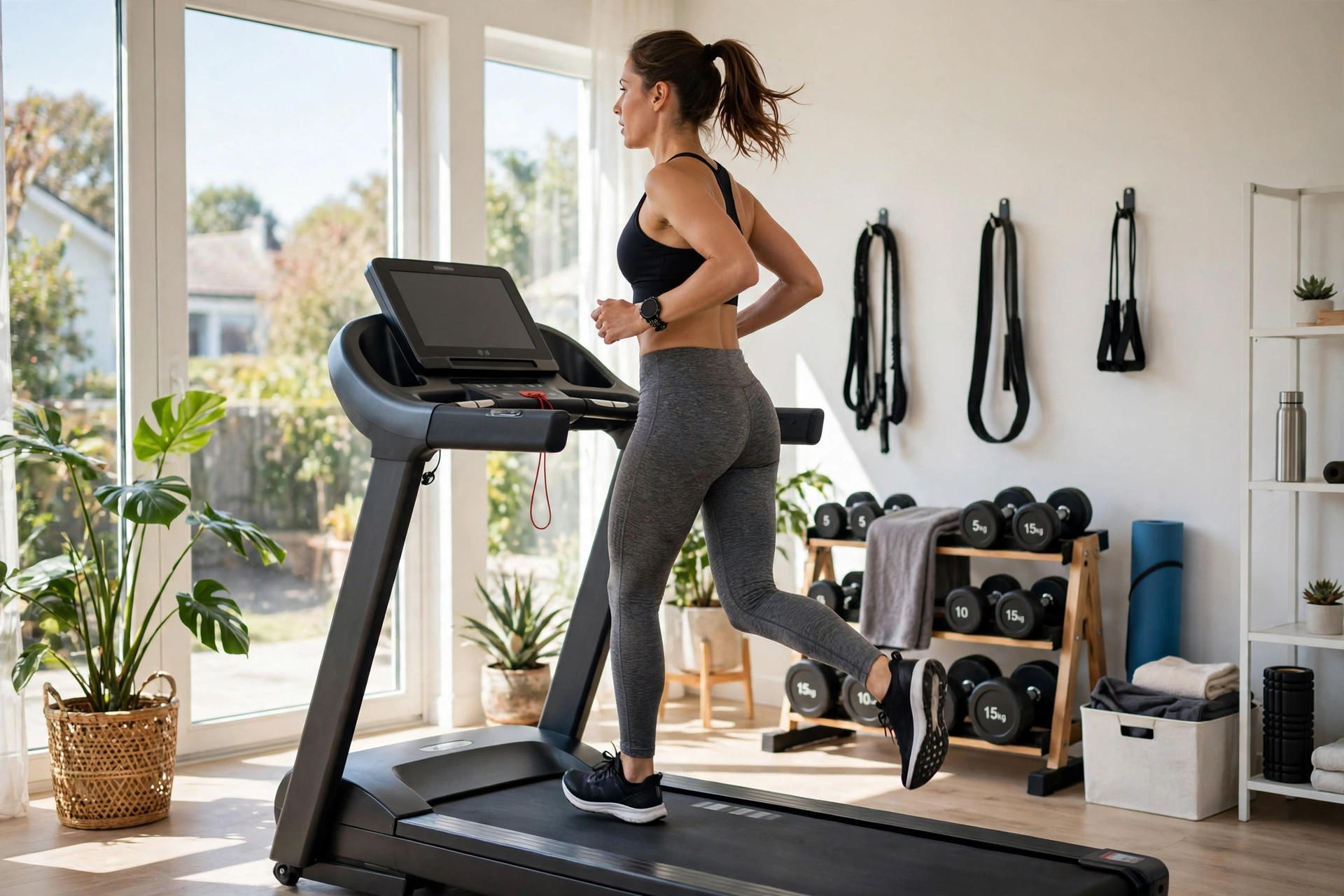
Entertainment matters too. A tablet, a show or a podcast turns a recovery run into something you will actually do, and consistency beats perfection every week of the year.
Surface, Impact and Injury Notes
Treadmill belts have more give than asphalt or concrete, so each step is slightly softer. That helps some runners with cranky knees, but the perfectly uniform stride can overload the same tissues in the same way, mile after mile. Outdoor surfaces vary from track rubber to concrete sidewalks, the hardest common option. Rotating routes and surfaces is the simplest protection either way: no single surface, repeated daily, is kind to every runner. Whichever you choose, change gradually. A runner who does everything outdoors in summer and everything on a belt in winter is fine; a runner who swaps all at once in one week often feels it in their calves and Achilles.
Boredom, Motivation and Getting It Done
Ask a room of runners which is more boring and the treadmill loses badly, but boredom is personal. Some runners love zoning out to music with zero decisions. Others need a changing route to run at all. The treadmill has one motivational trap: the stop button is always there, and quitting early costs nothing. Outdoor runs have built-in commitment, because stopping still leaves you a mile from home. Use each surface’s strength. Put the runs you dread on the surface you enjoy, and save your weaker surface for the easy days when motivation matters least.
How to Mix Both in One Training Week
A practical split for most runners: do your long run and one easy run outdoors for specificity and headspace, and use the treadmill for one workout where pace control matters, plus any run the weather tries to cancel. Keep the data honest across both. The pace and heart rate graphs in our Garmin heart rate monitor review make it easy to compare a treadmill tempo run with last week’s outdoor one, so the mix does not turn into two separate training logs in your head. The exact split matters less than the habit: plan the surface when you plan the workout, and the treadmill vs outdoor running question stops being a debate and becomes a tool.
Frequently Asked Questions
Is treadmill running easier than outdoor running?
At the same pace, usually a little. No wind resistance, a belt that assists your stride and stable temperatures all shave off effort. A 1 percent incline closes most of the gap at moderate paces. Judge by heart rate or feel rather than the display, and the two come out close.
Should I set the treadmill to 1 percent incline?
It is a reasonable default for steady runs, because it roughly replaces the wind resistance you lose indoors. It matters less at easy pace and more as you speed up. If the incline makes your calves or Achilles complain, run flat and simply accept that the effort is slightly lower.
Does treadmill running count the same as outdoor miles?
For fitness, yes. Your aerobic system responds to effort and time, not to scenery. The differences are in the details: outdoor miles add surface variety and race-specific skills, while treadmill miles add control. Log both honestly and count them both toward your weekly volume.
Treadmill vs outdoor running: which burns more calories?
Nearly the same at the same effort and duration. Outdoor running can edge ahead slightly because of wind and terrain, and treadmill running can edge ahead if the control helps you run longer. The surface you will actually use consistently burns the most calories over a season.
Can I train for a road race only on a treadmill?
You can build the fitness, and plenty of runners have. The risk is specificity: road races add camber, corners, weather and pacing judgment that a belt never teaches. If you can, move your longest runs and a few race-pace sessions outdoors in the final month.
Final Thoughts
Strip away the rivalry and treadmill vs outdoor running is not a contest with one winner. The treadmill is the tool for control, safety and weatherproof consistency. The outdoors is the tool for specificity, variety and runs that feed your head. Use both on purpose and the question answers itself, one workout at a time.

How to Choose Running Gloves, Hats and Layers by Temperature

How to Return to Running After 2, 4 and 8 Weeks Off
