Bocce League Night: How to Run a Small Backyard Tournament and Bracket9 min read
A bocce tournament sounds like something a social club runs with printed rules and a trophy budget. In a backyard, it is much simpler: a handful of teams, one court, a bracket on a sheet of paper, and a few hours of daylight or string lights.
What makes a league night feel official is not the paperwork. It is knowing the format before the first ball rolls, so nobody argues about who plays whom or what happens after a loss. This guide covers how to run a bocce tournament for 4, 6, or 8 teams: picking a format, building the bracket, seeding, scheduling, scoring, and settling ties before they start an argument.
Our top picks, compared:
How to Run a Bocce Tournament: Pick a Format for 4, 6, or 8 Teams
Start with your headcount, because the format follows from it. Teams of two are the backyard standard: easier to schedule, and everyone rolls often. Teams of four work if your group is big and your court is long.
| Teams | Recommended Format | Approx. Games on One Court |
|---|---|---|
| 4 | Double elimination, or round robin into a final | 5-7 games |
| 6 | Two pools of three, top two advance to semifinals | 8-9 games |
| 8 | Single elimination with a consolation game | 8 games |
Four teams is the relaxed option: double elimination keeps everyone playing most of the night, and a round robin guarantees every team faces every other team. Six teams is the awkward number, so pools solve it: each pool of three plays a mini round robin, and the top two from each pool cross over into semifinals. Eight teams is the classic bracket: the easiest format to explain, the fastest to finish, and the one the rest of this guide uses as the example.
Short on court space? Our step-by-step guide to building a backyard bocce court on a budget shows how much room a home court actually needs.
Single Elimination vs Double Elimination
Single elimination: lose once and you are done. It is fast, dramatic, and a little cruel to the team that draws the strongest opponent first. Double elimination gives every team a second life: losers drop into a losers bracket, and a team is only out after its second loss. The tradeoff is time: double elimination nearly doubles the number of games, fine for 4 teams and tough for 8 on one court before dark. Our recommendation for a backyard bocce tournament: single elimination for 6 or 8 teams, double elimination for 4.
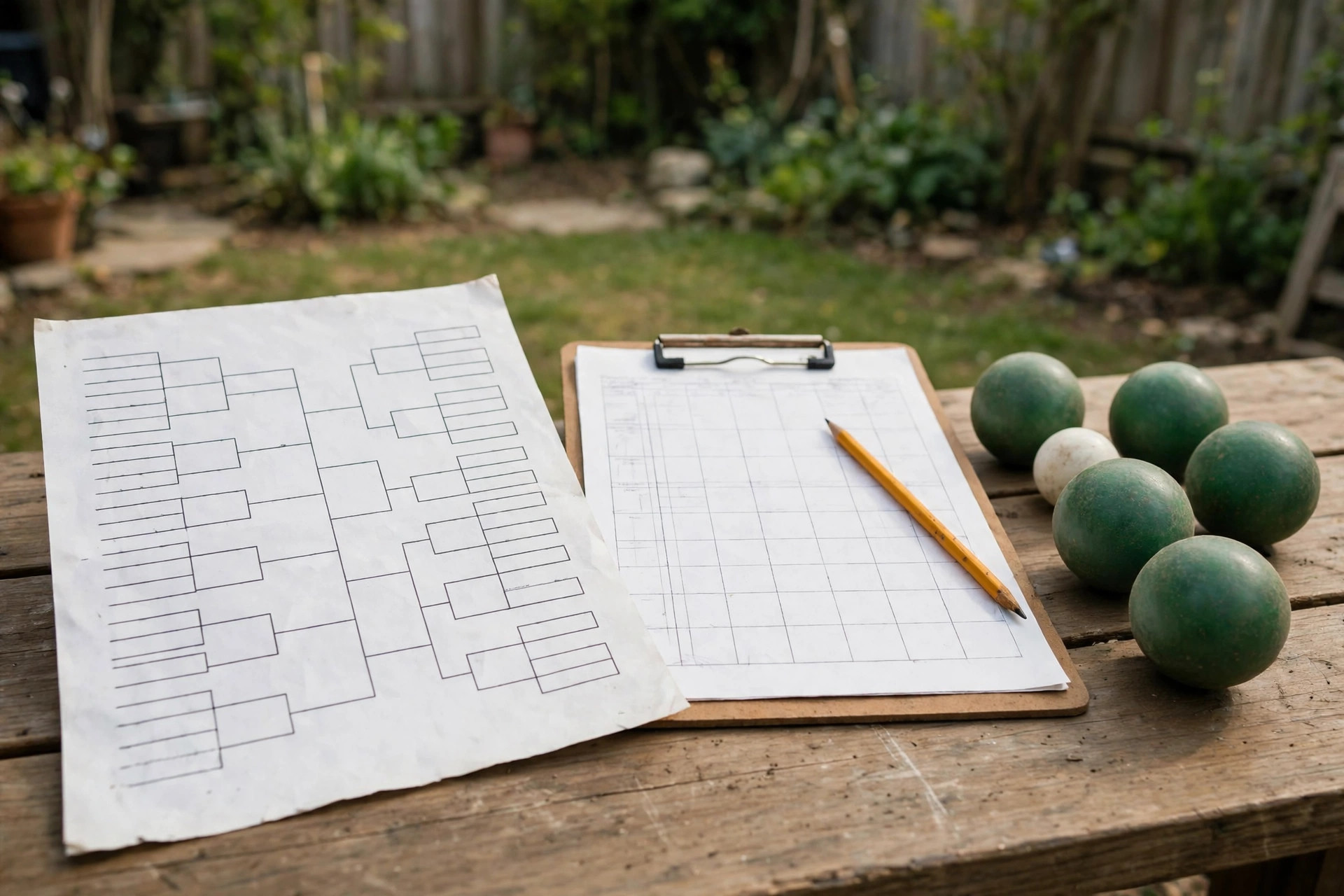
How to Build a Bocce Bracket: 8 Teams, Round by Round
Quarterfinals
Game 1: seed 1 vs seed 8. Game 2: seed 4 vs seed 5. Game 3: seed 2 vs seed 7. Game 4: seed 3 vs seed 6. This pairing protects the top seeds a little, which is the point of seeding, and the two best teams cannot meet until the final if they keep winning.
Semifinals
The winner of Game 1 plays the winner of Game 2. The winner of Game 3 plays the winner of Game 4. Run both semifinals back to back on one court.
The Final and a Consolation Game
The two semifinal winners play the final, ideally to a slightly higher target score than the earlier rounds. While the final runs, the two semifinal losers can play a consolation game for third place. It keeps four more players rolling instead of watching.
Seeding Your Teams Fairly
Seeding is ranking teams before the bracket is drawn, strongest first. Last week’s results are the best seed source if your league night repeats: the defending champions take seed 1. For a first night, seed by self-assessment and a coin flip: beginner, intermediate, or strong, rank within each group, flip coins for ties. What matters is that seeding happens before anyone sees the bracket.
Courts, Rounds, and Scheduling
One court means games run in sequence. A game to 12 points between teams of two usually takes 20 to 30 minutes, which is the number to plan around. Two courts, or one court plus a marked lawn lane, cuts the night nearly in half. Post the order of games where everyone can see it. If daylight is short, shorten games rather than rounds: early rounds to 9 points instead of 12 keeps the bracket intact and the final at full length.
Scoring Sheets and Scorekeeping
A bocce tournament runs on one sheet of paper per game: team names, target score, a running tally by frame, and the final score with both captains’ initials. The running tally matters more than the final score, because frames are where disputes start. Appoint one neutral scorekeeper per game. Keep every sheet until the night ends. If your set is worn or short a ball, our roundup of the best bocce ball sets covers replacements for every court size.
Tie-Breakers and House Rules to Settle First
For a tied frame, the common rulings are that the tied balls cancel and the next closest ball decides, or that nobody scores. Our guide to bocce scoring disputes, measuring and ties walks through each ruling. For a tied game at the target score, the cleanest fix is one more frame; if that also ties, a single-ball roll-off: each team rolls one ball, closest to the pallino wins. Settle these house rules out loud before game one: target score, whether a kiss counts double, pallino out of bounds, and whether hitting shots are allowed at full strength.
Prizes and Hosting Tips
The prize matters less than the ceremony: a goofy traveling trophy or the right to choose next week’s format works better than anything expensive. Feed people between rounds, not during them: a grill break after the quarterfinals resets the night. Keep water and shade at the court end. End the night by reading the final standings out loud and posting the bracket.

A Sample One-Evening Bocce Tournament Schedule
Here is a bocce tournament evening that fits 8 teams, one court, and a summer night. Start times assume games to 12 in the early rounds and 15 in the final.
| Time | What Happens |
|---|---|
| 5:30 PM | Court setup, seeding announced, house rules read out |
| 6:00 PM | Quarterfinals 1 and 2 |
| 6:45 PM | Quarterfinals 3 and 4 |
| 7:30 PM | Grill break, consolation matchups set |
| 8:00 PM | Semifinals |
| 8:45 PM | Consolation game for third place |
| 9:15 PM | Final, then standings and prizes |
With two courts, pull every start time about 30 minutes earlier. With 4 teams, the same skeleton works with longer games and a longer grill break.
Frequently Asked Questions
How many teams do you need for a bocce tournament?
Four teams is the practical minimum for a bracket that feels like a tournament. Four teams support double elimination or a round robin plus a final. Eight teams is the classic single-elimination size, and six teams work well with two pools of three feeding semifinals.
How long does a backyard bocce tournament take?
Plan on about three hours for 8 teams on one court with games to 12 points. A game between two teams of two usually runs 20 to 30 minutes. Two courts or shorter early-round games can bring the night closer to two hours.
What is a bocce bracket and how do you fill one in?
A bocce bracket is the chart that maps every matchup. Write the seeded teams into the first-round slots, seed 1 playing seed 8, seed 4 playing seed 5, and so on. After each game, write the winner’s name into the next round’s slot until one champion remains.
How do you seed teams on a bocce league night?
Use last week’s finishing order if your league night repeats, with the defending champions as the top seed. For a first night, have teams rate themselves beginner, intermediate, or strong, rank within each group, and break ties with a coin flip. Always seed before showing anyone the bracket.
What is the best tie-breaker for a tied bocce game?
One extra frame is the fairest tie-breaker when time allows. If that frame also ties, switch to a single-ball roll-off: each team rolls one ball toward the pallino, and the closest ball wins the game.
Final Thoughts
Running a bocce league night is mostly decisions made early: the format, the seeds, the target score, and the tie-breakers. Make them before the first ball rolls, write them on the bracket sheet, and the tournament runs itself. Start with 4 teams and double elimination if it is your first night.

Bocce Ball Size Chart: Regulation, Backyard and Kids Sizes by Hand Size

5 Bocce Ball Bags to Carry Your Bocce Ball Set