Bocce for Kids: Shorter Courts, Lighter Balls and Simpler Rules10 min read
Bocce for kids works because the game shrinks gracefully. A regulation court is 76 feet long and the balls are heavy enough to make a toddler stagger, but nothing about bocce actually requires either. Shorten the court, hand a child a ball they can genuinely control, and strip the rules down to “roll it close,” and you have a game a four-year-old and a grandparent can play in the same frame. This guide lays out the adjustments by age, so you can set up a game that fits your youngest player without boring your oldest one.
Our top picks, compared:
Bocce for Kids by Age: Court Length, Ball Size and Rule Tweaks
Use this chart as your starting setup, then adjust. Kids develop at different speeds, so treat the age bands as a guide, not a test.
| Ages | Court Length | Ball Size | Rule Tweaks |
|---|---|---|---|
| 3-4 | 10-15 ft rolling lane | Soft or foam, oversized and light | Roll toward a target, no scoring, everyone rolls at once |
| 5-6 | 20-25 ft | 70-80 mm, light | Closest ball earns 1 point, games to 5, throw from a closer line |
| 7-9 | 30-40 ft | 80-90 mm, light to medium | Real scoring, games to 8, gentle hitting shots allowed |
| 10-12 | 40-60 ft, or a shortened full court | 90-100 mm | Near-full rules, games to 12, basic strategy and aiming at the pallino |
Ages 3 to 4: A Rolling Game, Not Bocce Yet
At this age the win is rolling the ball in roughly the right direction and waiting for a turn. Use soft or foam balls, set a bright target 10 feet away, and cheer for anything that arrives in the neighborhood. Skip scoring entirely. Five happy minutes beats one correct frame.
Ages 5 to 6: First Real Frames
Kids this age can aim, take turns, and understand “closest wins.” A 20 to 25 foot court keeps rolls reachable, and a closer throwing line for kids is fair, not a concession. Play to 5 points so a game ends while attention is still alive.
Ages 7 to 9: Real Rules, Shorter Court
This is the sweet spot for bocce for kids. Most children this age can roll a light 80 to 90 mm ball with control, keep score, and start aiming at the pallino instead of just near it. Introduce the real scoring system and let them attempt gentle hitting shots.
Ages 10 to 12: Nearly the Adult Game
Older kids can handle 90 to 100 mm balls and a longer court, and they usually want the real game, not a kids version. Play to 12, talk basic strategy, and let them throw the pallino. Many are ready for a full court within a season or two.
Choosing a Bocce Ball Size for Kids
The right bocce ball size for kids passes one test: the child can cradle the ball in one hand, palm up, without their fingers straining wide, and roll it underhand without dropping it or lobbing it. Weight matters as much as diameter. A ball that is too heavy turns every roll into a two-handed heave, and heaves go anywhere. Lighter recreational balls in the 70 to 90 mm range suit most kids under 10 far better than a regulation 107 mm ball. Our bocce ball size chart lists diameters, weights, and hand-size guidance for every age, including adults, so you can match a set to your whole group at once. Bright colors deserve a mention too. When every child can spot their own balls instantly, turns move faster and the “that one is mine” debate disappears.
Simple Bocce Rules for Kids
Here are simple bocce rules for kids, in the order you would teach them at the start of a game:
- One person rolls the little ball, the pallino, down the court.
- Take turns rolling your big balls and try to stop closest to the pallino.
- After everyone has rolled, the closest ball gets a point. If you have two balls closer than everyone else’s best, you get two points.
- First player or team to the target score wins. The winner throws the pallino next.
That is the whole game for a five-year-old. Add the adult refinements, foul lines, hitting shots, measuring close balls, as kids ask for them or as disputes demand them. When your kids are ready for the complete game, our guide on how to play bocce ball covers the full rules, scoring, and court setup. For close calls, let kids measure with a string themselves. It slows the game down in the best way, and children take a ruling they produced themselves far better than one handed down by a parent.
Safety Basics for Kids Bocce
Bocce is a gentle game, but the balls are the hazard. A regulation ball dropped on a small foot hurts, so a few ground rules keep everyone intact.
- Match the ball to the child: toddlers get soft or foam balls only, no exceptions, because they will drop them.
- Roll underhand, always: no overhand throwing, and no rolling while anyone is standing in the lane.
- Everyone stands behind the thrower: retrieving balls waits until the last ball of the turn is rolled.
- Clear the lane of toys, sticks, and wandering pets before each frame.
- Pick a flat, open spot away from driveways and streets, and supervise any game involving kids under 7.
With lighter kids balls and those habits, bocce is one of the safer lawn games a family can own.
Bocce Games for Kids That Keep Them Playing
Straight bocce holds most kids for a few frames. These bocce games for kids stretch a set across a whole afternoon.
Target Toss
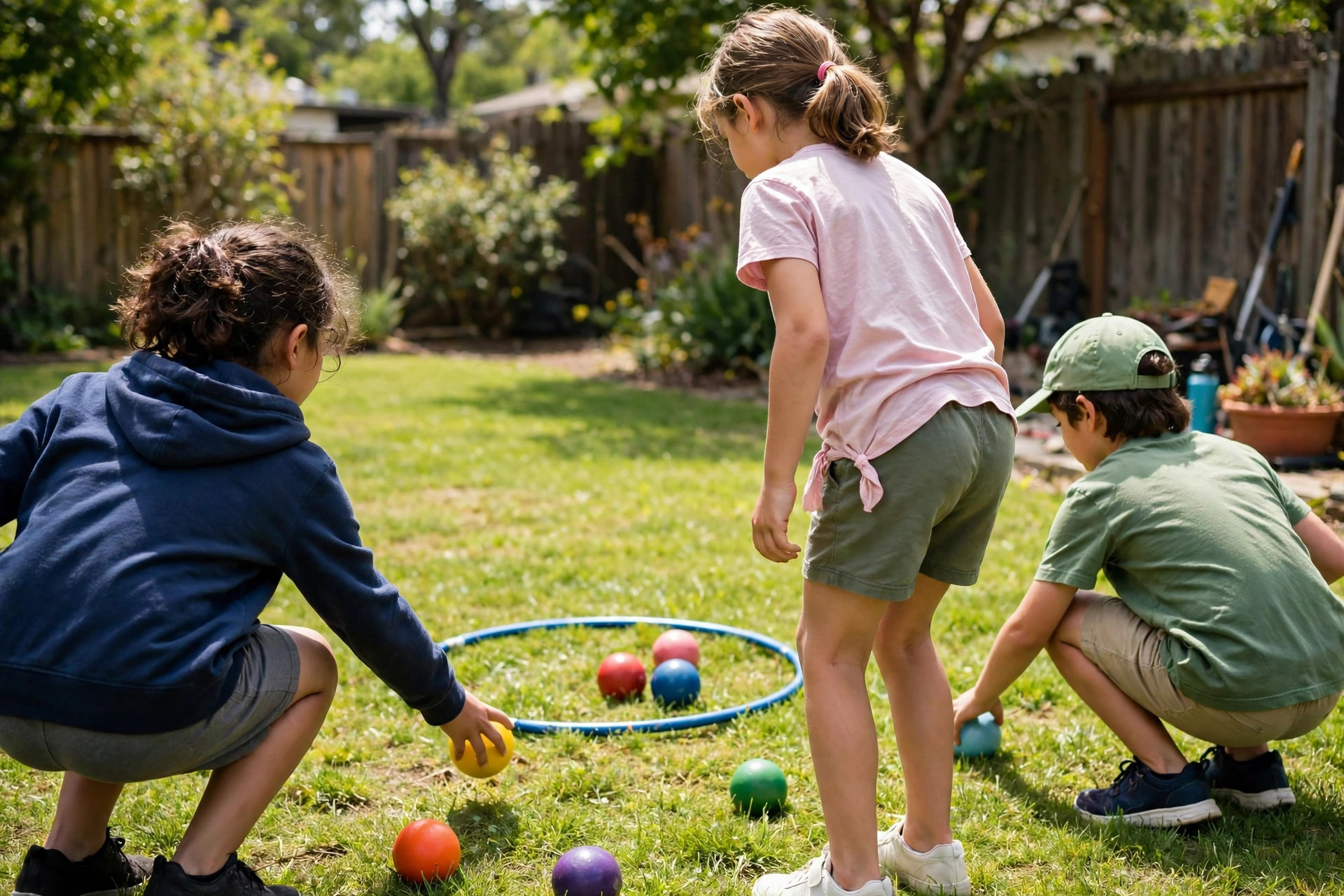
Place a hula hoop, a towel, or a chalk circle partway down the lawn. Players score a point for any ball that stops inside the target, and a bonus point for touching the pallino placed in the middle. Distance stops mattering, so younger kids compete evenly.
Bocce Bowling
Set up plastic bowling pins, empty bottles, or pool noodles at the end of the court and roll bocce balls to knock them down. Score it like bowling, one point per pin. This is the best first game for kids who find “closest to the little ball” too abstract.
Closest Wins the Round
Skip the pallino and play to a stuffed animal or a favorite toy placed down the lawn. Rotate who places the target. Kids invent their own variations within minutes, which is exactly the point.
Family Bocce Games for Mixed Ages: Keeping It Fair
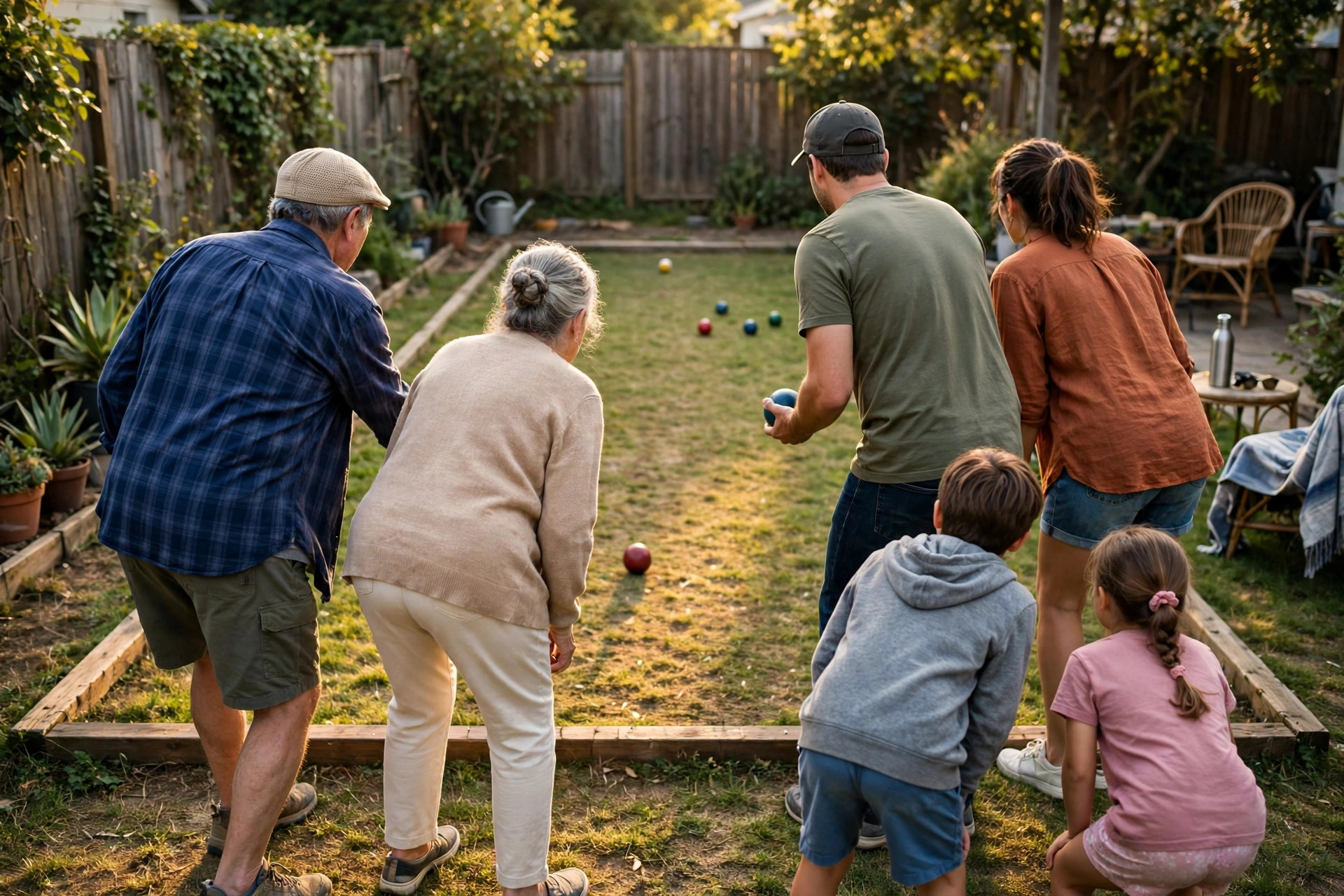
Family bocce games fall apart when a nine-year-old has to out-roll an adult on an adult court. A few handicaps keep bocce for kids and grown-ups in the same game genuinely competitive.
- Staggered throwing lines: mark a line per age group with a cone or a stick, youngest closest, adults at full distance; nobody comments on it after the first frame.
- An extra ball for the youngest: give the smallest player three balls against everyone else’s two; it quietly fixes most skill gaps.
- Mixed teams: pair each child with an adult on the same team, so coaching happens naturally and no team is all kids.
- Let kids throw the pallino: it is a small honor that costs adults nothing and makes a child feel like a real player.
Rotate the handicaps as kids improve. The goal is a game where the last frame actually decides the winner, for everyone.
If your family set is due for an upgrade to something with kid-friendly sizes included, our roundup of the best bocce ball sets compares sets by size, weight, and material.
Frequently Asked Questions
What age can kids start playing bocce?
Most kids can start a simplified version around age 3 or 4, rolling soft or foam balls toward a target over a short distance with no scoring. Real frames with turns and points usually click around age 5 or 6. By 7 to 9, most children can play with genuine scoring on a shortened court using light balls.
What size bocce balls are best for kids?
For ages 5 to 8, look for light balls around 70 to 80 millimeters. Ages 7 to 9 do well with 80 to 90 millimeters, and kids 10 to 12 can handle 90 to 100 millimeters. The real test is the grip: a child should cradle the ball in one hand and roll it underhand without dropping it.
How long should a bocce court be for kids?
A regulation court is 76 feet, far too long for children. Use 10 to 15 feet for ages 3 to 4, 20 to 25 feet for ages 5 to 6, 30 to 40 feet for ages 7 to 9, and 40 to 60 feet for ages 10 to 12. Shorter courts mean more balls near the pallino, keeping kids engaged.
Is bocce safe for toddlers?
Yes, with the right equipment. Give toddlers soft or foam rolling balls rather than real resin bocce balls, which are heavy enough to hurt a small foot when dropped. Play on grass, keep the distance short, and supervise closely. Treat it as a rolling and aiming game rather than formal bocce, and it is a safe, happy introduction.
How do you make bocce fun for kids who lose interest quickly?
Shorten everything: a shorter court, games to 5 points instead of 12, and turns that come around fast. Rotate in variations like target toss with a hoop or bocce bowling with plastic pins. Let kids throw the pallino, measure close calls with a string themselves, and finish while they are still asking for one more frame.
Final Thoughts
Bocce for kids is not a different game. It is the same game with the court shortened, the balls lightened, and the rules trimmed to what a child can hold in their head. Set it up by age, keep the handicaps invisible, and bocce becomes the rare lawn game your kids will still be playing, at full size, long after they outgrow the foam balls.

5 Bocce Ball Bags to Carry Your Bocce Ball Set

What is the Difference between Petanque vs. Bocce Ball?