Running in Heat and Humidity: A Dewpoint Adjustment Chart8 min read
The first hot week of summer humbles every runner. Easy pace feels like tempo, your heart rate floats ten beats high, and a route you owned in April owns you. That is running in heat and humidity doing exactly what physiology says it should, and the fix is not toughness. It is adjusting on purpose.
Temperature matters, but dewpoint is the number that tells the real story, because it measures how much moisture the air already holds, and moist air is what blocks your cooling system.
This guide gives you a dewpoint chart for slowing down, the timing and hydration habits that make summer miles workable, and the warning signs that mean a run should end early.
Our top picks, compared:
Why Running in Heat and Humidity Feels So Hard
Your body cools itself by moving blood to the skin and evaporating sweat. Humidity sabotages the second step: when the air is already saturated, sweat drips instead of evaporating, and the cooling never happens. So your heart does double duty, sending blood to working muscles and to the skin at the same time. Less blood per beat reaches the muscles, your heart rate climbs to compensate, and the same pace costs far more. Coaches call the gap between pace and heart rate drift, and it is the defining feature of summer running. This is also why a dry 90-degree day in the desert can feel easier than a muggy 80-degree morning. The temperature is higher, but the dewpoint is lower, and evaporation still works.
The Dewpoint Chart: How Much to Slow Down
Forget the temperature on its own and check the dewpoint before summer runs, because dewpoint is the number that governs running in heat and humidity. Use this dew point running chart as a starting frame, then adjust by feel:
| Dewpoint (°F) | How It Feels | Pace Adjustment |
|---|---|---|
| Under 55 | Comfortable for most runners | No adjustment; train as planned |
| 55-60 | Noticeable but manageable | Slow easy pace by about 1-2%, or simply run by effort |
| 60-65 | Uncomfortable; effort climbs late in runs | Slow by roughly 3-4%; shorten quality work |
| 65-70 | Tough; heart rate drifts up steadily | Slow by about 5-7%; easy runs and shorter workouts only |
| 70-75 | Oppressive for most runners | Slow by 8-10% or more; move workouts to dawn or indoors |
| 75+ | Dangerous for hard efforts | Short, easy runs only, or rest; heat illness risk is real |
Two cautions. First, these are adjustments to pace at the same effort, so if you run by heart rate or feel, the slowdown happens on its own. Second, direct sun, no wind and dark clothing all push you one row worse.
How Much Does Heat Slow Running Pace at Your Level?
Faster runners often lose less, in percentage terms, because they finish sooner and their form holds up. Newer runners lose more, because heat punishes inefficiency and their easy pace has less room to give. A useful way to find your own number: compare heart rate at a familiar pace on a cool day and a hot one. The drift you see is your personal heat tax, and it is more useful than any generic chart. The zone method in our guide to heart rate zones explained shows how to hold the right zone and let pace land where it lands. Expect the tax to shrink as you acclimate. Nobody escapes it entirely, and pretending otherwise is how runners end up in trouble.
When to Run: Summer Running Tips for Timing Your Miles
The cheapest performance gain in summer is the clock. Early morning offers the lowest temperature of the day, though humidity is often at its peak; evening trades a little more heat for drier air and shade. Both beat midday easily.

Midday is the worst slot for hard work and the slot to avoid for long runs. If midday is all you have, shorten the run, slow it down, and treat it as heat training rather than pace training. Plan routes around water and shade. A loop past drinking fountains, or an out-and-back under tree cover, turns a survival run into a manageable one, and a bailout point halfway is a feature, not a weakness.
Hydration and Electrolytes That Actually Work
Start runs hydrated rather than trying to catch up during them. Drink to thirst across the day, and check the simple gauge: pale yellow urine means you are roughly where you need to be. During runs over an hour, water alone is not the whole story. Sweat takes sodium with it, so a sports drink or salty food around long runs replaces what water cannot. These running hydration tips matter most on back-to-back hot days, when small deficits quietly stack up.
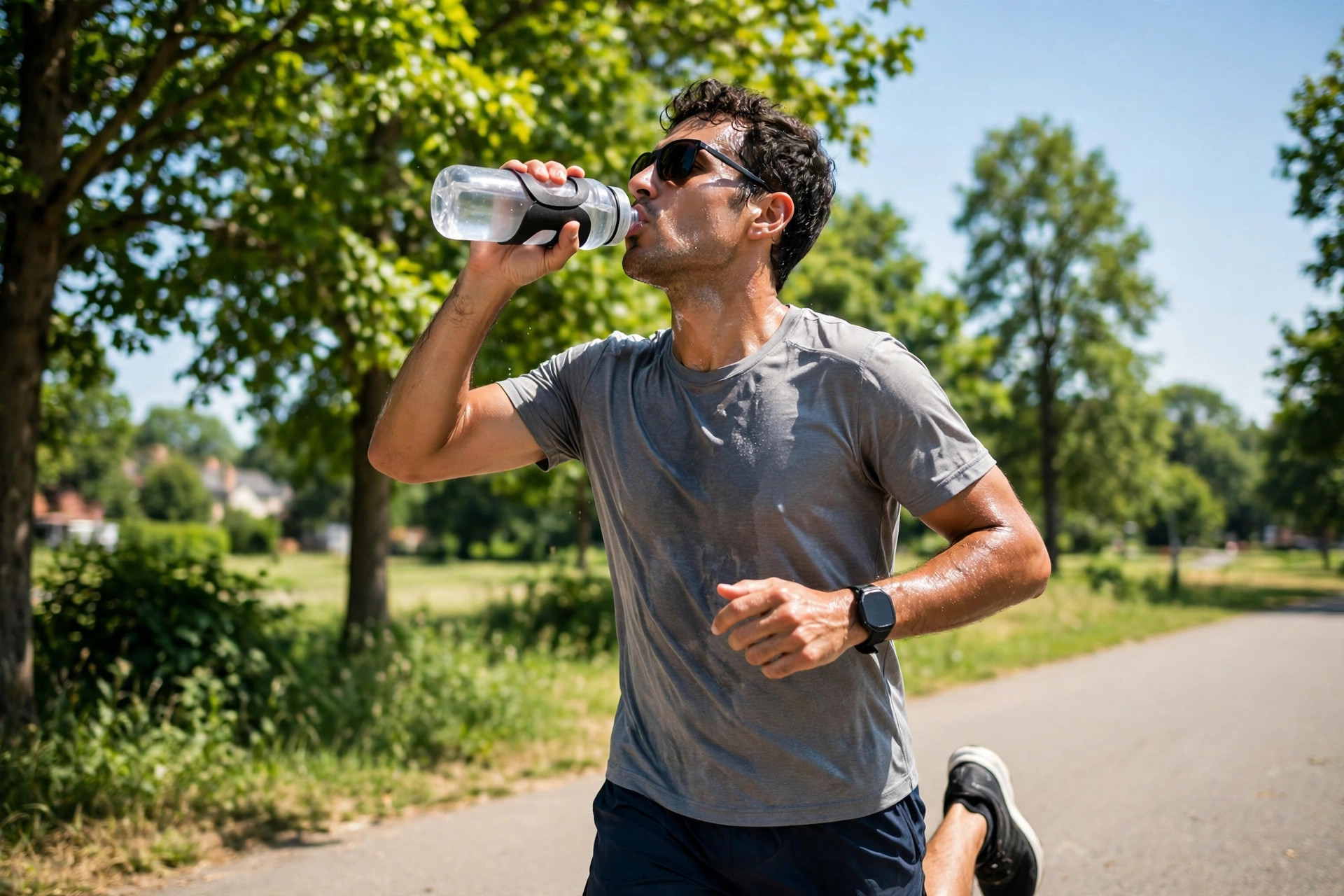
After the run, drink steadily rather than flooding your stomach, and eat something salty with your next meal. Weighing yourself before and after long runs a few times teaches you your personal sweat rate better than any formula.
Clothing, Gear and the Data on Your Wrist
Light colors, loose fits and breathable fabrics are the whole wardrobe strategy. A visor shades your face without trapping heat the way a cap can, and sunscreen protects the skin your cooling system depends on. Your watch helps if you read the right fields. Heart rate is the honest number in the heat; pace is the vanity number. Our Garmin heart rate monitor review covers the watches and straps that hold up in sweat and summer rain, and why chest straps read more reliably than wrist sensors when your skin is soaked. Set your workout targets by zone or effort before you leave, and let the pace be whatever the day allows. Chasing a cool-weather pace number in July is the fastest route to a blown workout.
Heat Safety: Warning Signs to Respect
Heat illness is the one running problem that escalates fast, so learn the ladder. Heavy sweating, unusual fatigue and a headache are early notes to slow down and cool off. Nausea, dizziness, chills or goosebumps in the heat mean the run is over: stop, find shade, and cool down with water on your skin. Confusion, stumbling or stopping sweating altogether are emergencies. Get help immediately. No workout is worth the alternative, and every runner who has pushed through those signs has a story they tell as a warning, not a badge. When in doubt, downgrade the day. An easy run instead of a workout, or a rest day instead of an easy run, costs you almost nothing across a season.
Acclimation: Give It Two Weeks
Your body adapts to heat on a schedule you cannot rush. Over roughly 10 to 14 days of regular hot runs, blood plasma volume rises, sweating starts earlier and works better, and the same run costs measurably less. Build into it: keep the first hot week easy and shorter, then restore normal volume in the second week, and only then bring workouts back. Runners who respect that order find that running in heat and humidity in week three feels like a different sport from week one. The same route at the same heart rate gets faster across the two weeks, and the trend graphs in our Garmin heart rate monitor review make the adaptation easy to see. Acclimation fades after a week or two away from the heat, so a cool vacation in July means rebuilding when you return.
Frequently Asked Questions
What dewpoint is too high to run in?
There is no single cutoff, but most runners find dewpoints above 70 genuinely oppressive and above 75 a reason to keep runs short and easy. Fitness, acclimation and sun exposure all shift your personal line. When in doubt, run by effort, shorten the plan, and never do hard workouts at the top of the chart.
How much slower should I run in the heat?
Use the dewpoint chart as your starting point: a few percent at a dewpoint of 60, roughly 5 to 7 percent near 70, and 10 percent or more above that. Running by heart rate or perceived effort gets you to the same place automatically, which is why most summer training works better by effort.
Is running in heat and humidity good training?
Yes, within limits. Heat training raises blood plasma volume and improves your cooling response, and those adaptations can carry over to cool-weather performance. The gains come from consistent, mostly easy exposure over two weeks, not from one heroic sufferfest. Respect the warning signs and the heat becomes a training tool instead of a hazard.
How long does heat acclimation take?
About 10 to 14 days of regular running in the heat. Plasma volume expands in the first week, sweating becomes earlier and more efficient in the second, and most runners feel a clear difference by the end of week two. Keep the first week easy and short, then rebuild volume before restoring workouts.
Should I drink water or sports drinks on hot runs?
Water covers most runs under an hour. Beyond that, or on very sweaty days, add electrolytes, especially sodium, through a sports drink or salty food before and after. Drink to thirst rather than forcing a schedule, and replace the salt that plain water leaves behind.
Final Thoughts
Running in heat and humidity will never feel like April, and it is not supposed to. Check the dewpoint, slow down by the chart, run early, drink with salt, and give your body two weeks to adapt. Do that, and summer stops being the season your training survives and becomes the season that sets up your fall.

5 Tips for Couch to 10k

Why I Wear a HR Monitor: Garmin Heart Rate Monitor Review