
Exploding Kittens House Rules and Variations That Keep Games Fresh9 min read
Exploding Kittens is already chaotic, but after a dozen games the same Defuse standoffs start to feel familiar. That is exactly when exploding kittens house rules earn their place: small, agreed tweaks that change the pressure of a game without changing the game you love.
The trick is restraint. One or two well-chosen rules sharpen the tension; a stack of them turns a fifteen-minute party game into an argument with cards.
This guide collects the variations groups keep coming back to, plus notes on who each one suits. Still deciding whether the game belongs on your shelf? Our full Exploding Kittens review covers how the base game plays and who it suits. If you already own it and it has gone a little stale, read on.
Our top picks, compared:
Quick Recap: The Standard Exploding Kittens Rules
House rules only work when everyone agrees on the official baseline first. Players take turns, and a turn ends by drawing a card. Draw an Exploding Kitten and you explode and are out, unless you play a Defuse to save yourself. A defused kitten goes back into the deck wherever you secretly choose, which is where most of the mind games live. The deck holds one fewer kitten than there are players, so exactly one person survives: the last player who has not exploded wins. Action cards bend the odds. An Attack card ends your turn without drawing and forces the next player to take two turns. A Nope card cancels most action cards. Playing two matching cards lets you steal a random card from another player. Everything below builds on those rules rather than replacing them.
Exploding Kittens House Rules at a Glance
Here are the five variations on one table. Pick by group, not by novelty.
| House Rule / Variation | What Changes | Best For |
|---|---|---|
| The Defuse Auction | A player who draws a kitten with no Defuse can offer cards from their hand; another player may spend a Defuse to save them and take the offered cards | Groups who love negotiation and table talk |
| Pair Steals, Expanded | Matching pairs can be slapped down at any time, not just on your turn, to steal a random card from any player | Fast, reactive groups who like interruptions |
| Attack Stack Cap | Stacked Attack cards stop at a set limit, usually four turns maximum, instead of growing without end | Ending marathon turns that stall the game |
| Beginner Peek Mode | One fewer kitten than standard, and new players may peek at the top card before drawing in their first rounds | Teaching kids and first-time players |
| Zombie Deck, Bottom Draw | Eliminated players keep a small hand, draw from the bottom, and return to the game if they draw a Defuse | Larger groups where nobody wants to sit out |
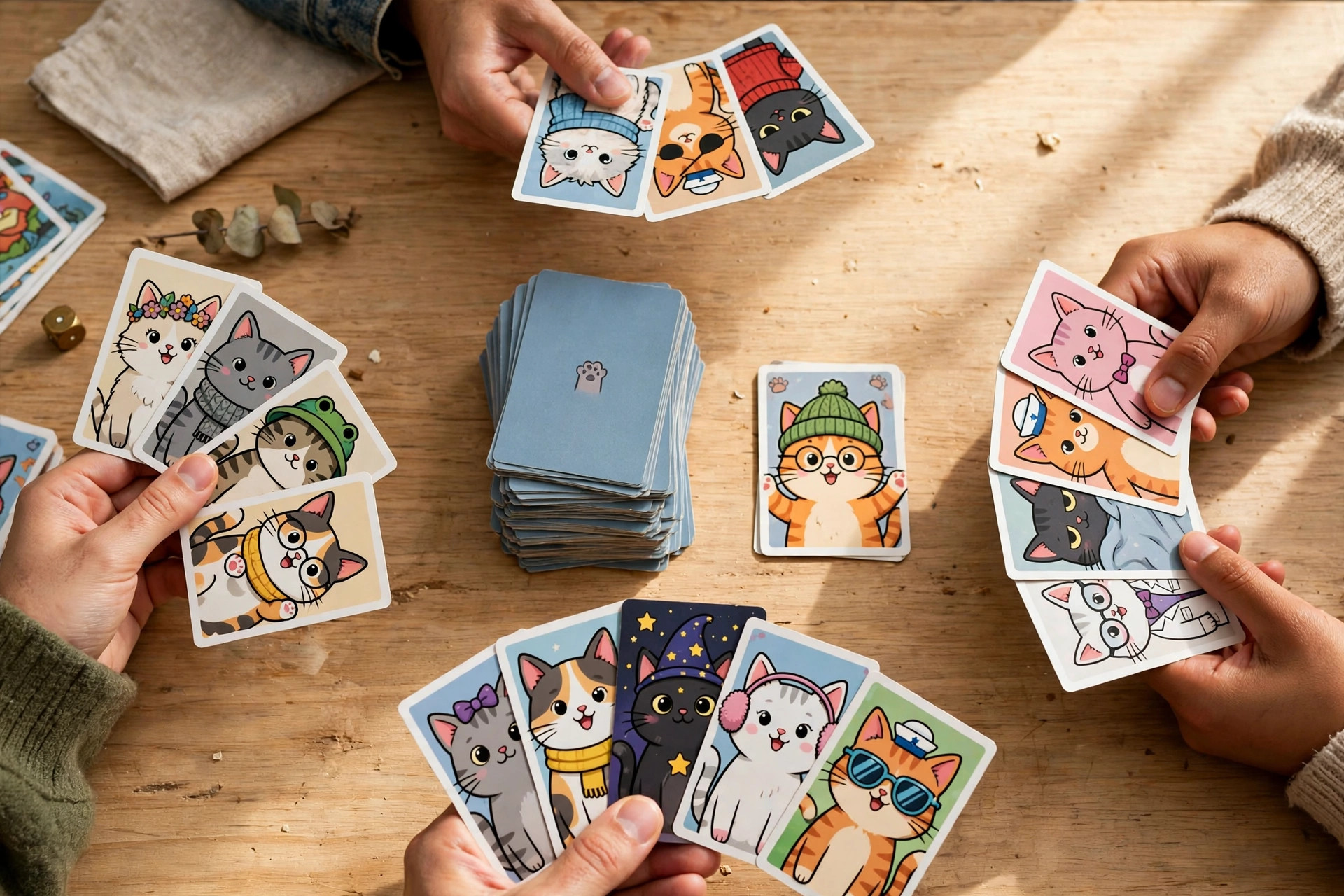
House Rule 1: The Defuse Auction
Nothing deflates a game faster than a player exploding in the first five minutes and watching everyone else finish. The Defuse Auction fixes that with a market. When a player draws a kitten and has no Defuse, they may offer any cards from their hand, face down or face up by group agreement. Anyone holding a Defuse can accept the trade: they play the Defuse, save the exploding player, and take the offered cards. Suddenly a Defuse is worth more than survival. It is currency. Players hoard Defuses to buy hands off desperate opponents, and the kitten placement after an auctioned save still belongs to the saved player, so the drama never fully leaves the table. Set one limit before you start: a player can only be auction-saved once per game. Without that cap, a card-rich player becomes effectively immortal and the tension leaks away.
House Rule 2: Pair Steals, Expanded
In the standard game, playing a matching pair on your turn steals a random card from another player. The expanded version borrows the energy of slap games: a pair can be slapped down at any moment, even during someone else’s turn, and the steal resolves immediately. This changes hand management completely. Holding a pair becomes a risk, because someone may notice the matching card you just drew and react first. Turns get louder, hands get played faster, and quiet players suddenly watch every draw. One safeguard: a slapped pair cannot interrupt a kitten draw already being resolved.
House Rule 3: Cap the Attack Stack
Attack cards stack in the standard game, so a run of bad luck can hand one player six or eight forced turns in a row. That is funny exactly once. The cap rule sets a ceiling, usually four turns, and any Attack played beyond the cap simply adds nothing. The cap keeps the Attack card meaningful without letting it become a turn-deletion machine. Players still fear a double Attack, but nobody spends ten minutes as a spectator to their own turn. Prefer a softer fix? Cap the stack at two turns instead. Either way, agree the number before the first shuffle.
Beginner Mode: Fewer Kittens, Gentler Landings
Exploding Kittens is often a first card game, and the standard setup can feel harsh when a new player explodes twice in ten minutes. Beginner mode softens two dials at once. First, shuffle in one fewer Exploding Kitten than the standard count, so early explosions are rarer. Second, during their first two rounds, new players may peek at the top card before deciding how to end their turn. The peek is training wheels, not a permanent rule. It teaches new players what the deck contains and why cards like See the Future matter. Once a beginner has survived a full game, retire the peek and restore the missing kitten. Most groups find one beginner-mode game is enough.
Exploding Kittens Variations for Repeat Players
Once your group knows every card, freshness comes from changing the game’s shape rather than its rules. These exploding kittens variations layer well on the house rules above. Zombie Deck is the crowd favourite for bigger groups. An exploded player becomes a zombie with a two-card hand who draws from the bottom of the deck on their turn. Draw a Defuse as a zombie and you claw back into the living game. It keeps five- and six-player tables involved to the end. Bottom Draw nights flip the deck entirely: everyone draws from the bottom. Cards that peek at or rearrange the top of the deck lose their power, kitten placement becomes guesswork, and experienced players lose their favourite tricks in one move.
Adding Exploding Kittens Expansions to the Mix
Expansions slot into all of this cleanly. Our Streaking Kittens review explains how that expansion’s hold-a-kitten mechanic changes the bluffing game, and it pairs especially well with the Defuse Auction.
How to Make Exploding Kittens More Fun Without Breaking It
Most failed house rules share one flaw: they remove consequences. If nobody can really explode, the deck stops being scary and the game stops working. When you judge how to make exploding kittens more fun for your group, keep the kitten lethal and change everything around it. Add one rule per session, not three. Play a full game with it, then vote on whether it stays. Rules that survive a vote become your group’s permanent exploding kittens house rules, and new players learn them as simply “how we play.” Write them down, too: a note on your phone saves the recap debate at the start of every game night.
Frequently Asked Questions
What are the best exploding kittens house rules for beginners?
Start with Beginner Peek Mode: one fewer kitten in the deck and a peek at the top card for new players during their first rounds. Add the Attack Stack Cap next if turns drag. Save auctions and slap steals until the group knows the standard game well.
Can you play Exploding Kittens with 6 or more players?
The base game is built for 2 to 5 players, with one fewer kitten than players shuffled in. For 6 or more, combine two decks or add an expansion so the kitten count and hand sizes still work. The Zombie Deck variation also helps, because eliminated players stay involved.
What happens if you draw an Exploding Kitten and have no Defuse?
You explode and are out. Your cards leave play with you, and that kitten is removed rather than returned to the deck. The game continues until only one player has not exploded. The Defuse Auction exists precisely to soften this moment for groups who dislike early eliminations.
Can a Nope card stop a Defuse or an Exploding Kitten?
No. A Nope cancels action cards such as Attack, Skip, Shuffle and Favor, and another Nope can cancel that Nope. It cannot cancel a Defuse, and it cannot stop an Exploding Kitten from exploding. Defuses and kittens sit outside the Nope chain, which keeps the endgame tense.
How long does a game of Exploding Kittens usually take?
A standard game takes about 15 minutes. Most exploding kittens house rules add only a few minutes, mainly through negotiation in the Defuse Auction and extra steals from expanded pairs. If your games regularly pass half an hour, the Attack Stack Cap and a strict one-save auction limit bring them back in line.
Final Thoughts
The base game is a tight little engine: draw, sweat, defuse, repeat. The right exploding kittens house rules do not rebuild that engine; they tune it for your table, whether that means rescuing early casualties, capping Attack stacks, or keeping zombies in the game. Comparing editions before a game night? Our Exploding Kittens review covers which version and expansions suit your group. Then pick one rule from this page, shuffle up, and see if it survives the vote.

Yea or Nay? A Streaking Kittens Review & Should You Buy the Game?

Yea or Nay? An Imploding Kittens Review & Should You Buy the Game?
