How to Choose a Soccer Ball Size by Age: Size 1 to 5 Chart9 min read
Soccer balls come in five sizes, and the difference between them is not cosmetic. Hand a seven-year-old an adult size 5 and every kick becomes a heave; hand a teenager a size 3 and they learn to strike a ball that behaves nothing like the real thing. Getting soccer ball size by age right is the cheapest skill upgrade in youth soccer.
The system is simpler than it looks. Leagues around the world assign each age group a ball size, the sizes step up gradually through childhood, and by the early teens every player is on the same size 5 ball adults use. This guide lays out the full chart, then explains what each size is actually for.
Once the ball is sorted, match it with a goal the same player can realistically score on. Our roundup of the best portable soccer nets and goals lists the goal sizes that pair sensibly with each age group and ball.
Soccer Ball Size by Age Chart
Here is the complete chart in one place. Circumference is the measurement printed on most ball packaging, and it is the number to check if a listing only gives you a size range.
| Ball Size | Circumference | Age Group | Use |
|---|---|---|---|
| Size 1 | About 18 to 20 in | All ages (mini) | Skills and trick training, souvenirs, fun |
| Size 2 | About 20 to 21 in | Ages 3 to 5 | Starter ball for toddlers and preschoolers |
| Size 3 | About 23 to 24 in | Ages 5 to 8 | First match ball, youth leagues under 8 |
| Size 4 | About 25 to 26.5 in | Ages 8 to 12 | Youth match and training ball |
| Size 5 | About 27 to 28 in | Ages 13 and up, adults | Official match ball at every senior level |
Weight climbs with size, too. A size 3 weighs noticeably less than a size 5, which is the real reason behind the whole system: young legs and growing joints should not be striking a heavy adult ball hundreds of times a week.
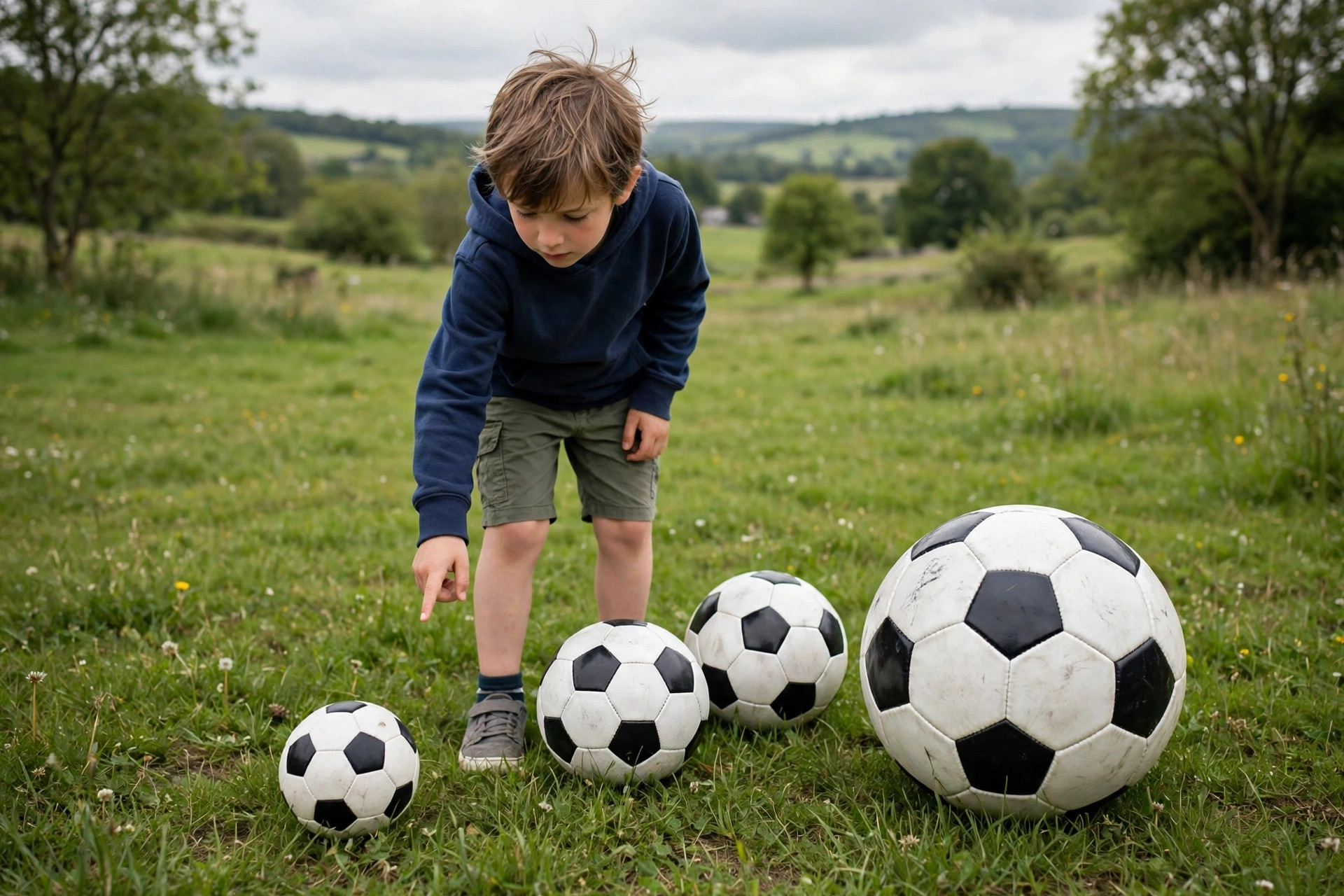
Why Ball Size Matters for Young Players
Technique is built on repetition, and the wrong size ball teaches the wrong technique. A ball that is too big and heavy for a child turns a proper instep strike into a toe-poke swing of the whole leg, because that is the only way they can move it. Coaches then spend months un-teaching the habit. The right size lets a young player use the same mechanics an adult uses: ankle locked, strike through the middle of the ball, follow through toward the target. It also makes juggling, dribbling, and first touch learnable, since the ball responds the way a ball should at their strength level. There is a safety angle as well. Heading and blocking shots with an adult-weight ball is a poor idea for small players, and most youth leagues set their size rules with exactly that in mind.
Size 1 and Size 2: Mini and Starter Balls
Size 1 balls are mini balls, about 18 to 20 inches around. Nobody plays a match with one. They exist for skills training, freestyle tricks, and fun; advanced players use them to sharpen touch because a small ball punishes sloppy control. They also make popular gifts and souvenir balls. Size 2 is the true starter ball, sized for children roughly three to five years old. At about 20 to 21 inches in circumference it is light enough for a preschooler to kick without strain and small enough to dribble without tripping over it. For this age group the ball is mostly a toy that builds familiarity. Short, playful sessions matter more than drills, and a size 2 that a child can actually move is what keeps them coming back to it.
Size 3: The First Real Match Ball
Size 3, about 23 to 24 inches in circumference, is the official match ball for the youngest league age groups, generally players eight and under, and it suits most children from about five to eight years old. This is where real technique starts. A size 3 is big enough to strike, pass, and receive properly, but light enough that a six-year-old can lift it off the ground with a correct kicking motion rather than a scoop. If your child plays in an organised league, check the league’s rule sheet before buying, because the size 3 versus size 4 boundary is the one leagues set slightly differently. Most follow the under-8 line in the chart above.
Size 4: The In-Between Ball
Size 4, roughly 25 to 26.5 inches around, is the youth ball for players about eight to twelve years old. It is the ball of elementary and middle school soccer, and the size most children will use for the longest stretch of their playing lives. The step up from size 3 is deliberately modest. A size 4 feels bigger and flies truer, which rewards better striking technique, but it is still lighter than the adult ball so growing players can shoot and clear it without muscling every kick. Because players spend four or five seasons on a size 4, this is the size where buying a durable training ball pays off. A ball that survives a few school years of recess, practice, and driveway work is the real value pick at this age.
Size 5: The Official Adult Ball
Size 5 is the ball, the official match size for everyone from high school players to the World Cup, at 27 to 28 inches in circumference. Players generally move up to it at about thirteen, and from then on the size never changes again. The jump from size 4 to size 5 is the biggest in the chart, and new teenagers feel it for a few weeks: passes need more weight, shots need a cleaner strike, and controlling a dropping ball takes a softer touch. That adjustment is normal and temporary. If you are setting up a backyard for a teenager, pair the size 5 with a goal worth shooting at; the regulation-minded options in our guide to the best portable soccer nets and goals hold up to full-power size 5 shots far better than toddler goals do.
How to Choose a Soccer Ball Size by Age When Your Child Is Between Sizes
Birthdays do not always line up with league cutoffs, and plenty of children sit right on a boundary. The deciding rule is simple: if your child plays in a league, buy the size the league uses, even if the chart suggests the next one. Training with the match ball is worth more than training with the theoretically perfect ball. For practice-only players, judge by the child rather than the birthday. A small, slight nine-year-old may still strike a size 3 more cleanly, while a big, strong eight-year-old may already handle a size 4 well. Watch a few kicks: if they can strike through the ball with a locked ankle and no whole-body heave, the size is right. When in doubt, size down rather than up. A slightly small ball builds technique; a slightly big one builds bad habits and sore shins. And whatever size you choose, pair it with simple cone work from our roundup of the best sports and soccer cones and control improves faster than with the ball alone.

A Note on Weight, Pressure and Panels
Size is the headline number, but two other details shape how a ball plays. Weight rises with each size, which is why the chart works at all, and inflation matters more than most parents realise: an under-inflated size 4 feels heavier and deader than a properly pumped size 5. Most balls list a recommended pressure on the panel near the valve, usually somewhere around 8.5 to 15.6 PSI depending on size and model. A simple pump with a gauge removes the guesswork, and a squeeze test, firm with slight give under both thumbs, is a decent field check. Panel construction, machine-stitched, thermally bonded, or hand-stitched, affects durability and flight, but for youth players it matters far less than size and pressure. Get those two right first.
Frequently Asked Questions
What size soccer ball does a 7-year-old need?
A seven-year-old needs a size 3 ball, which measures about 23 to 24 inches in circumference. Size 3 is the match standard for players eight and under in most youth leagues, and it is light enough for a child that age to strike with proper technique rather than swinging at it.
What is the difference between a size 4 and size 5 soccer ball?
A size 4 measures about 25 to 26.5 inches in circumference and is lighter, suiting players roughly eight to twelve. A size 5 measures 27 to 28 inches, is the heaviest standard ball, and is the official match size for players thirteen and older, including all adult and professional soccer.
What size soccer ball do adults and professionals use?
Adults and professionals use a size 5 ball, 27 to 28 inches in circumference. It is the only size permitted in senior competition worldwide, from high school and college soccer up to professional leagues and the World Cup. Every player who keeps playing eventually ends up on a size 5.
Can a child practice with a bigger ball than their league size?
It is better not to. A bigger, heavier ball encourages toe-poking and whole-leg swings, and it adds strain that young legs do not need. Practicing with the league ball builds technique that transfers directly to matches. Save the bigger ball for the season your child actually moves up.
How do I measure a soccer ball’s size at home?
Wrap a soft tape measure around the widest part of the fully inflated ball to get its circumference, then match it to the chart: about 23 to 24 inches is a size 3, 25 to 26.5 a size 4, and 27 to 28 a size 5. Most balls also have the size printed near the valve.
Final Thoughts
Soccer ball size by age is one of the few equipment questions in youth sports with a genuinely settled answer: size 2 for the littlest starters, size 3 to about age eight, size 4 through twelve, and size 5 from thirteen on. Match the league first, the child second, and the chart third, and the ball will quietly stop being a problem. That leaves everyone free to argue about the things that actually decide games.

Indoor Soccer Variations for Rainy Days and Gyms

7 Best Portable Soccer Nets and Goals to Buy