How to Set Up a Spikeball Net So It Does Not Sag or Wobble8 min read
A sagging, wobbly net ruins more rallies than bad hands do. The ball dies in the middle, kicks sideways off a loose edge, or bounces twice as high on one side as the other. Most of that is not the net’s fault; it is what happens when nobody in the group knows how to set up a spikeball net properly. The fix is even tension, level legs, and a rim that stays put, and done properly it takes about five minutes. If your kit has seen a few seasons, compare it against our roundup of the best Spikeball sets to see what a firm, modern frame looks like.
Our top picks, compared:
Start With the Parts: Spikeball Net Assembly Basics
Lay everything out before you connect anything. A standard set has five rim pieces, five legs, and the net itself, and spikeball net assembly goes faster when you can see nothing is missing or bent. Check each rim piece for cracks and each leg for a foot that still grips. Work on the flattest ground you can find, and press down where the legs will stand to feel for soft spots.
How to Set Up a Spikeball Net Step by Step
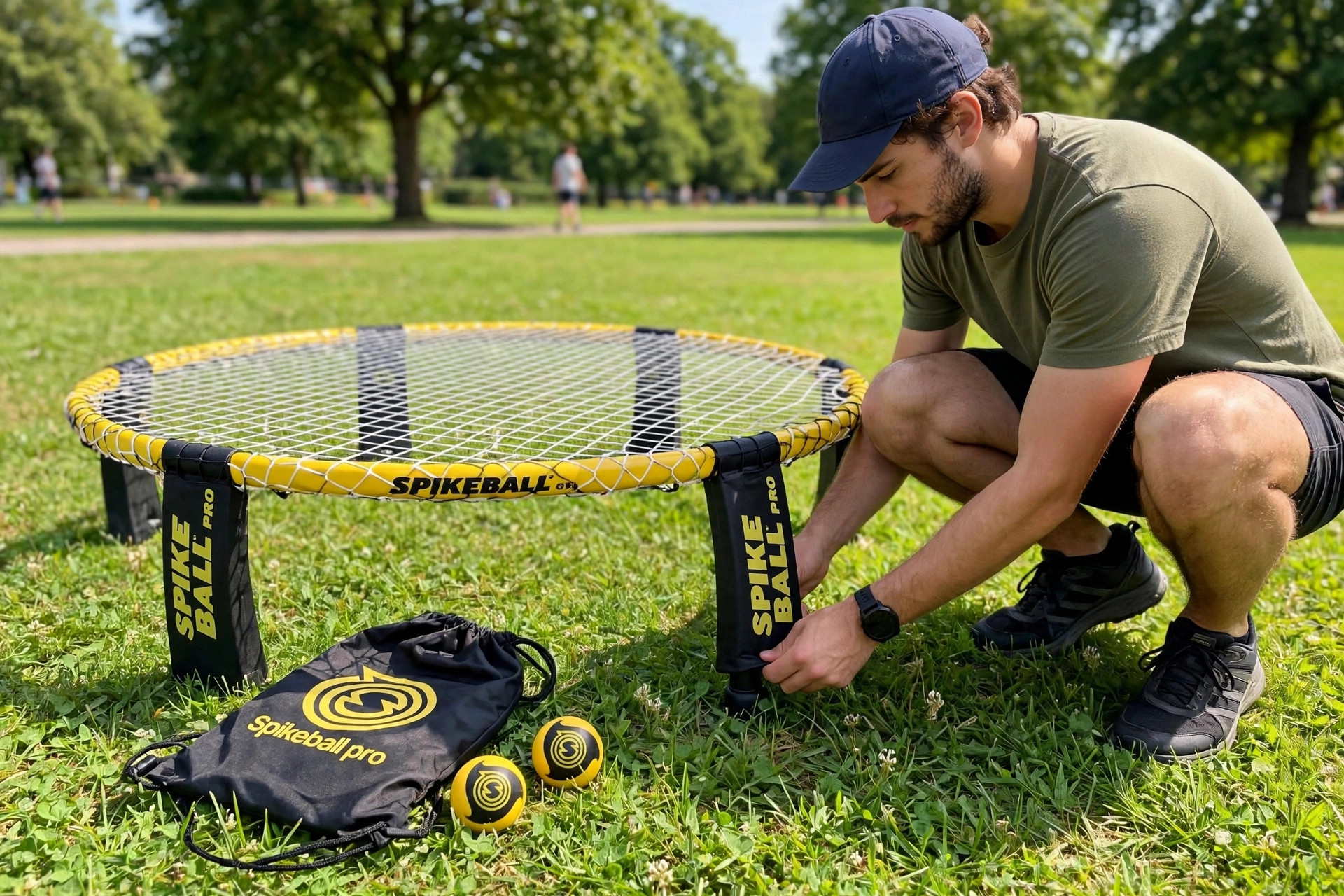
Connect the five rim pieces into a full circle on the ground, pressing each joint until it seats completely. Attach the legs next, one at each rim joint, and give each a small twist to confirm it is locked. Now stretch the net over the rim:
- Hook the net at four opposite points first, at roughly 12, 3, 6, and 9 o’clock, so tension starts balanced.
- Work around the circle in order, hooking each section in sequence.
- Pull each section to the same stretch.
- Finish with a full lap of small adjustments, tugging any section that feels looser than its neighbors.
Skip the opposite-points step and you will chase uneven tension around the rim for the rest of the day.
Dial In the Spikeball Net Tension Evenly
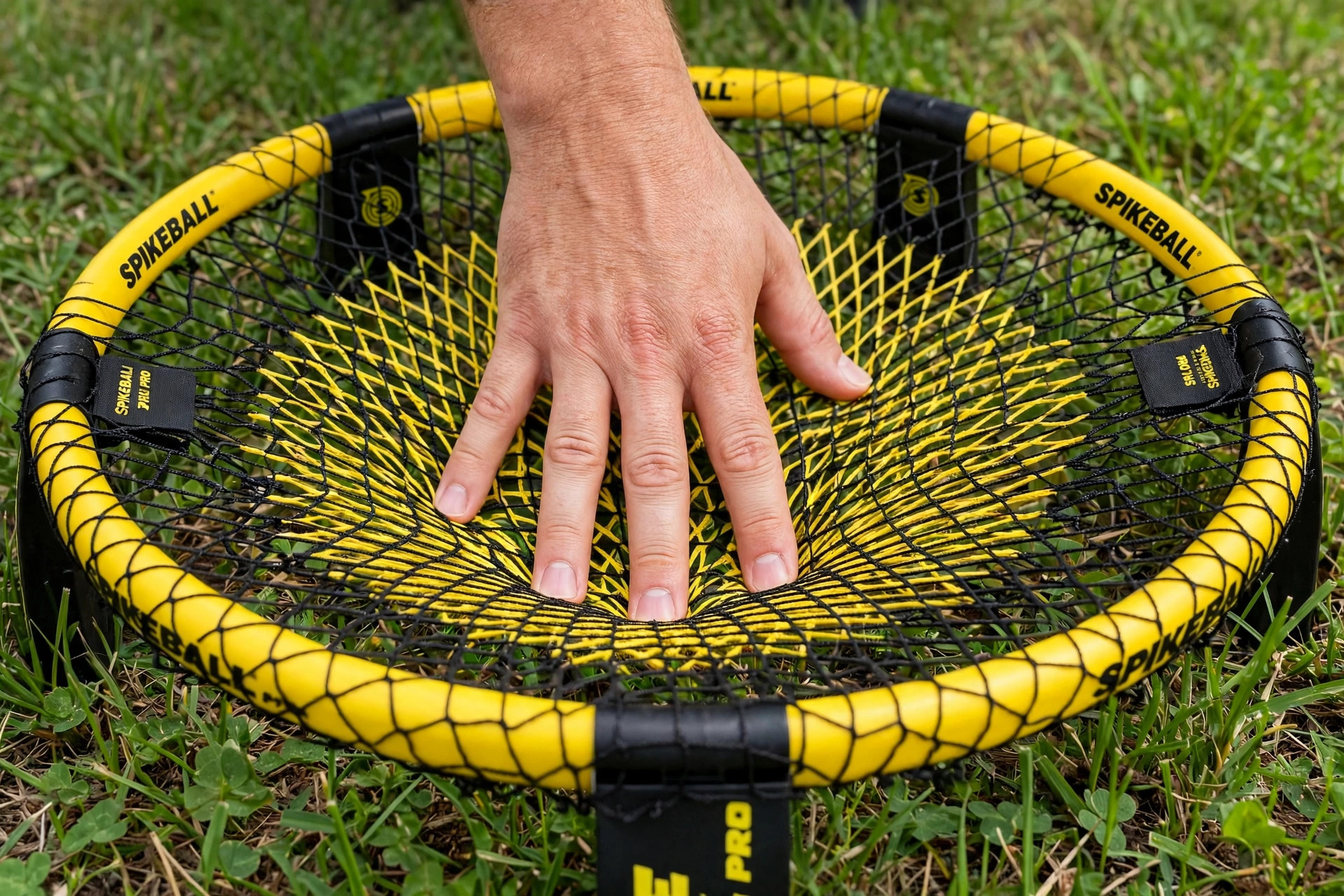
Spikeball net tension should feel like a small trampoline: firm in the center, with a consistent give everywhere else. Press the middle of the net with your palm; it should push back evenly, not sink. Then press halfway between the center and the rim at four or five spots around the circle; each press should feel the same. Avoid the temptation to make the net drum-tight: an over-stretched net plays fast and unforgiving, wears out sooner, and makes serves bounce unpredictably high. Even beats tight, every time.
Level the Legs to Stop Rim Wobble
A perfectly tensioned net still wobbles if the frame rocks. Set the net down and push gently on the rim at a few points; if it tips or clicks against the ground, one leg is effectively shorter than the others. On grass, the usual fix is ground, not hardware: move the short leg a few inches to firmer soil, or press the other legs slightly deeper. On sand, bury each leg to the same depth and pack sand around the feet. On hard courts, check that every rubber foot is present and seated.
The Bounce Test: How Tight Is Tight Enough
Drop the ball from about chest height onto the center of the net. It should bounce back up cleanly, roughly to knee or thigh height, in a straight line. Repeat the drop at four spots near the rim; the bounce height should look the same at each spot. A dead bounce at one edge means loose netting there; a rocket bounce in the middle means the center is over-tensioned. Once the net passes, serves behave predictably too, which is why our Spikeball serving techniques for beginners guide assumes a properly tensioned net.
How to Tighten a Spikeball Net That Keeps Loosening
Work around the rim and give each section a short, even pull, one joint at a time, rather than yanking one spot hard. If the same side keeps loosening, check the rim joint under it: a joint that flexes lets the netting slip a little on every hard spike. Between games, take the net off the rim instead of leaving it stretched in a hot car, because constant tension plus heat permanently stretches netting out.
Troubleshooting: Sag, Wobble and Dead Bounces
When a bounce goes wrong, match the symptom to the cause before you start pulling on things.
| Symptom | Likely Cause | Fix |
|---|---|---|
| Sagging center | Net hooked unevenly, or netting stretched with age | Re-hook at four opposite points and re-tension evenly; replace a permanently stretched net |
| Wobbling rim | One leg on soft ground or not fully seated | Re-seat each leg and level the feet on firmer ground |
| Uneven tension | Sections hooked out of order, one side pulled harder | Take the net off and re-attach in sequence around the circle |
| Net too loose on one side | A rim joint flexing or netting slipping at one joint | Check and re-seat the joint; re-tension that section last |
| Ball bouncing dead | Overall tension too low, or a soft quadrant | Press-test each quadrant and pull the soft sections snug |
Spikeball Setup Tips That Keep the Net Tight Longer
Store the net off the rim so the elastic rests. Keep rim pieces bagged, not loose in a trunk, where grit stops the joints seating fully. Rinse sand and salt off the netting after beach play and let it dry before bagging it. Finally, retire gear honestly: if the rim cracks, the legs no longer lock, or the net stays baggy no matter what you do, the set has done its job. Our roundup of the best Spikeball sets covers the current options, from budget frames to the sturdier tournament-style rims that hold tension best.
Frequently Asked Questions
How long does it take to set up a Spikeball net?
About five minutes once you know the routine. Connect the rim, attach the legs, hook the net at four opposite points, then work around the circle evening out the tension. Add a minute for the bounce test.
How tight should a Spikeball net be?
Firm like a small trampoline, with an even give across the whole surface. A ball dropped from chest height should bounce back to about knee or thigh height, the same at the center and near the rim. If it feels like a drum, it is too tight.
Why does my Spikeball net keep sagging in the middle?
Usually because the net was hooked unevenly, or because the netting has stretched with age and heat. Re-hook it starting at four opposite points and tension it evenly. If a fully re-tensioned net still sags, the netting itself is worn out.
Can you set up a Spikeball net on sand or uneven ground?
Yes, with small adjustments. On sand, bury the legs to equal depth and pack sand around the feet. On uneven grass, move short legs to firmer soil or press the longer legs deeper until all five share the load. Always finish with the bounce test.
How do you stop a Spikeball net from wobbling?
Wobble is almost always a leg problem, not a net problem. Make sure every leg is pushed fully onto the rim and locked, every rubber foot is present, and all five feet stand on ground of equal firmness.
Final Thoughts
Even tension, level legs, and a rim with every joint fully seated: that is the whole secret. Learn how to set up a spikeball net with the opposite-points method, verify it with the bounce test, and the net stops being part of the game. Setup becomes a five-minute routine your group barely notices.

5 Differences between Spikeball vs. Slammo

Spikeball for PE Teachers and Youth Groups: Large-Group Variations