Jump Rope Workouts for Busy Parents: 10-Minute Sessions9 min read
Ten minutes is not a consolation workout. Programmed well, ten minutes of rope work gets your heart rate up, practises real footwork, and ends before the window you carved out closes again. I’d rather see a parent do three honest ten-minute sessions a week than plan one long session that never survives the family calendar.
You need a rope that fits you, a flat patch of floor or driveway, and a session picked before you start, which is why the three templates below are written out minute by minute. If you are still choosing a rope, start with the full range of jump rope styles and pick for your surface first.
At a Glance: The Three 10-Minute Sessions
| Session | Best for | Format inside the 10 minutes | Impact |
|---|---|---|---|
| Steady Bounce Intervals | Beginners and returners | 30 seconds jumping, 30 seconds rest, repeated | Moderate, controlled |
| EMOM Mixed Footwork | Confident basic bounce | A new move at the start of every minute | Moderate to high |
| Quiet Low-Impact Session | Early mornings, thin floors, tired joints | Short rope intervals mixed with no-jump rope turns and marching | Low |
Before You Start: The Two-Minute Warm-Up
I’d program the warm-up inside the ten minutes. Minute one is ankle circles, calf raises, and marching in place. Minute two is rope turns without jumping, stepping over the rope at walking pace. The American Council on Exercise makes the same point in its jump rope workout guidance: warm up first, land softly, and add impact gradually.
Session 1: Steady Bounce Intervals for Beginners
This is the session I’d give almost everyone first. After the warm-up, jump for 30 seconds and rest for 30 seconds, eight times. That is eight minutes of structured work, and the rest periods are part of it.
Keep the bounce small, low and quick rather than high. If 30 seconds feels too long in week one, cut it to 20 seconds on and 40 seconds off and keep the same eight rounds.
A beaded rope like the Sportbit turns a little slower and gives you clearer feedback on each revolution. A friend of mine jump ropes for boxing training, and boxing gyms build beginners up on short rounds for a reason. Short rounds let you stop while your form is still good.
Session 2: EMOM Mixed Footwork for Busy Parents
EMOM means every minute on the minute. At the start of each minute, do the listed move for 30 to 40 seconds, then rest for whatever is left of that minute.
I’d program it like this. Minutes one and six are basic bounce. Minutes two and seven are boxer step, shifting weight from foot to foot. Minutes three and eight are side to side hops. Minutes four and nine are marching high knees with the rope turning slowly. Minutes five and ten are your choice, basic bounce or the move that felt weakest.
Use this session only once your basic bounce holds together for a full minute without a trip. If a move falls apart, swap it for basic bounce. A faster rope suits this format, and a speed rope like the Redify is the tool for quicker footwork days. It is also the least forgiving option here, so do not learn these moves on one.
Session 3: A Quiet Low-Impact Jump Rope Workout
Sometimes the constraint is not fitness. It is a sleeping household, thin floors, or knees that are not interested in ten minutes of hopping.
Work for 40 seconds and rest for 20 seconds across eight rounds, alternating two moves. The first is a rope turn with a step over instead of a jump, one foot then the other, at a brisk pace. The second is low marching with small hops only if they feel fine, or heel taps if they do not.
A mat softens both sound and landing, and a PVC rope like the BuyJumpRopes licorice rope runs quieter on a mat than a beaded rope, which clicks against hard ground. If noise is still a problem, take the same session outside and keep the low-impact moves.
Form Cues That Keep the Rope Off Your Feet
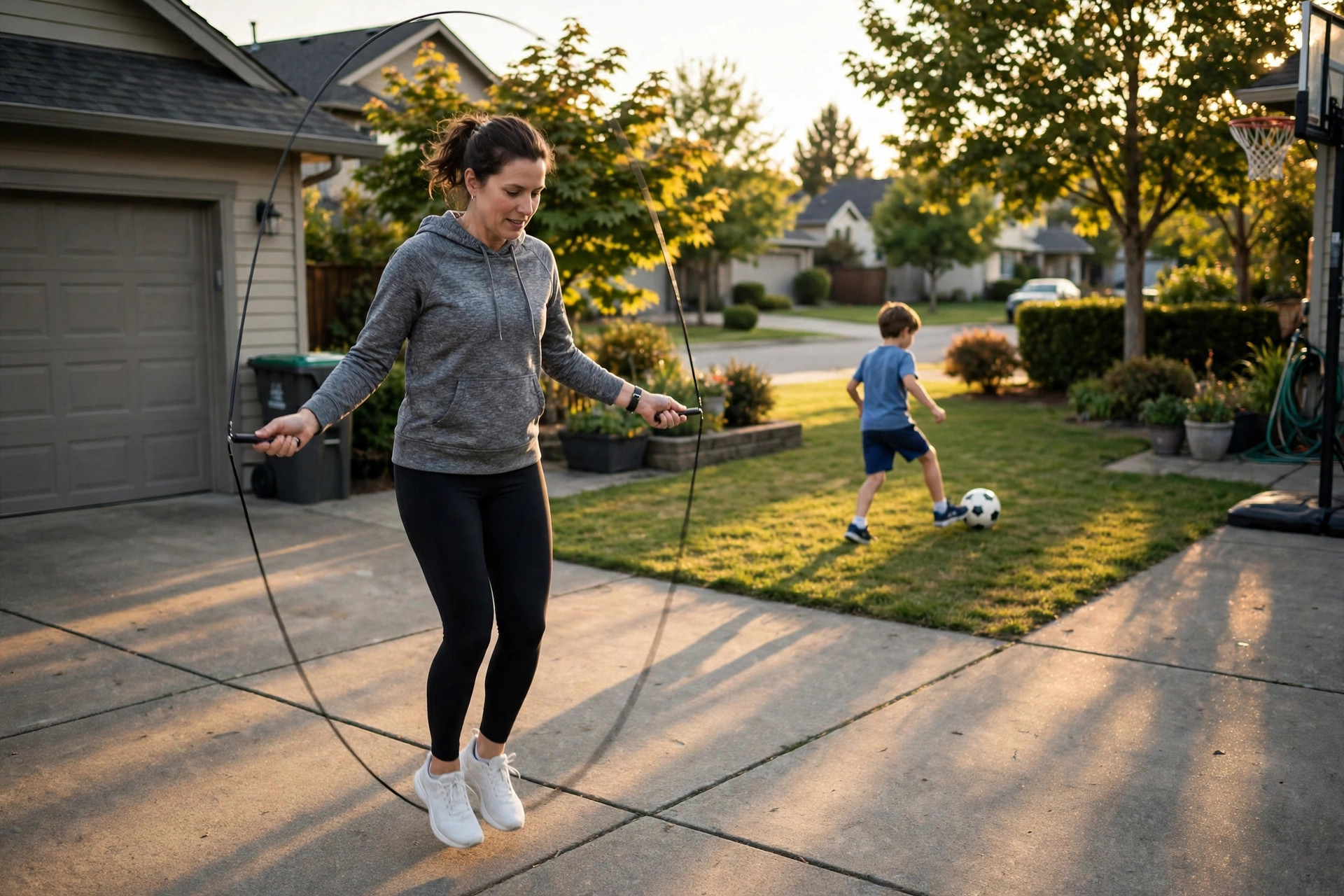
Keep your elbows close to your ribs and turn the rope from your wrists, not your whole arms. Look straight ahead, keep the bounce low, and slow the turn down if the rope keeps clipping the same foot. Our breakdown of why your rope keeps hitting your feet walks through the common causes in order, before you blame the rope and buy another one.
Surfaces, Shoes, and Where to Jump at Home
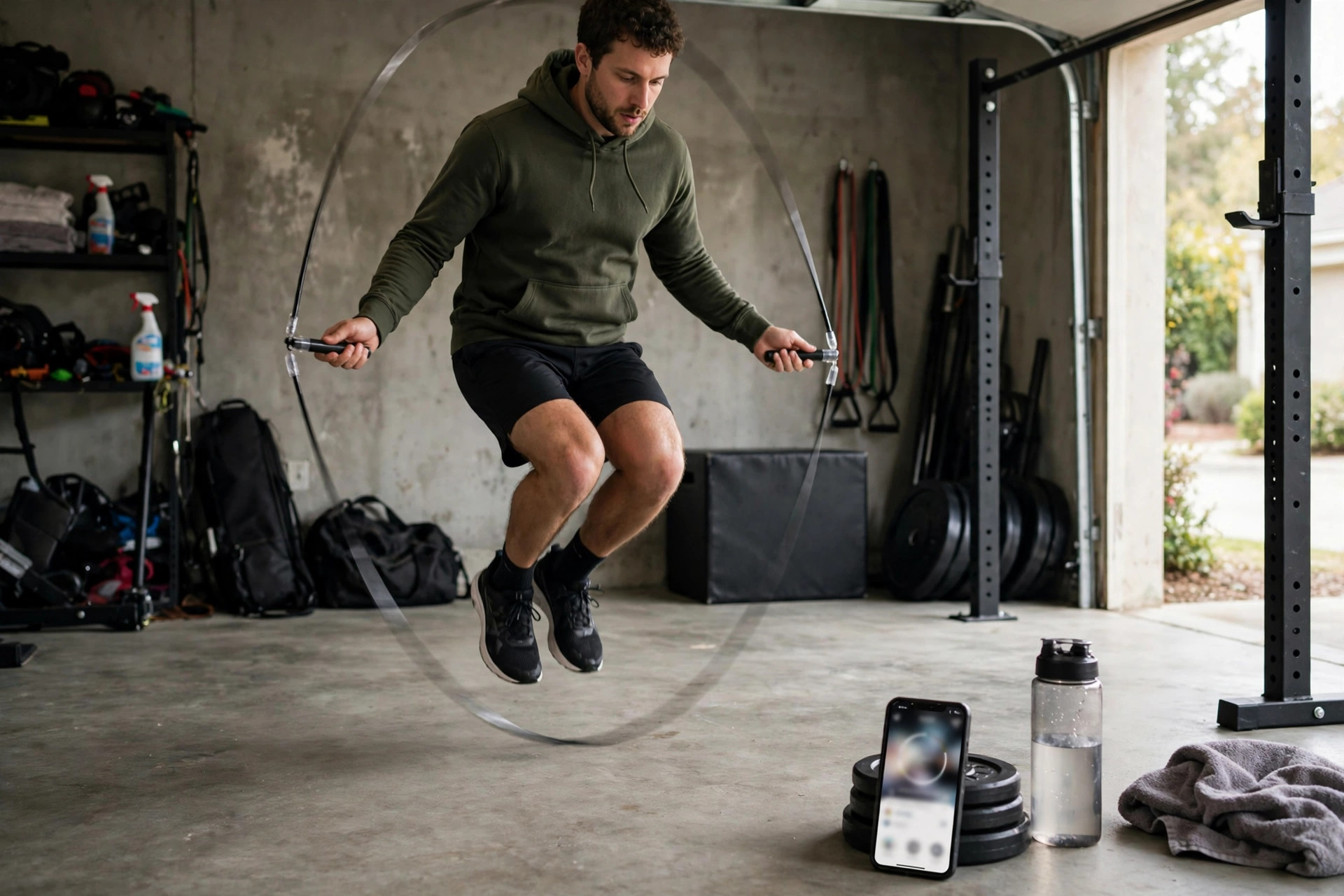
A smooth driveway, a garage floor with a mat, a patio, or a gym floor all work. Rough concrete is hard on lighter ropes and on your joints, which is another reason the second look at jump rope styles is worth it before you commit to one rope for every surface.
Wear trainers with a firm, fairly flat sole and decent cushioning under the forefoot. Skip barefoot jumping on hard floors, and skip tall, soft running shoes that wobble during footwork. Land on the balls of your feet, knees soft. If your joints complain the next day, drop to the low-impact session for a week. ACE notes jumping rope can be hard on the joints, so gradual progression is the sensible default.
A Weekly Schedule That Fits a Parent’s Calendar
Three or four sessions a week is a realistic target. The CDC’s adult activity guidelines put the weekly goal at 150 minutes of moderate activity, or 75 minutes of vigorous activity, or a mix, and activity can be broken into smaller chunks across the week. Ten-minute sessions count when you actually repeat them.
A simple pattern: Monday is Steady Bounce Intervals, Wednesday is the Quiet Low-Impact Session, and Friday or Saturday is EMOM Mixed Footwork once your bounce is reliable, otherwise repeat Session 1. Add a fourth day only when the first three have felt manageable for two weeks.
Anchor each session to something that already happens, like school drop-off or the gap before dinner prep. Vague plans to jump later lose to specific plans. If you are brand new to the rope, spend your first week on the starting skills in our jumping rope for beginners guide and treat these sessions as week two onwards.
How to Scale a Session Up or Down
Scale the work interval first, the moves second, and the total time last. Easier means 20 seconds of jumping with longer rest, or a step-over version of a hopping move. Harder means 45 seconds of work, shorter rest, or one extra round. Do not scale everything at once. Progress you can repeat beats a heroic session you need three days to recover from.
Frequently Asked Questions
how many times a week should I do jump rope workouts
I’d start with three sessions a week on non-consecutive days and add a fourth only after two steady weeks. That spacing gives your calves and joints a day to adapt. Four ten-minute sessions plus your normal walking is a solid base for most busy parents.
is 10 minutes of jump rope a good workout
Yes, if the ten minutes is structured and you are actually working during the work intervals. Short vigorous sessions fit the CDC guidance that weekly activity can be broken into smaller chunks. Ten easy, distracted minutes is different, so use a timer and a written format.
can I do a jump rope workout without waking the kids
Usually, yes, if you pick the low-impact session, jump on a mat, and keep your hops small or swap them for step-overs. A PVC rope on a mat is quieter than a beaded rope on hard flooring. If your floors carry sound badly, a garage or driveway solves more than any technique tip.
what shoes should I wear for jump rope workouts
I’d wear trainers with a firm, fairly flat sole and some cushioning under the forefoot. You want stability for side to side footwork more than a tall, soft heel. I would not learn in bare feet on concrete or in wobbly shoes.
Ten Minutes Counts If You Keep Showing Up
Pick Session 1 for your first week, put three dates on the calendar, and keep the rope somewhere you will see it. The best session here is not the hardest one. It is the one that still fits your life in week four.
Jump Rope 101: Jumping Rope for Beginners

Jump Rope for Runners: A Simple Cross-Training Plan That Fits Marathon Training