
Spikeball for PE Teachers and Youth Groups: Large-Group Variations8 min read
Roundnet was built for four players and one net, which sounds like a problem when you are facing thirty students and a forty-minute period. In practice, spikeball for PE classes works better than most small-sided games, because the net is cheap, the rules teach in five minutes, and every rally keeps all four players moving. The real challenge is logistics: how many sets do you need, how do you organize courts so nobody stands in line, and which variations keep a whole class engaged? This guide answers those questions with the numbers worked out. Start with equipment: our roundup of the best Spikeball sets covers the durable, firm-net models that survive school and camp use.
Our top picks, compared:
Why Spikeball for PE Classes Works So Well
The whole game fits in a small footprint, so six courts fit where one basketball game would go. There is no goalie, no bench, and no position a weak player can hide in, so participation is built into the format. The skill curve is kind: a student who has never played can keep a rally going within ten minutes, because the net does the hard work of redirecting the ball. It also travels: the same sets work on gym floors, grass, and sand, and a class set packs into one bag.
How Many Sets Do You Need? The Group Size Chart
The math is simple: one set serves four players at a time.
| Group Size | Sets Needed | Variation | Notes |
|---|---|---|---|
| 8 students | 2 sets | Standard 2 vs 2 games | Everyone plays every rally; ideal for a first lesson or a small elective group |
| 16 students | 4 sets | 2 vs 2 with winners-stay rotation | Rotate losing teams off every few minutes so matchups stay fresh |
| 24 students | 6 sets | 2 vs 2 courts plus one skills station | The extra station absorbs early finishers and gives beginners extra touches |
| 30+ students | 6-8 sets | Station rotation or 3 vs 3 on some courts | Larger groups rotate through courts in timed blocks; 3 vs 3 keeps more players per net |
You can stretch fewer sets with 3 vs 3 games, which put six players on one net. What does not work is one set for a whole class: lines kill the activity.
Setting Up Courts for a Full Class
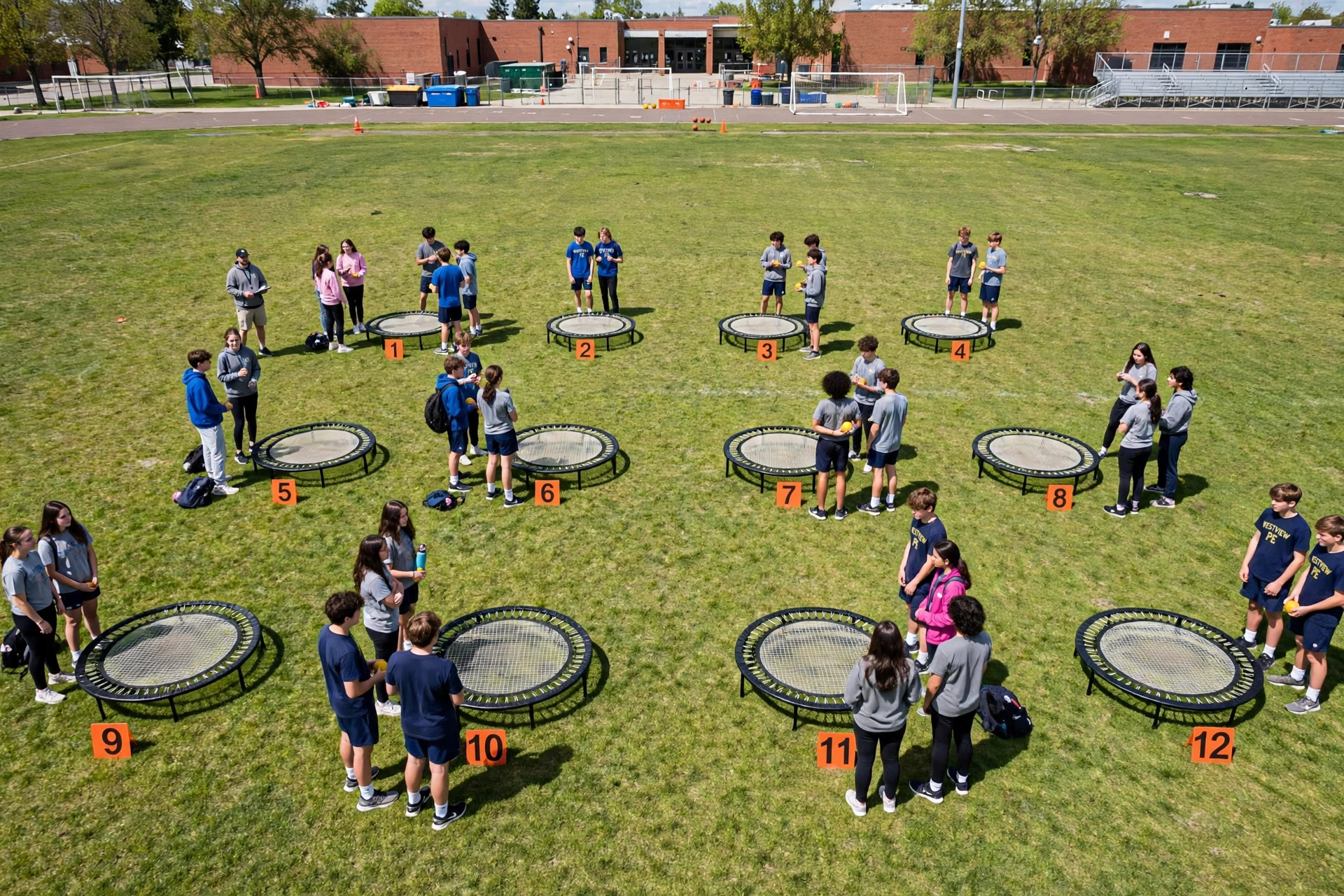
Lay courts out in a grid with at least six feet of buffer between nets, more if your group is young or energetic. On grass or turf, small cones mark each court’s rough boundary and give servers a serving line. In a gym, tape lines do the same job. Give each court a number: numbered courts turn rotation instructions into one sentence, winners move up a court, losers move down. That single habit is the core of spikeball class management.
Teaching the Basics in One Short Demo
Resist the full rules lecture. Five minutes of demo covers everything:
- The rally shape: four players around the net, two per team, possession alternates, up to three touches to return the ball onto the net.
- The serve: hit from behind the serving line, one clean bounce off the net.
- The scoring: rally scoring, games to 11 for class play.
- The big three faults: rim, pocket, and carrying, called honestly and replayed when unclear.
Then let them play. Our guide to Spikeball serving techniques for beginners is a good handout link for students who want to practice a real serve.
Large-Group Variations That Keep Everyone Moving
Winners stay, losers rotate: winning teams hold their court, challengers rotate in; set a win cap, such as three wins in a row, so dominant teams cycle out too.
3 vs 3 big-net games: six players per net, one extra touch allowed per side; perfect for squeezing a large group onto fewer sets.
Around the world: players rotate around the net after every hit; chaotic, loud, and the best warm-up variation.
King’s court ladder: courts are ranked, winners move up toward court one, losers move down, and the period ends with a championship rally on the top court.
Target serving contest: between games, each court runs a two-minute serving challenge.
Rotations: Winners Stay, Round Robin and Station Days
Free rotation (winners stay): best for a single period with mixed motivation; movement is constant and instructions are minimal.
Round robin: best when you want every team to play every other team, such as a two-day class tournament.
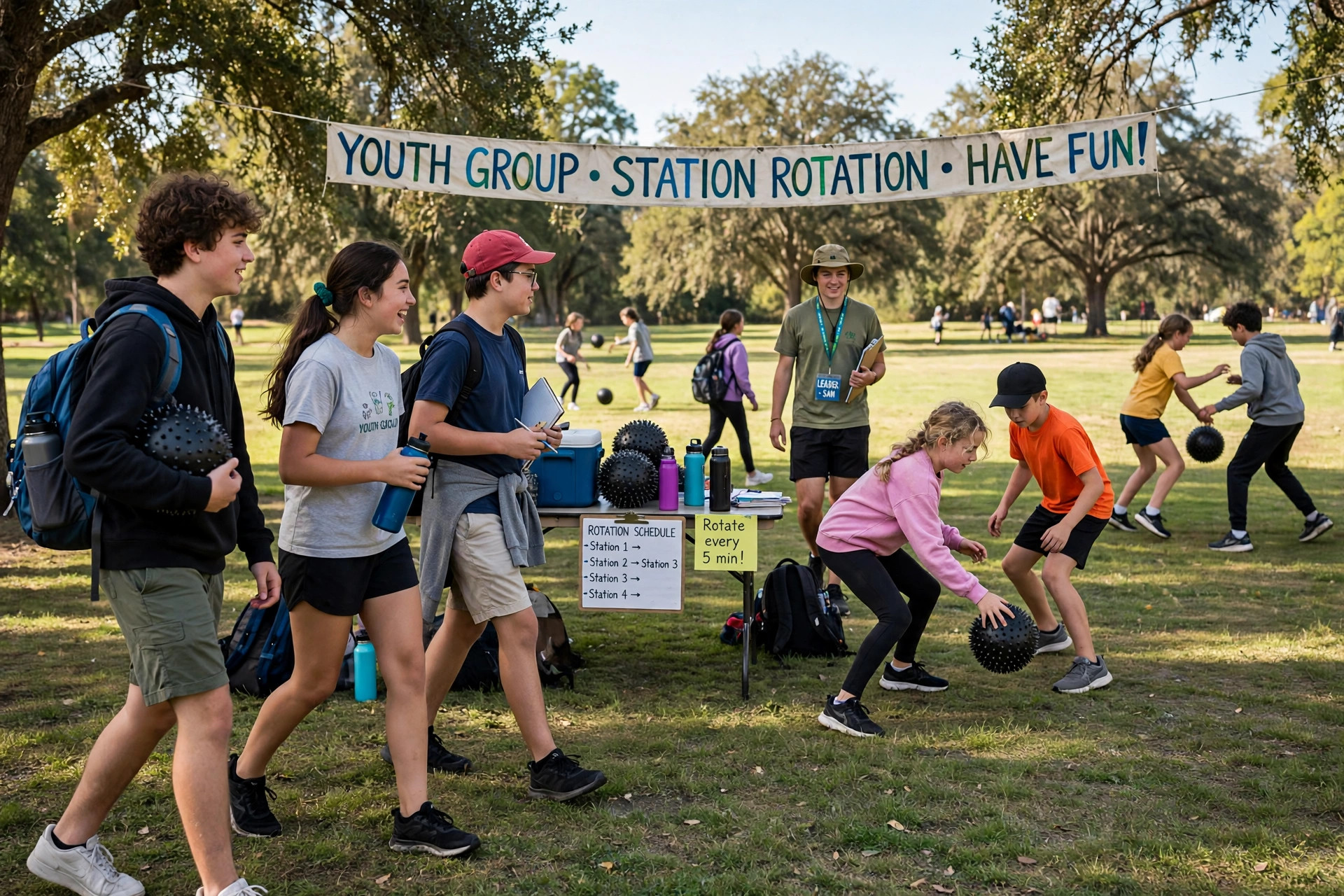
Station rotation: best for the biggest groups; courts become stations in a circuit, some playing games, one running a serving drill, one running a passing drill, in timed blocks of six to eight minutes.
Adapting Spikeball for Youth Groups and Mixed Ages
Youth groups add two wrinkles: a wider age range and no grades to motivate anyone. Pair across ages instead of grouping by them: a confident older player partnered with a younger one balances teams and quietly teaches leadership. For very young players, lower the net tension slightly and allow a bounce before the return. Keep teams fluid: re-drawing partners every fifteen minutes prevents the stacked-team problem. End with a whole-group game: one net, everyone around it, rotating in after each rally.
Safety, Space and Class Management Tips
Teach players to call “mine” early, because most collisions come from two partners diving for the same ball. Keep the area behind each server clear, and retrieve stray balls by walking, not by wandering through a live court. Balls are the main consumable, so buy spares with the sets and store everything in one bag per court. The durable options in our guide to the best Spikeball sets include the firmer rims that survive being stepped on during cleanup. Finally, set the fault culture on day one: players call faults on themselves, disputes replay the point, and the teacher’s ruling ends arguments.
Frequently Asked Questions
How many Spikeball sets do I need for a class of 30?
Plan on six to eight sets. Six sets run 2 vs 2 games for 24 students with a skills station absorbing the rest, while eight sets put nearly everyone on a court. With fewer sets, use 3 vs 3 games to place six players per net, and rotate in timed blocks.
What age is Spikeball appropriate for in PE?
Most students from about age nine up can play a real game, since the net redirects the ball and rallies do not demand much strength. Younger children can join with softer rules, such as a slightly looser net and an allowed bounce before returning the ball.
How long does it take to teach Spikeball to a class?
About five minutes of demonstration covers the rally shape, the serve, rally scoring to 11, and the main faults. Students learn fastest by playing, so get them onto courts quickly and coach during rallies.
Can Spikeball be played indoors in a gym?
Yes. Roundnet works well on gym floors, and the small court footprint means six or more courts fit in a standard gym. Use tape for serving lines and court numbers, and leave extra buffer between courts because balls roll farther on hard floors.
How do I keep games fair with mixed skill levels?
Rotate partners often, use a winners-stay format with a win cap so strong teams cycle out, and pair stronger players with beginners rather than grouping by skill. Short games to 11 also help, because a mismatch ends quickly.
Final Thoughts
Running spikeball for PE classes is mostly a logistics problem, and logistics have answers: four players per set, numbered courts, one of three rotation systems, and variations ready when energy dips. Set the fault culture early, keep the teams fluid, and let the rallies do the teaching.

What is Spikeball: The Rules and How to Play
Spikeball Serving Techniques: 7 Serves Every Beginner Should Learn
