Carrom for Beginners: Setup, Break Shot and Your First Game10 min read
Carrom for beginners starts with one good setup. Get the coins in the right pattern, the board powdered, and everyone seated on the correct side, and your first game teaches itself as it goes. Get the setup wrong, and you spend the evening arguing about where the queen was supposed to be. This guide walks through the whole first session in order: what you need, how the coins are arranged, who shoots first, the break shot, and how a game flows to the last coin. One thing makes all of it easier: a flat board with a smooth, fast finish. If you are still shopping for one, our roundup of the best carrom boards covers the sizes and surface finishes that suit new players learning at home.
Our top picks, compared:
Carrom for Beginners at a Glance: The Setup Checklist
Setup takes about two minutes once you know the pattern. Here is the whole routine, with the slip that catches most new players at each step:
| Setup Step | What to Do | Common Beginner Slip |
|---|---|---|
| Arrange coins | Build the centre pattern: rings of alternating coins around the queen | Scattering coins randomly instead of alternating the colours |
| Place queen | Set the red queen in the very centre of the centre circle | Putting the queen anywhere in the circle instead of dead centre |
| Powder the board | Spread a light, even dusting of carrom powder, then brush off the excess | Dumping on a thick layer that clumps and slows the coins |
| Seat players | Singles sit opposite each other; doubles partners sit opposite too | Sitting next to your doubles partner instead of across from them |
| Break shot | First player flicks the striker from their baseline into the pack | Flicking as hard as possible and scattering coins off the board |
The sections below take each step in turn, then cover how the game itself runs.
What You Need Before Your First Game
A standard set has everything in one box: the board, 19 coins (nine white, nine black, and the red queen), and at least one striker. You also want carrom powder, the fine boric acid based powder that makes the surface glide, and a stand or sturdy table that holds the board level. Check the board before you play. It should sit flat without rocking, and the pockets at the four corners should have their nets attached underneath. A wobbling board ruins more beginner games than bad aim does. Count the coins first: a missing coin changes the pattern.
Carrom Board Setup: Arranging the Coins
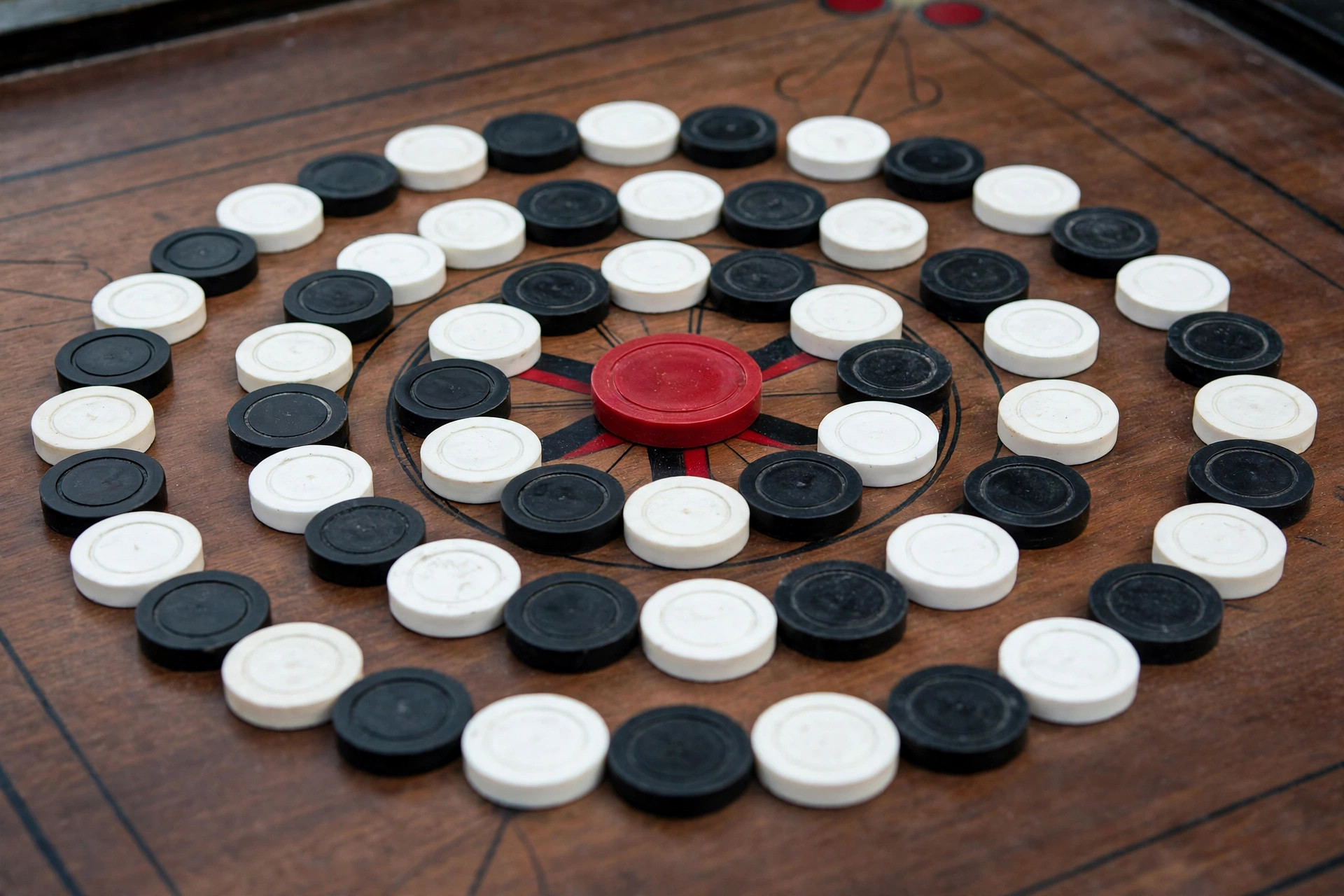
The carrom board setup follows a fixed pattern in the centre circle, and it is the same at kitchen tables and tournaments alike. Start with the queen. She goes in the very centre of the board, inside the small red circle. Around her, place a ring of six coins, alternating white and black all the way around. Around that ring, place the remaining twelve coins, again alternating colours, and turn the whole pattern so that a white coin points along the line toward each player’s baseline.
That pattern matters more than it looks. Alternating colours means the break scatters both sides evenly, and no player starts with a cluster of their own coins gift-wrapped.
Seating, Turns and Who Shoots First
In singles, the two players sit on opposite sides of the board. In doubles, partners also sit opposite each other, so turns rotate around the table and each side defends two baselines between them. You always shoot from your own baseline, the line in front of your seat. The striker is placed on that line, between the two red circles at its ends, and it must not touch the diagonal arrows printed beside them. Your hand may rest on the board; your elbow stays behind the line. Decide who breaks with a coin toss. The winner can choose to break or choose their colour. White always takes the first shot of the game, so if the toss winner picks black, their opponent breaks.
The Carrom Break Shot: Your First Shot of the Game
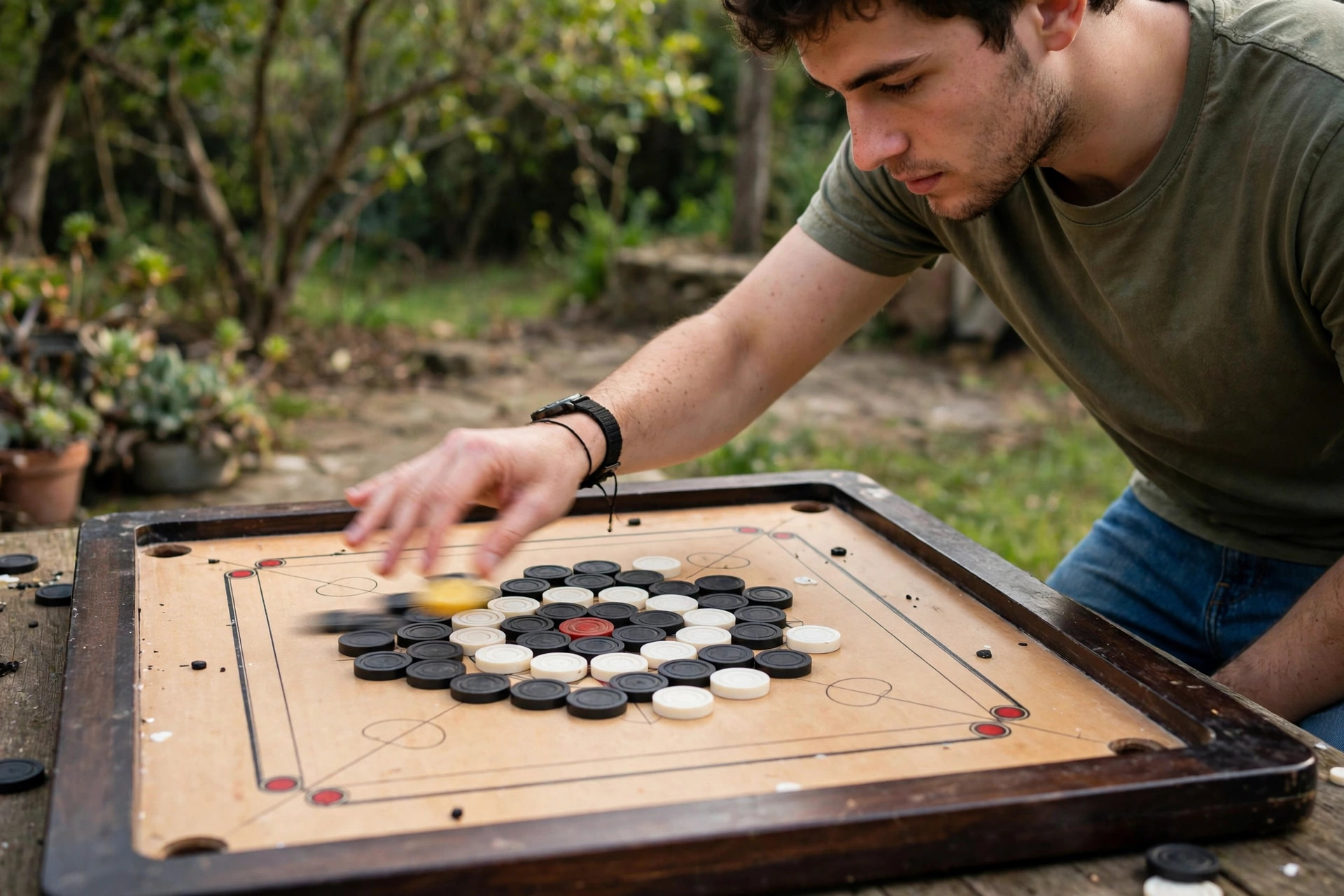
The carrom break shot opens every game. The first player places the striker on their baseline and flicks it into the packed coins in the centre, aiming to scatter the pattern and, with luck, pocket a coin of their colour straight away.
Aim slightly off centre rather than at the middle of the pack. A dead-centre hit often stops the striker in the pile, while a glancing hit on the edge of the pattern spreads the coins toward the pockets. Use a firm, medium flick: power matters less than contact.
If you pocket one of your coins on the break, you shoot again. If the striker does not reach the pack at all, the break is retaken. Either way, the game is now open, and normal turns begin.
How Your First Game Flows
Once the break is done, the rhythm of carrom for beginners is simple. On your turn, flick the striker from your baseline and try to pocket one of your own coins. Pocket one and you shoot again; miss, and the turn passes to the next player. Your colour is yours for the whole game. White pockets only white coins, black only black. Pocketing an opponent’s coin is a wasted shot: the coin stays in the pocket but your turn ends, and in stricter games it counts against you. The queen is the bonus. She sits in the centre until someone pockets her, and she only counts if the player then pockets one of their own coins on the same shot or the very next one, which is called covering her. Fail to cover, and she goes back to the centre. The board ends when one player has pocketed all of their coins, or when only the queen is left and she is settled. For the full official sequence, including scoring across a match, our guide on how to play carrom covers the complete rules once your first games feel comfortable.
Fouls Beginners Need to Know
Three fouls cover most of what goes wrong in a first game. Pocket the striker itself, and one of your already pocketed coins comes back to the centre as a penalty, and your turn ends. Touch a coin with your hand, or move the striker with anything but a flick, and the same kind of penalty applies. Jumping a coin off the board is the third. The coin is placed back in the centre, and play continues. House games often forgive these while everyone learns; just agree on that before you start, not after a foul happens. Pushing the striker is the quiet foul beginners rarely notice in themselves: the striker must be flicked with one finger, never pushed or dragged.
Carrom Beginner Tips: The Slips That Slow Your First Game Down
Most of these carrom beginner tips come down to one idea: slow down. New players flick before they aim, sighting along the striker only after it has already gone. Lower your head, sight the line from striker to coin to pocket, and then shoot. A rough or sticky board causes the rest of the frustration. Coins that stop dead halfway are usually a surface problem, not a skill problem, and a warped board makes every shot unpredictable. If you are buying once and buying right, the boards in our guide to the best carrom boards are the ones that stay flat and fast while you learn. Finally, keep the first games short and friendly: one board, winner breaks next time, and no running score across the evening.
Frequently Asked Questions
How many coins are in a carrom set?
A standard set has 19 coins: nine white, nine black, and one red queen. The queen starts in the very centre of the board, surrounded by two rings of alternating white and black coins. You also need a striker, which is larger and heavier than the coins and is flicked, never pocketed on purpose.
Who breaks first in carrom?
Decide with a coin toss. The winner chooses either to break or to pick their colour, and white always shoots first, so the break and the colour choice are linked. In friendly games, many groups simply let the loser of the last game break the next one.
What happens if I pocket the striker?
That is a foul. One of the coins you have already pocketed is returned to the centre of the board as a penalty, and your turn ends immediately. If you have not pocketed any coins yet, the penalty coin is owed and comes back from your next pocketed coin instead.
Can beginners play carrom with just two players?
Yes. Singles is the standard two-player game, with each player on an opposite side pocketing their own colour. Four players form two doubles teams, with partners sitting opposite each other. Both formats use the same setup, break, and queen rules, so beginners can switch between them freely.
How long does a first carrom game take?
Most first games run about 15 to 30 minutes for a single board, depending on how often turns change hands. Games get quicker as aim improves. If a board is dragging on, groups often agree that the player with fewer coins left on the board wins when time runs out.
Final Thoughts
Carrom for beginners is mostly a setup and a rhythm: queen in the centre, colours alternating, a light dusting of powder, and a break that scatters rather than smashes. Learn that pattern, take your time over each flick, and the rest of the game arrives with practice.

Carrom Board Size Guide: Home, Club and Tournament Boards

Carrom Queen Rules Explained: Covering, Points and Common Disputes