
Running Cadence Drills: Raise Your Turnover Without Forcing It6 min read
If your easy runs feel heavy and plodding, your turnover is a likely suspect. Running cadence drills fix that problem directly: they train your feet to cycle faster in short, focused sessions, so a quicker rhythm starts to feel natural instead of forced.
Cadence is simply your steps per minute count, both feet included. Many recreational runners sit around 160 to 165; a modest rise of 5 to 10 steps per minute usually means shorter, lighter steps, less bouncing, and less braking with every stride. You do not need to chase a magic number; you need drills that nudge your rhythm up gradually.
Our top picks, compared:
What Cadence Is and Why It Matters
Every step either moves you forward or wastes energy. Long, slow strides tend to land ahead of your body, which acts like a brake. Quicker, shorter steps land closer to under your hips, which usually means less vertical bounce, a quieter footstrike, and an easier feel at the same pace. Cadence is also individual: height, leg length, pace, and terrain all shift your natural number, so treat any target as a direction, not a rule.
Find Your Current Cadence First
Measure your baseline on a normal easy run: count one foot’s strikes for 30 seconds and multiply by four. A watch does the counting for you; most Garmin watches report cadence after every run, and our Garmin heart rate monitor review explains why pairing a chest strap with a watch gives cleaner training data overall. Write the number down; your goal over the next few weeks is a rise of roughly 5 percent.
Running Cadence Drills: The Session Plan
Two short drill sessions a week is enough. Slot them after an easy run or inside a warm-up, keep every drill relaxed, and stop the moment your form falls apart.
| Drill | Time | Cadence Target | How |
|---|---|---|---|
| Metronome runs | 4 x 1 minute | Baseline + 5 spm | Run easy while matching your steps to a metronome app set just above your current cadence |
| Quick-feet strides | 6 x 20 seconds | As fast as feels smooth | Short, snappy strides on flat ground, full walk-back recovery between reps |
| Downhill strides | 4 x 20 seconds | Naturally elevated | Gentle slope, let gravity lift your turnover while you stay tall and relaxed |
| Cadence checks each mile | Whole easy run | Baseline + 5 spm | Count steps for 30 seconds at each mile marker and adjust before you drift |
| High-knees / butt kicks | 2 x 30 seconds each | Fast and light | Form drills in place or over 20 metres, emphasising quick ground contact |
Short and frequent beats long and rare: ten focused minutes twice a week will move your rhythm further than one exhausting drill session a month.
Metronome Runs: Let the Beat Set Your Feet
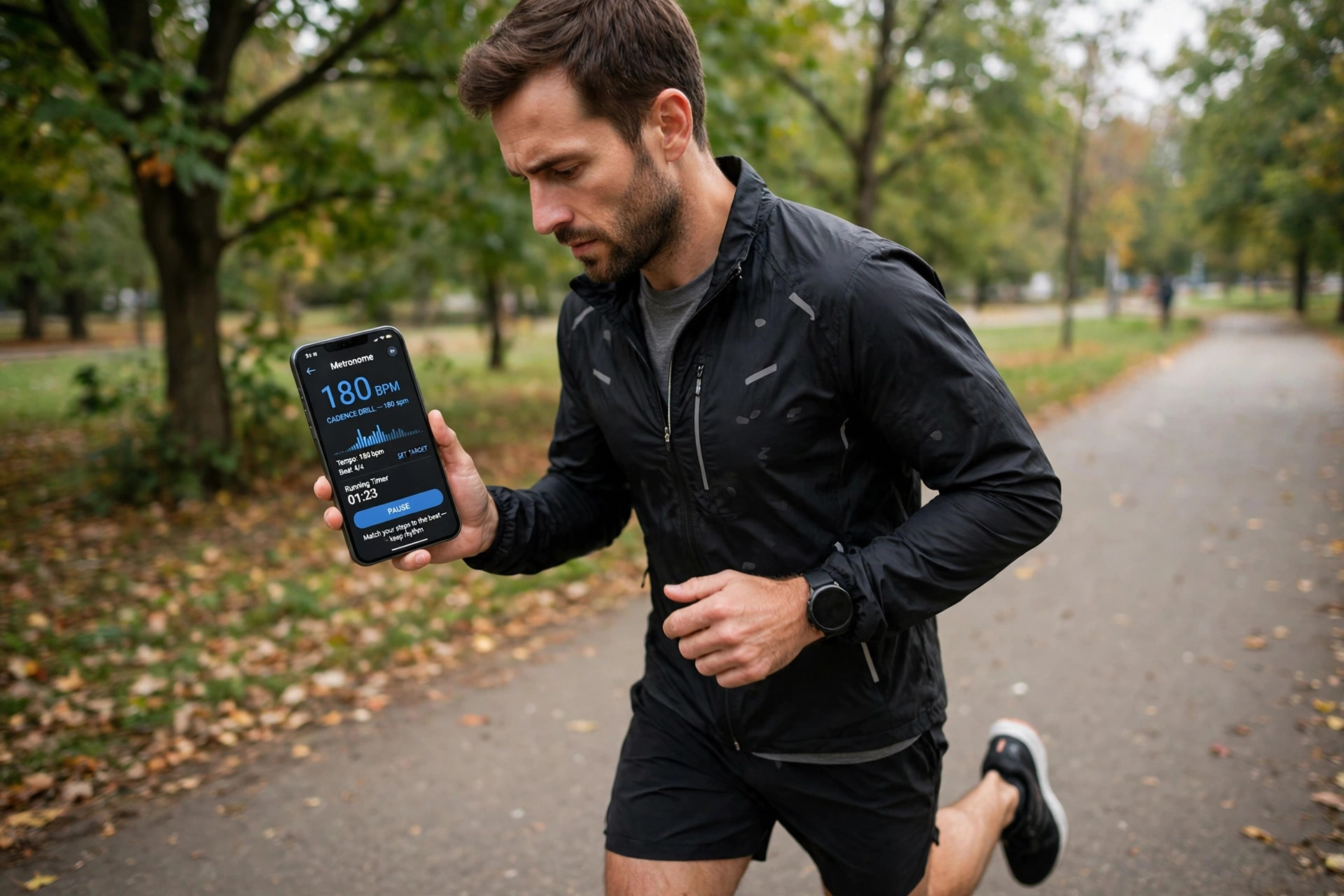
Set a metronome app to your current cadence plus five steps, then run easy for one minute while matching each beep to a footstrike. Walk or jog slowly for a minute, then repeat; four rounds is plenty for the first week. When plus five feels easy for a full session, add another two or three steps the following week. The beat does the thinking for you, and your stride shortens on its own.
Quick-Feet Strides and Downhill Strides
For quick-feet strides, run 20 seconds focusing on the fastest, lightest steps you can manage without sprinting; think of the ground as hot, walk back slowly, and repeat six times. Downhill strides use a gentle slope, around 2 to 3 percent: gravity pulls your legs through faster, so your turnover rises without extra effort. Stay tall, keep your steps short, and never let it turn into an uncontrolled sprint.

Both stride types work best on soft, flat, predictable ground.
Form Drills: High Knees and Butt Kicks
High knees teach your legs to lift and cycle quickly; butt kicks teach fast recovery of the heel after each step. Keep both drills light and bouncy, 30 seconds at a time, with your torso tall and your steps landing under you. Quick and controlled beats fast and sloppy.
Cadence Checks on Every Easy Run
Drills build the skill, but checks make it stick. Once or twice per easy run, count your steps for 30 seconds and compare with your target. The cadence field and post-run graphs in our Garmin heart rate monitor review show how the strap-and-watch setup tracks rhythm alongside heart rate. Cadence work also pairs well with the zone-based easy running in our heart rate training guide, because most cadence gains stick during genuinely easy miles. Expect drift late in a run, and catch it at the final mile marker.
Common Cadence Mistakes to Avoid
Chasing 180 as a rule: the famous 180 figure came from elite racers at race pace; for most runners, a 5 to 10 step rise from their own baseline delivers the benefit.
Forcing it all run long: raising cadence for an entire long run before your legs adapt usually just makes the run harder.
Shortening stride by shuffling: cadence should rise because your legs cycle faster, not because you chop your steps.
Ignoring pace: cadence naturally rises as you run faster, so compare like with like.
Frequently Asked Questions
What is a good running cadence for beginners?
Most beginners land between 155 and 170 steps per minute at an easy pace. Rather than chasing a universal number, aim to raise your own baseline by about 5 percent using running cadence drills, then reassess after a few weeks.
How long do cadence drills take to work?
Most runners feel a difference within two to three weeks of twice-weekly drill sessions. Full habit change usually takes six to eight weeks of consistent short sessions.
Can a higher cadence help my knees?
It can help some runners: a slightly higher cadence usually shortens your stride, so your foot lands closer to your body and each step carries a little less braking force. Persistent knee trouble deserves a proper assessment.
Should my cadence be the same at every pace?
No. Cadence naturally rises as pace increases. Your easy pace, tempo pace, and race pace will each have their own typical number; track each one separately.
Do I need a watch to do cadence drills?
No. A free metronome app and a 30-second count of one foot’s steps, multiplied by four, give you everything you need to start. A running watch simply automates the counting and stores your history.
Final Thoughts
Running cadence drills work because they are small, specific, and repeatable. Measure your baseline, add a metronome session and some strides twice a week, and check your rhythm once a mile on easy runs. Within a month, quicker and lighter steps stop being a drill and start being how you run.

Insights on Losing & Regaining Running Fitness

Winter Running Gloves to Keep Your Hands Warm this Upcoming Winter
