
How to Play Cornhole With 3, 5 or 6 Players: Odd-Number Variations6 min read
Cornhole is built for even numbers: two players, or two teams of two. So the moment a third friend walks into the backyard and you try cornhole with 3 players, the standard format breaks. It is not a real problem, though. Odd numbers just need a different structure. This guide covers the formats that actually work: cutthroat for three players, rotation and handicap formats for five, and 3v3 or a three-team round robin for six. Each one keeps everyone throwing and avoids the worst odd-group outcome, one person holding a drink and watching for twenty minutes.
If your boards have seen better days, our guide to the best cornhole boards covers regulation and backyard sets before you round up a group.
Our top picks, compared:
Why Odd Numbers Break Standard Cornhole
Standard cornhole assumes symmetry: each side throws four bags per inning, partners stand at opposite ends, and cancellation scoring compares two equal totals. An odd player breaks all three assumptions. The fixes below equalize the number of throws, or rotate the extra player so the sitting-out is shared. Competitive friends do better with cutthroat or a round robin; a casual mixed group usually prefers a rotation queue.
Odd-Number Formats at a Glance
| Players | Format | Scoring Note |
|---|---|---|
| 3 | Cutthroat | No cancellation; every player scores their own bags, first to 21 (or 15) |
| 3 | Winner-stays rotation | Head-to-head games to 11; the loser rotates out |
| 5 | 2 vs 3 with sit-out rotation | One player on the three side rests each inning, so ends stay 4 bags vs 4 bags |
| 5 | Rotation queue | Short games to 11, winner stays, losers go to the back of the queue |
| 6 | 3 vs 3 | Each player throws 2 bags per inning; standard cancellation scoring |
| 6 | Three teams of two, round robin | Games to 11 or 15; most wins takes the night, total points break ties |
Every format uses standard bags and boards. Playing with younger kids in the group? Shorten the throwing distance first using our cornhole distance for kids by age chart, then apply the same formats.
Cornhole With 3 Players: Two Formats That Work
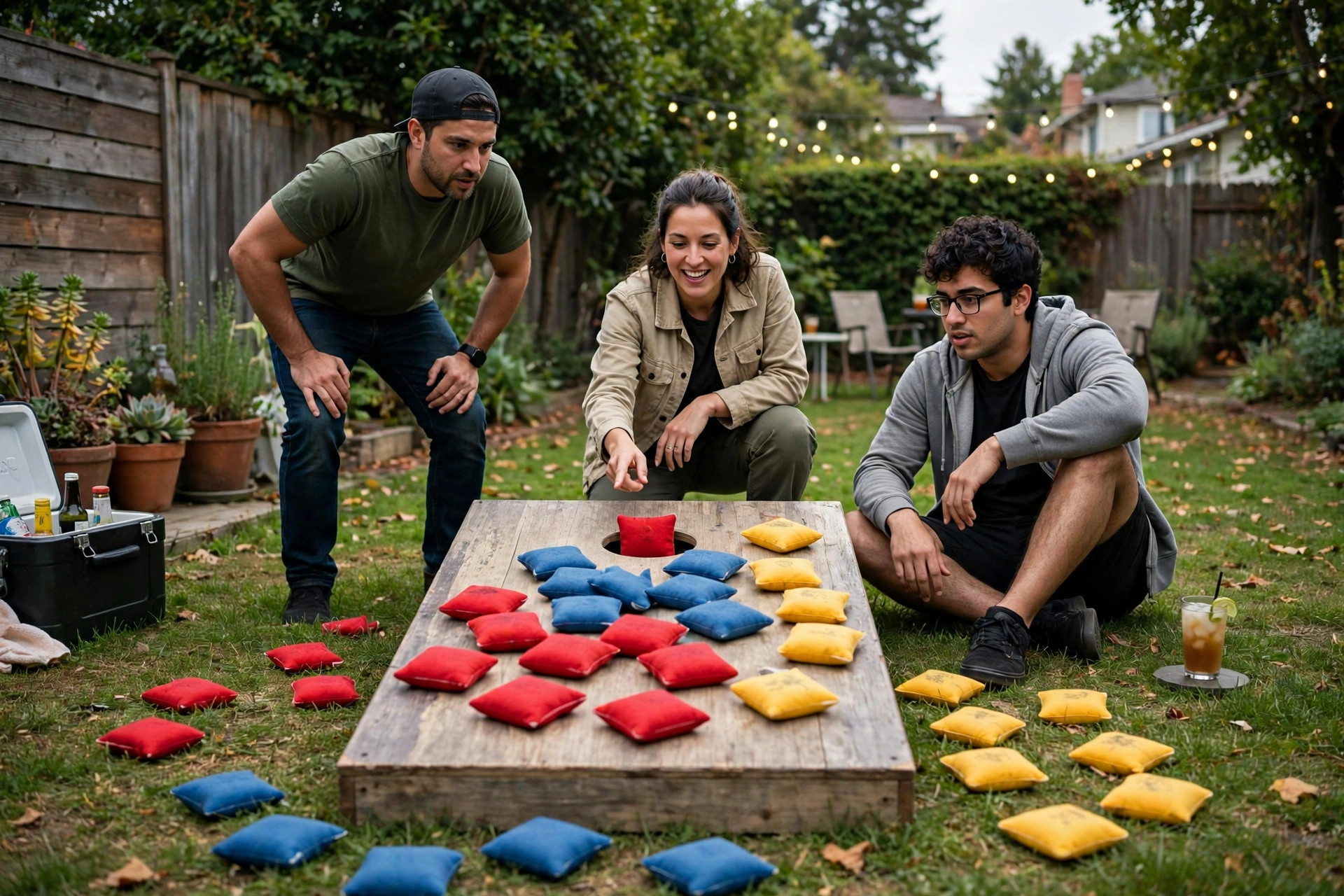
Cutthroat: The Classic Three Player Cornhole Game
Cutthroat removes teams entirely. Each player throws their own four bags per inning and scores their own points: three for a bag in the hole, one for a bag on the board. The big change is cancellation: under the cutthroat cornhole rules most backyard groups play, cancellation disappears, so every bag counts. Play to 21, or 15 for faster games, and rotate who throws first each inning.
Winner-Stays Rotation for 3 Players
Two players play a normal head-to-head game to 11 while the third keeps score. The loser sits out the next game and the waiting player rotates in. Over an afternoon, everyone plays roughly two games out of three. This is the fairest version of cornhole with 3 players when skill levels are close.
Cornhole With 5 Players: Handicaps and Rotation Queues
2 vs 3 With a Sit-Out Rotation
Play standard doubles scoring, but each inning one player on the three side sits out, rotating who rests, so both ends throw four bags against four bags. Rotate the sit-out every inning, not every game. If the pair is clearly stronger, flip the handicap: the three side plays everyone, and the pair gets a small head start. Bag condition matters in handicapped games; our guide to fixing cornhole bags that are too slick or too sticky evens them out.
Winner-Stays Rotation Queue
For a casual group, skip fixed teams. Play short games to 11, winners stay on the boards, losers go to the back of the queue, and the next player or pair rotates in. With five players, the longest wait is a single short game, and the format self-balances.
Cornhole With 6 Players: 3v3 or a Three-Team Round Robin
3 vs 3 on One Set of Boards
Split into two teams of three, teammates spread across both ends. Each player throws two bags per inning instead of four, so each team still throws four bags per inning from the throwing end, and cancellation scoring works as normal. Rotate who stands at which end every few innings.
Three Teams of Two, Round Robin
Three pairs, and each pair plays the other two in short games to 11 or 15. Most wins takes the night, with total points as the tiebreaker. A bad game costs you one match, not the whole evening.
Fairness Tips for Any Odd-Number Game
- Rotate the sit-out and the throwing order on a fixed schedule, not by argument.
- Use shorter target scores, 11 or 15, so rotations and queues keep moving.
- Put your strongest players in the format with the least help: in 2 vs 3, the pair should be your two best throwers.
- Keep a written scoresheet for round robins.
- Agree on the format before the first bag.

Frequently Asked Questions
Can you play cornhole with 3 players?
Yes. The two formats that work best are cutthroat, where each player throws their own four bags and scores their own points with no cancellation, and a winner-stays rotation, where two players play to 11 and the loser swaps out.
What are the cutthroat cornhole rules?
In cutthroat, every player plays for themselves. Each throws four bags per inning and scores three points per bag in the hole and one per bag on the board. Most backyard groups drop cancellation scoring, so every bag counts. First to 21 wins, or play to 15 for faster games.
How do you play cornhole with 5 players?
Two formats work well. In 2 vs 3, one player on the three side sits out each inning on rotation, so both ends always throw four bags against four. In a rotation queue, short games to 11 are played winner-stays, and waiting players rotate in after every game.
Can you play cornhole with 6 players on one set of boards?
Yes, two ways. In 3 vs 3, each player throws two bags per inning and teammates split the ends, keeping four bags per team per inning. Or form three teams of two and run a round robin of short games to 11 or 15, with most wins taking the night.
How do you keep odd-number cornhole games fair?
Equalize bags per end, rotate sit-outs and throwing order on a fixed schedule, and use shorter target scores so nobody waits long. Balance teams by skill before adding handicaps, and write the format down before the first game.
Final Thoughts
An odd headcount does not have to shrink your cornhole game. Cornhole with 3 players works as cutthroat or a rotation, five works with a sit-out or a queue, and six is a genuine team game. And if the group outgrows your current set, our best cornhole boards roundup covers the upgrade.

7 Best Cornhole Wraps and Decals

6 Tips to Improve Your Cornhole Technique
