
How to Play Horse Collar Shuffleboard: Rules and Scoring10 min read
Most table shuffleboard games score one winner at a time. Horse collar shuffleboard flips that idea: one side shoots every puck, counts everything that lands, and then hands the table over.
It is toad in the hole style play on a table: a whole turn is shot and tallied before anyone answers. That rhythm makes it perfect for groups: big turns change the score fast, and one bad frame leaves you with the game’s namesake, a big round zero. Here are the rules, the scoring, and the strategy that keeps you off zero.
What Is Horse Collar Shuffleboard?
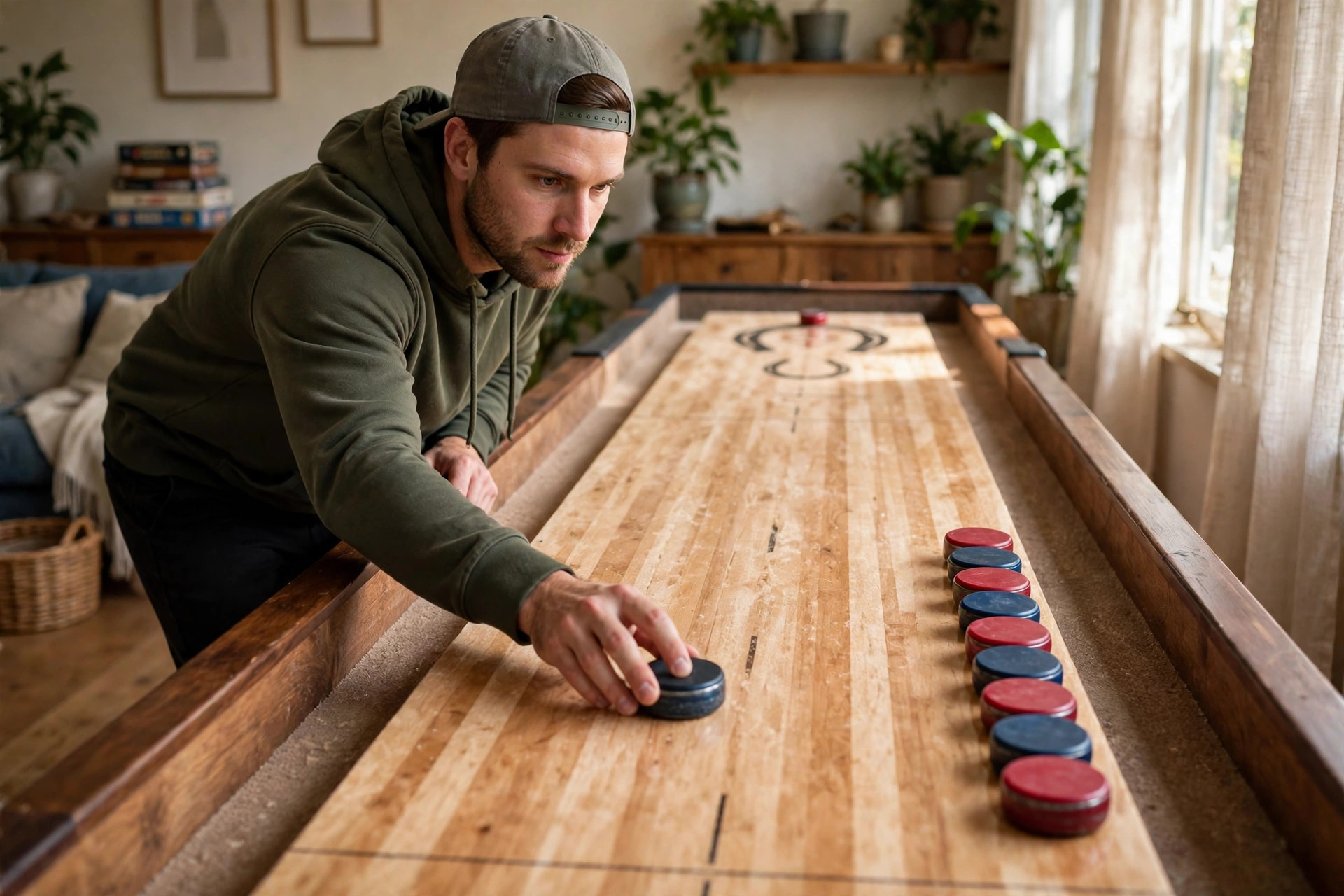
Horse collar shuffleboard is a variant of table shuffleboard played on a standard table with eight pucks, four red and four blue. Instead of alternating shots, a player or team shoots all eight in a row from one end, tallies the score, and clears the table for the next side. Because every puck counts, scores climb fast: one strong frame can top 20 points. That is why the winning target is 51 points, not the 15 or 21 of regular play. There is no opponent puck to knock off during your frame, either. Your only enemy is the foul line, the gutters, and your own touch.
What You Need and How to Set Up
You need a shuffleboard table, eight pucks in two colors, and a way to keep score. A scoreboard or abacus unit helps, because the numbers get big. Our roundup of the best shuffleboard tables covers lengths and playfield quality if you are shopping, and our guide to shuffleboard dimensions and table lengths explains the zones used below. Setup takes a minute:
- Decide the shooting end for the first frame. Many groups shoot every frame from the same end; others alternate ends each frame.
- Give one player or team all eight pucks. In team play, teammates split the pucks evenly.
- Wax or powder the playfield as you normally would, and agree on the house rules in the next sections before the first shot.
Players, Teams and Shooting Order
Horse collar works with almost any group size, which is a big part of its appeal:
- Singles: two players, each shooting all eight pucks per frame.
- Doubles: two teams of two, with partners splitting the eight pucks, usually four each.
- Big teams: teams of four or eight, each player shooting two pucks or one puck per frame.
One full pass by every side is a frame: Team 1 shoots all eight pucks, the score is tallied, the table is cleared, and Team 2 shoots from the same end. Keep one shooting order all game. Many teams let their most reliable foul-line clearer shoot last, in case the frame comes down to the final pucks.
How Scoring Works in Horse Collar Shuffleboard
After all eight pucks stop, count every puck that crossed the foul line completely and stayed on the playfield. Nothing cancels, because only your pucks are on the table. Each puck scores by the zone it finishes in:
| Where the puck finishes | Points |
|---|---|
| Short of the foul line, in the gutter, or off the table | 0 |
| Past the foul line, before the 2 line (the 1 zone) | 1 |
| Past the 2 line, before the 3 line (the 2 zone) | 2 |
| Past the 3 line, short of the back edge (the 3 zone) | 3 |
| Hanging off the back end of the table (a hanger) | 13 |
| Hanging off a back corner of the table (a corner hanger) | 26 |
A puck must fully clear a line to earn the higher value; one sitting on the foul line scores nothing. The hangers make horse collar scoring famous: a 13-point hanger beats four 3-zone pucks, and a 26-point corner hanger can nearly win a game alone. Chasing them is thrilling, and risky, which brings us to the rule that gives the game its name.
The Horse Collar: Scoreless Frames and the Qualifying Rule
In the most commonly played version, a frame only counts if it qualifies. The usual test has two parts: every puck must cross the foul line and stay on the table, and at least one puck must reach the 3 zone or better. Fail either part and the whole frame scores zero, no matter what else is sitting out there. That zero is the horse collar, named for the big round O it leaves on the score sheet. Some groups add a friendly penalty on top, such as a small wager into a pot, but the zero itself is the standard punishment.
House Variations to Agree On First
Published rule sets and house rules differ, so settle these before you play:
- Some groups skip the qualifying test and tally every frame; beginners score more, but the drama of the horse collar disappears.
- Some groups require only the 3-zone puck, and forgive one puck short of the foul line.
- Hanger values are widely played at 13 and 26, but a few houses score a plain hanger at a lower number; confirm before someone hangs one.
Winning the Game: First to 51 and Finishing the Frame
The first side to 51 wins, with one fairness twist: if a team hits 51 mid-frame, the teams still to shoot in that frame get their turn, and a higher score overtakes it. Finishing the frame matters, because the last shooter always knows the exact number needed. Going first should not end the game early. If two sides end tied at 51 or more, most groups play one extra frame as a tiebreak. And no, a team need not land exactly on 51: passing it is fine, as long as the frame finishes out.
Horse Collar Shuffleboard Strategy
Strategy here is about protecting the frame first and chasing glory second. A zero undoes everything, so play it in layers.
Clear the foul line early: post safe 1s and 2s with your first pucks; once the frame is alive, you can aim smaller.
Build one 3-zone puck before you need it: the qualifying 3 is the frame’s most important puck; settle one in by mid-frame, so your last pucks are free to attack.
Chase hangers last, and only with touch: a hanger attempt that flies off the table can kill the frame under the strict qualifying rule; save hanger shots for your final puck, and slide them, never throw them.
Use your own pucks as backstops: a puck parked at the back of the 2 zone gives later shots something to tap against, turning near-misses into 3s instead of gutter balls.
Know the number you need: count before your last two pucks; if a plain 3 wins it, take the plain 3.
Horse Collar vs Regular Table Shuffleboard Games
For game night, the short version: regular table play is a duel, horse collar is a time trial. Regular play alternates shots, only one side scores per round, and knock-offs are half the game. Horse collar gives you the table alone, counts every puck, and makes the foul line your opponent. Mixed groups often prefer it, because a beginner’s good frame counts in full instead of being cancelled by one better opposing puck. Our shuffleboard court vs table comparison covers the outdoor version too.
Frequently Asked Questions
What are the basic horse collar shuffleboard rules?
One player or team shoots all eight pucks from one end, then counts every puck that fully crossed the foul line: 1, 2 or 3 points by zone, 13 for a hanger, 26 for a corner hanger. First side to 51 after a complete frame wins.
Why is a scoreless frame called a horse collar in shuffleboard scoring?
A frame that fails to qualify scores zero, and that round zero on the score sheet gives the game its name. In the commonly played version, a frame fails when any puck stops short of the foul line or leaves the table, or when no puck reaches the 3 zone or better.
How many points is a hanger worth in horse collar scoring?
A puck hanging off the back end of the table is worth 13 points, and a puck hanging off a back corner is worth 26 points. Those values are the widely played standard, but a few house games score hangers differently, so confirm the numbers before the first frame starts.
Can you play horse collar shuffleboard with four players?
Yes. Four players form two teams of two, and partners split the eight pucks, most often four shots each. Larger groups can run teams of four or eight, each player shooting two pucks or one. Everyone shoots from the same end during a frame, then the other team takes its turn.
Do you have to hit exactly 51 points to win?
In the standard game, no. The first side to reach or pass 51 wins, but only after every team has finished that frame, so a later shooter can still overtake the score. Some house games add an exact-51 rule for extra tension, so agree on it before you start.
Final Thoughts
Horse collar shuffleboard takes ten minutes to learn and one zero frame to respect. Agree on the qualifying rule and the hanger values, protect your frame early, and save the hero shots for last. Do that, and the collar stays on somebody else.

How to Play Shuffleboard: A Shuffleboard 101 Guide

How to Level a Shuffleboard Table and Use Climate Adjusters
