Outdoor Shuffleboard Court vs Table Shuffleboard: Which Should You Buy?9 min read
Shuffleboard comes in two very different forms, and choosing between them is not really about which game is better. The shuffleboard court vs table decision comes down to your space, your weather, and how you want to play. One is played standing on a long outdoor court, pushing discs with a cue. The other is played indoors, sliding pucks down a polished wooden table by hand. Same scoring idea, very different ownership experience.
Shuffleboard Court vs Table at a Glance
| Factor | Outdoor Shuffleboard Court | Table Shuffleboard |
|---|---|---|
| Space needed | Long, flat outdoor area, about 52 feet for a regulation court | One room, with clearance around a 9 to 22 foot table |
| Cost tier | Low to moderate for a surface court, high for a poured permanent court | Moderate to high, priced like serious furniture |
| Players | 2 to 4, standing and walking the court | 2 to 4, standing around the table |
| Gameplay feel | Full-body cue push, discs glide on a court surface | Hand slide, fine touch, pucks glide on wax |
| Maintenance | Sweeping, surface cleaning, weather wear | Leveling, waxing, playfield shape care |
| Portability | Permanent or semi-permanent, not portable | Heavy, but indoors and relocatable with help |
What Is an Outdoor Shuffleboard Court?
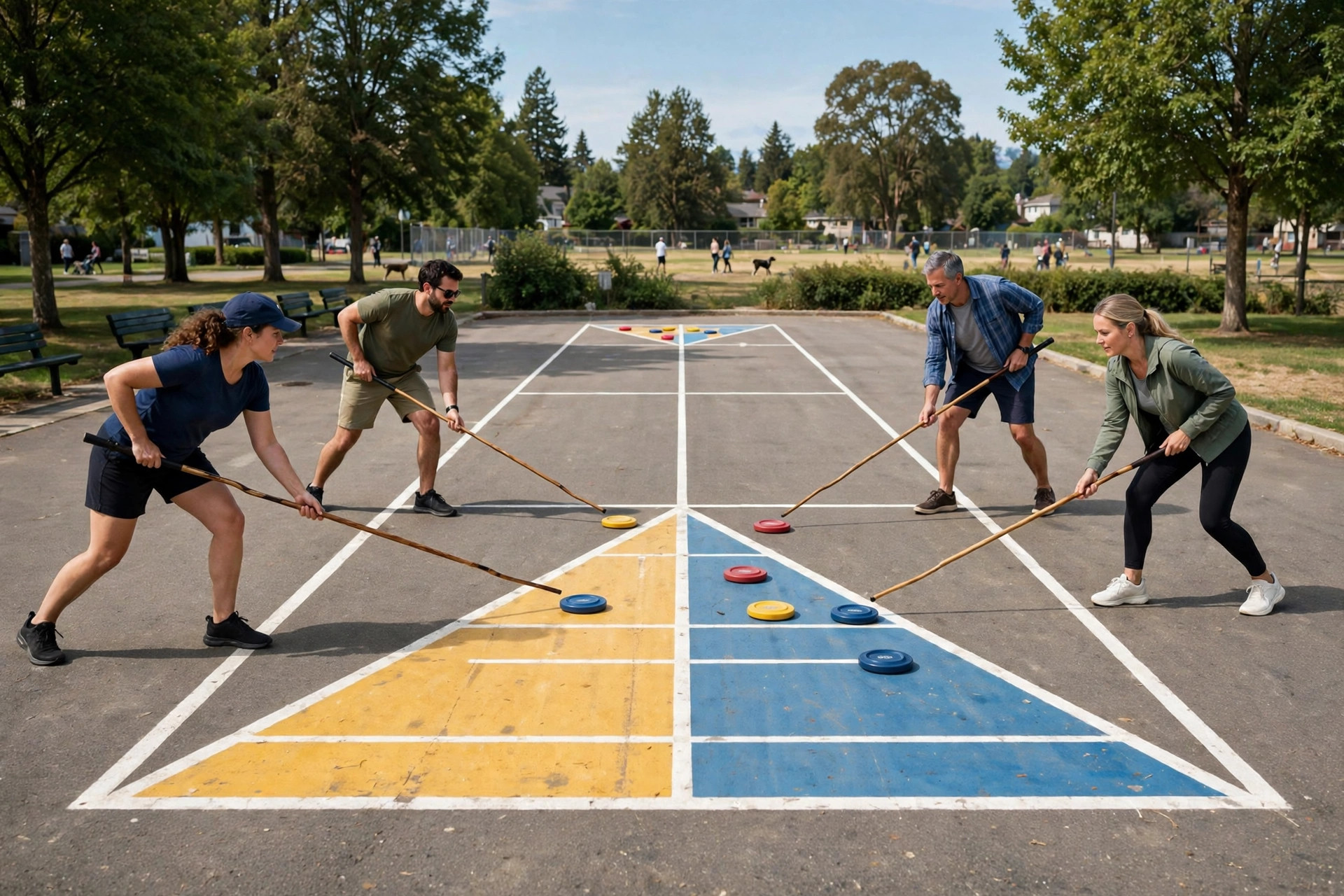
An outdoor shuffleboard court, often called deck shuffleboard, is the version many people first meet on a cruise ship, at a resort, or in a retirement community. Players stand on the court itself, and use a long cue to push a disc toward a scoring triangle at the far end. The discs are larger and heavier than table pucks, because they travel much farther.
Shuffleboard Court Dimensions in Plain English
A regulation court is about 52 feet long and 6 feet wide, with the scoring triangle set in from each end. Many home players mark a shorter court and still have a great game. What matters more is a flat, smooth surface: concrete, a purpose-built court surface, or a roll-out mat. Grass does not work, and cracked pavement ruins the slide. For exact numbers, see our guide to shuffleboard dimensions for tables and courts.
What Is Table Shuffleboard for Home Play?
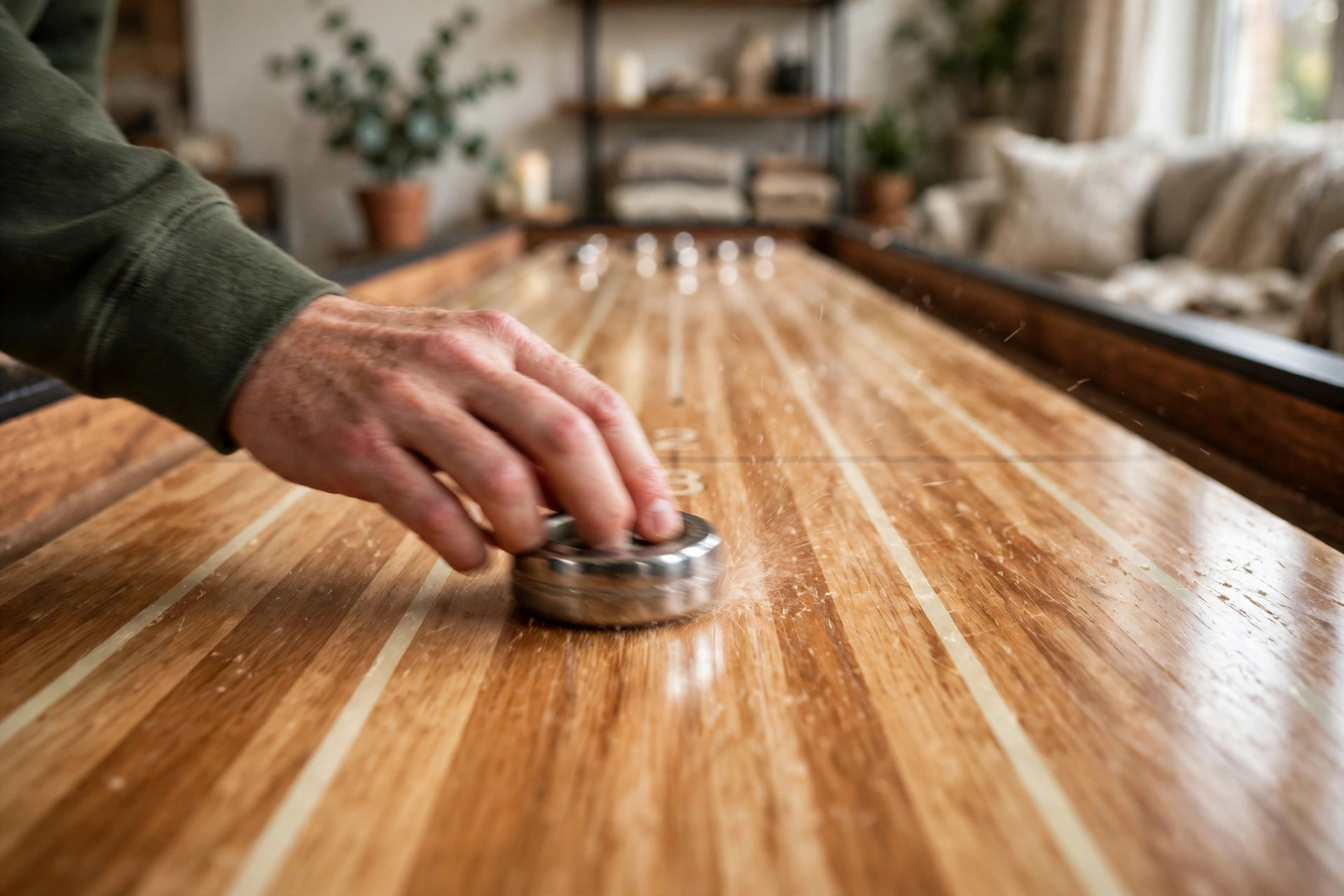
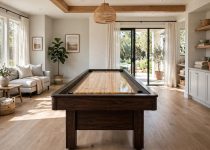
Table shuffleboard for home use shrinks the same idea onto a raised wooden table, usually 9 to 22 feet long. You stand beside it and slide a weighted puck by hand across a polished, waxed playfield. A puck only counts if it clears the foul line and stays on the table, so play rewards a soft touch more than power. Our roundup of the best shuffleboard tables covers lengths, materials, and what separates a sturdy table from a wobbly one.
Space: The Factor That Usually Decides It
Space is where the shuffleboard court vs table choice usually ends. Measure first, fall in love second. A court needs length outdoors, but almost nothing indoors, and a painted or roll-out court can share a patio or driveway when not in use. A table needs a dedicated room, plus room to stand at each end and slide your arm without hitting a wall. A common mistake is measuring the table and forgetting the players. If the room only just fits the table, it does not fit the game.
Cost Tier: What You Are Really Paying For
We will keep this in tiers, because exact prices change by material and region. A simple surface or roll-out court is usually the lowest-cost way in. A poured, permanent court is a higher tier, because you are paying for flat, durable outdoor construction. A table is a furniture purchase: shorter home tables are a moderate tier, long tables with thick butcher-block playfields are a high tier. Running costs differ too: a court needs discs, cues, and cleaning supplies, while a table needs wax and occasional replacement pucks.
Gameplay: Same Scoring Idea, Different Skills
On a court, the skill is a smooth, repeatable cue push over a long distance. You walk the court, read the surface, and adjust for small imperfections and a light breeze. On a table, the skill is touch. You control speed with your fingers and wrist on a fast surface, so knock-off shots, blocking, and hanging a puck on the back line matter more. Neither is easier: court play forgives an imperfect slide because the disc is heavier, while table play shows every small error.
Maintenance and Upkeep Compared
Outdoor Court Maintenance
Sweep before play, because grit changes how discs slide and wears the surface. Clean stains and mildew as your material requires, and in cold climates check each spring for cracks from freeze and thaw.
Table Maintenance
A table needs its legs leveled, its playfield cleaned and waxed, and its side-to-side shape checked as humidity changes the wood. None of that is hard, but it is regular work. Our guide to leveling a shuffleboard table and using climate adjusters shows what is involved and how long it takes.
Which One Fits Your Household?
Choose an outdoor court if you have a long flat patio or yard, a long outdoor season, want a game for gatherings, have no spare room, and prefer full-body play. Choose a table if you have a game room with real clearance, want to play year-round and at night, enjoy fine-touch strategy shots, are happy to level and wax a wooden playfield, and want a room centerpiece. Choose neither, for now, if your only options are a court on rough ground or a table in a room with no clearance. A roll-out court or smaller table beats forcing the wrong format into the wrong space.
Our Recommendation
For most homeowners, the shuffleboard court vs table answer is a table, but only if the room truly fits it. It gets played more often, because weather and darkness never cancel a game, and guests understand it in two minutes. For clubs and warm-climate homes with outdoor space to spare, deck shuffleboard is the smarter buy. It serves bigger groups, costs less to start, and never takes over a room. Start with your space measurement, not a product listing.
Frequently Asked Questions
How big is a regulation outdoor shuffleboard court?
A regulation outdoor shuffleboard court is about 52 feet long and 6 feet wide, including the standing areas at each end. Home courts are often built a little shorter to fit a patio or driveway, and casual play works fine as long as both ends match and the surface stays flat and smooth.
What is the difference between deck shuffleboard and table shuffleboard?
Deck shuffleboard is played standing on a long outdoor court, pushing larger discs with a cue toward a triangle at the far end. Table shuffleboard is played beside a raised wooden table, sliding smaller pucks by hand across a waxed playfield. The scoring idea is similar, but the equipment and space differ.
Can you play table shuffleboard for home games with more than 4 players?
Most table shuffleboard for home play works best with 2 to 4 players at a time, because everyone needs room to stand and slide at the ends. Larger groups can rotate in a tournament or knockout format, with winners staying on, which keeps the game moving without crowding the table.
Which lasts longer, a shuffleboard court or a table?
Both can last for many years when looked after. A permanent outdoor court must survive weather, sun, and freeze cycles, so its surface may need resurfacing over time. An indoor table avoids weather, but its wooden playfield needs leveling, waxing, and humidity care to stay true.
Is shuffleboard court vs table scoring the same?
The core idea is the same in a shuffleboard court vs table game: only the player or team with the disc or puck farthest into the scoring area scores, and shots must pass the foul line to count. Courts use the ground triangle, tables use the marked playfield zones.
Final Thoughts
Do not buy the format, buy the life around it. If your best game nights happen outside with a group, mark the court. If they happen in a finished room all winter, buy the table.
How to Resurface a Shuffleboard Table (and When Not To)
Shuffleboard Table Room Size Guide: Clearance You Actually Need