
How to Run a Cornhole Tournament: Brackets, Rules and Payouts8 min read
Learning how to run a cornhole tournament is mostly about decisions you make before the first bag flies. Pick the format, settle the rules, and set the payouts in advance, and the day itself feels easy.
A backyard event with eight teams runs on the same bones as a forty-team fundraiser: a bracket that fits your courts, rules everyone heard before play started, and scorekeeping that never lets the bracket stall.
Good boards help too; if you are short a set, our roundup of the best cornhole boards covers the regulation builds worth borrowing or buying.
Our top picks, compared:
How to Run a Cornhole Tournament: Start With the Format
Single Elimination: Fast and Ruthless
Win and advance, lose and you are done. The quickest format and the easiest to explain, perfect for parties. The downside: a decent team can draw the strongest pair first and be finished in fifteen minutes.
Double Elimination Cornhole: The Backyard Favorite
Every team gets a second life in a losers bracket; only a second loss sends them home. It roughly doubles the game count, but early losses stop being fatal, weaker teams get more games, and the final usually features the two best teams. For most backyard events, this is the format to beat.
Round Robin Into a Bracket
Every team plays everyone else, then seed a single elimination bracket from the results. Everyone is guaranteed several games and seeding is earned. It needs the most organization, so save it for groups that sign up in advance.
How Many Teams, Courts and Boards Do You Need?
One court hosts one game at a time, and a typical game to 21 runs about fifteen to twenty minutes. Count the games your format creates, divide by your courts, and multiply by twenty minutes to get a rough schedule.
| Teams | Format | Approx. Rounds/Games |
|---|---|---|
| 8 | Single elimination | 3 rounds, 7 games total |
| 8 | Double elimination | 14 games total (15 with a bracket reset final) |
| 16 | Single elimination | 4 rounds, 15 games total |
| 16 | Double elimination | 30 games total (31 with a bracket reset final) |
| 32 | Single elimination | 5 rounds, 31 games total |
| 32 | Double elimination | 62 games total, best split across 6 or more courts |
Two courts is the comfortable minimum past eight teams; with four courts, a sixteen-team double elimination event fits a relaxed afternoon. If the math says your format will not finish before dark, shrink the bracket, not the rules.
Building the Cornhole Tournament Bracket and Seeding Teams
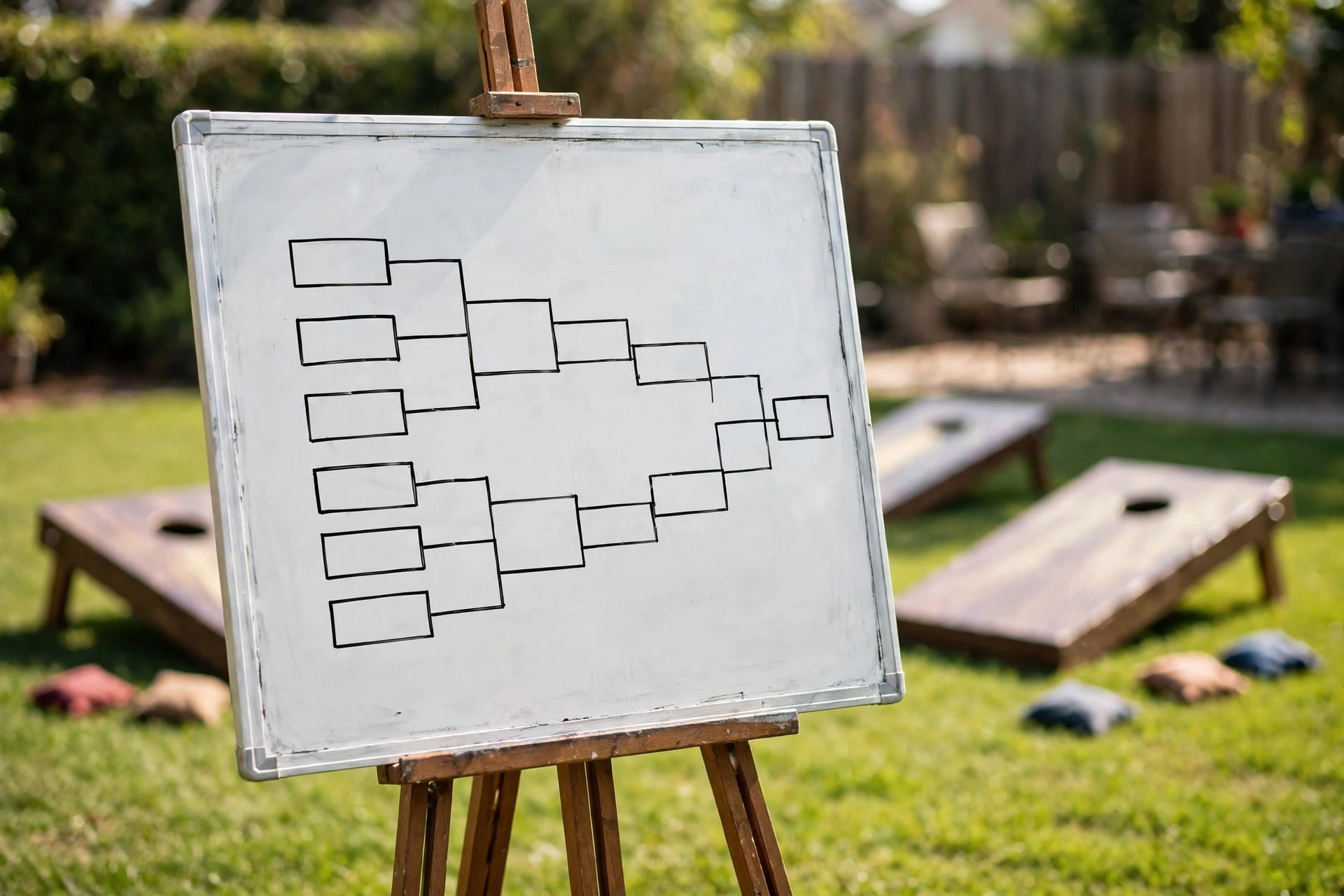
For a casual group, a public random draw is fair, fast, and argument-proof. If a few teams are clearly stronger, seed them into different quarters so they cannot meet until the semifinals. Team counts rarely land on a power of two; first-round byes go to the top seeds, or are drawn publicly. If sign-ups land on an awkward headcount, our guide to playing cornhole with odd numbers of players covers formats that absorb late arrivals. Post the bracket where everyone can see it.
Cornhole Tournament Rules to Announce Before the First Bag
- Scoring: cancellation scoring to 21; three points in the hole, one on the board, only the higher side scores the difference.
- Winning: first to 21; decide in advance on win by two and bust rules; most backyard events skip both.
- Fouls: a foot over the foul line or a bag thrown out of turn is a dead bag.
- Skunk rule (optional): some groups end a game at 7-0 or 11-0; announce it if you use it.
- First throw and bags: flip a coin for the first throw, then the scoring side throws first; decide house bags or own bags before play starts.
Write the card down and tape it near the bracket.
Scorekeeping That Keeps the Day Moving
Give every court a simple way to report: a paper scoresheet the winners bring to the bracket table, or one person per court calling results in. Winners reporting the score is the classic system.
If you run the event more than once, our guide to cornhole scoring apps and scorekeeping without an app compares app features with paper and score tower methods.
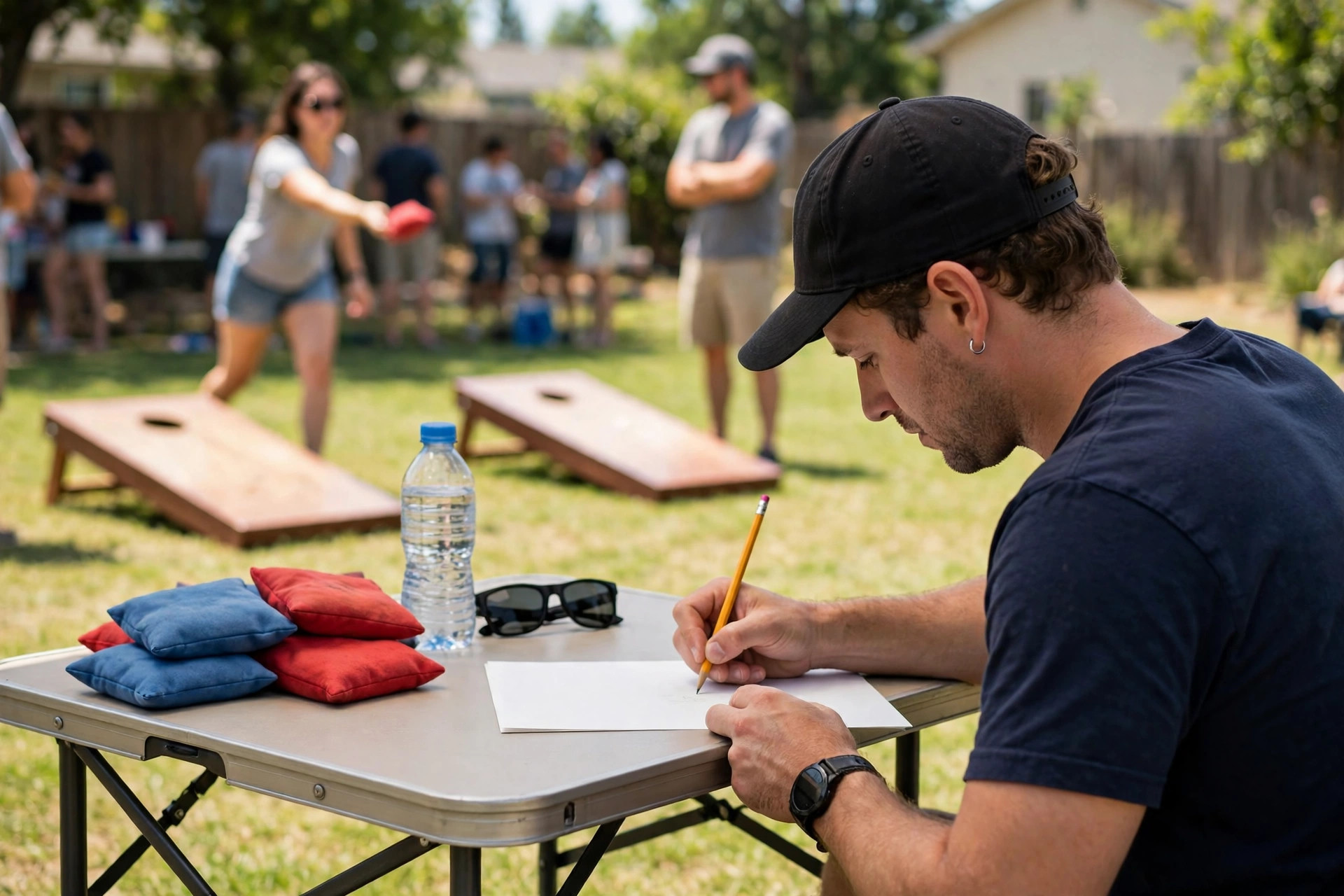
Update the public bracket after every result, not in batches.
Cornhole Tournament Payouts That Feel Fair
Payouts work best as percentages of the prize pool, announced before the first game.
| Place | Winner-Take-Most Split | Spread-the-Wealth Split |
|---|---|---|
| 1st | 70% | 50% |
| 2nd | 20% | 30% |
| 3rd | 10% | 15% |
| 4th | 0% | 5% |
Winner-take-most suits small, competitive fields; the spread version suits parties and fundraisers. For a charity event, state the charity’s cut first and split what remains. Pay out immediately after the final, in front of everyone.
A Sample Afternoon Timeline
- 12:00 Set up courts, post the bracket and the rules card
- 12:30 Check-in, warm-up tosses, sign-ups close
- 1:00 Announce the rules out loud, first matches called
- 1:00 to 4:00 Bracket play, losers bracket starting by 1:45
- 4:00 Semifinals
- 4:30 Final, then payouts and photos
Build in slack.
Tournament Day Checklist
- Boards and bags: one full set per court plus a spare; a backup from the sets in our best cornhole boards roundup keeps a court from sitting idle.
- The posted bracket with a marker that works.
- The rules card, taped where players gather.
- Scoresheets or a scoring app, plus pencils.
- Measuring help for close calls: a phone flashlight and a straight edge.
- Water, shade and a first aid kit.
- Prizes or payout envelopes, prepared before the final.
Frequently Asked Questions
How long does a 16-team cornhole tournament take?
A 16-team double elimination event runs about 30 games. On four courts at roughly twenty minutes a game, that is three to four hours with breaks. Single elimination halves it to about 15 games. Court count matters more than anything else.
Is single or double elimination better for a backyard tournament?
Double elimination is better for most backyard events, because every team plays at least two games and one bad draw does not end a team’s day. Single elimination wins when time is short or the tournament shares the day with other activities.
How do you seed a cornhole tournament fairly?
For casual groups, draw names publicly at random. If a few teams are clearly stronger, seed them into separate quarters so they meet late. When time allows, a short round robin earns the seeds on the boards instead of by reputation.
How much of the prize pool should the winner get?
Somewhere between 50 and 70 percent is the normal range. Winner-take-most splits near 70 percent suit competitive fields, while friendlier events spread more to second, third and fourth. Announce the percentages before the first game.
What happens if an odd number of teams signs up?
The bracket absorbs it with first-round byes. Give byes to the top seeds, or draw them publicly in a casual group, and the rest of the bracket runs normally.
Final Thoughts
How to run a cornhole tournament comes down to three early decisions: a format that fits your courts and clock, rules announced before the first throw, and payouts set as percentages everyone heard in advance. Make those calls the day before, keep the bracket updated, and the tournament runs itself.

6 Tips to Improve Your Cornhole Technique

15 Best Cornhole Boards for Your Next Game
