
Carrom Board Size Guide: Home, Club and Tournament Boards10 min read
Carrom board size sounds like a detail you can sort out later, until the board arrives and either swallows your dining room or plays like a toy. Boards are sold in several sizes, and the differences change the game itself: shot distances, rebound angles, and how much skill a long pot actually takes.
The good news is that the sizes follow a clear ladder, from the tournament standard at the top down to small travel boards. Once you know the ladder, matching a board to your room and your players takes minutes.
This guide walks through every common board size, explains which measurements actually matter, and shows how much room each board needs around it. If you are comparing specific models as well, our roundup of the best carrom boards lists the sizes alongside the boards worth buying.
Our top picks, compared:
Why Carrom Board Size Matters More Than You Think
Shrink the board and every shot gets shorter, rebounds arrive sooner, and beginners pot coins they had no business reaching. Grow it to the full standard and the same shots demand real aim and power control. Size also decides who the board suits. A full-size board rewards experienced players and frustrates small children who cannot reach the middle comfortably. A compact board does the opposite. Neither is wrong; they are tools for different rooms and different players. Finally, size decides whether the board can live in your home at all. The board itself is only part of the footprint, because players sit on all four sides and need elbow room to shoot.
Carrom Board Size at a Glance
Here is the ladder of common sizes. Playing surface is the measurement that defines each class; overall size adds the frame.
| Board Type | Playing Surface | Overall Size | Best For |
|---|---|---|---|
| Tournament (ICF standard) | 29 in (about 74 cm) | About 32 to 33 in square including the frame | Serious players, clubs, competition practice |
| Club size | About 28 in | About 31 to 32 in square | Regular home players who want near-standard play in slightly less space |
| Home / compact | About 26 in | About 29 to 30 in square | Family games, smaller rooms, casual players |
| Kids / travel | About 20 in or smaller | About 24 in square or less | Children, beginners, travel and tight storage |
Notice how small the steps are. An inch or two of playing surface does not sound like much, but across a full game it changes every long shot and every rebound, which is why players who learn on a compact board need a few games to adjust to a full-size one.
Tournament Carrom Board Size: The ICF Standard
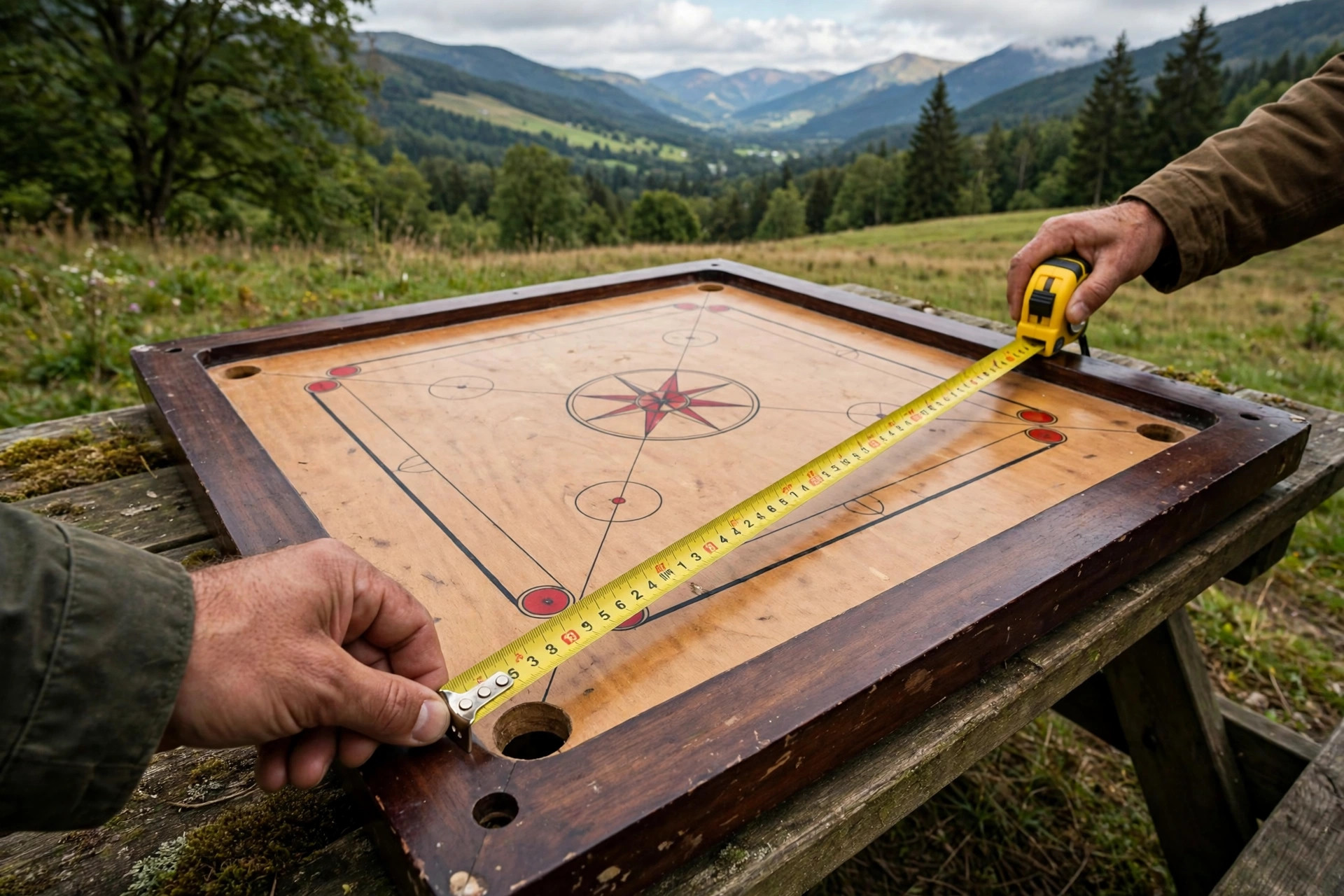
The tournament carrom board size is fixed by the International Carrom Federation: a playing surface of 29 inches square, roughly 74 cm, with the frame bringing the whole board to about 32 to 33 inches across. The corner pockets, baselines and centre circle are all laid out to match that surface, so the geometry of the game is identical in every competition hall. If you play in a club, enter local events, or simply want the game exactly as it is meant to be played, this is the size to buy. It is also the size every serious technique guide assumes.
The trade-offs are space and reach. A tournament board needs a proper stand or table and a room that fits players on all four sides, and younger children will struggle to reach shots near the centre.
Club and Home Carrom Board Dimensions
Drop one step to club size, about 28 inches of playing surface, and most home players honestly cannot feel the difference in casual games. These carrom board dimensions suit regular players who play weekly, host friends, and want honest rebounds without giving the room to a full tournament board. Home and compact boards, around 26 inches of playing surface, are the family sweet spot. They fit on a dining table, store more easily, and shorten the game just enough to keep younger players involved. Shots play a touch quicker and rebounds come back livelier, which casual groups often prefer. Below that, treat anything around 20 inches as a starter or travel board. They are great for teaching children the idea of the game, but the pockets and distances are scaled down so far that skills transfer only loosely to a full-size board.
Frame Width, Pockets and Playing Surface: What the Numbers Mean
Listings throw several measurements at you, and they are not interchangeable. The playing surface is the flat area inside the frame where the coins move; that is the number that defines the size class. The overall size includes the frame, which is why a 29 inch board needs a 32 to 33 inch table. Frame width matters for play, not just footprint. The frame’s inner faces are the rebound surfaces, so a wider, heavier frame gives truer, more consistent rebounds and keeps the board rigid. Thin frames on cheap boards flex and deaden rebounds. Pockets scale with the board. On a standard board the corner pockets are about 4.45 cm across, sized to swallow a coin cleanly without being generous. On small boards the pockets shrink in proportion, which is another reason scaled-down boards play differently.
How Much Room Space a Carrom Board Needs
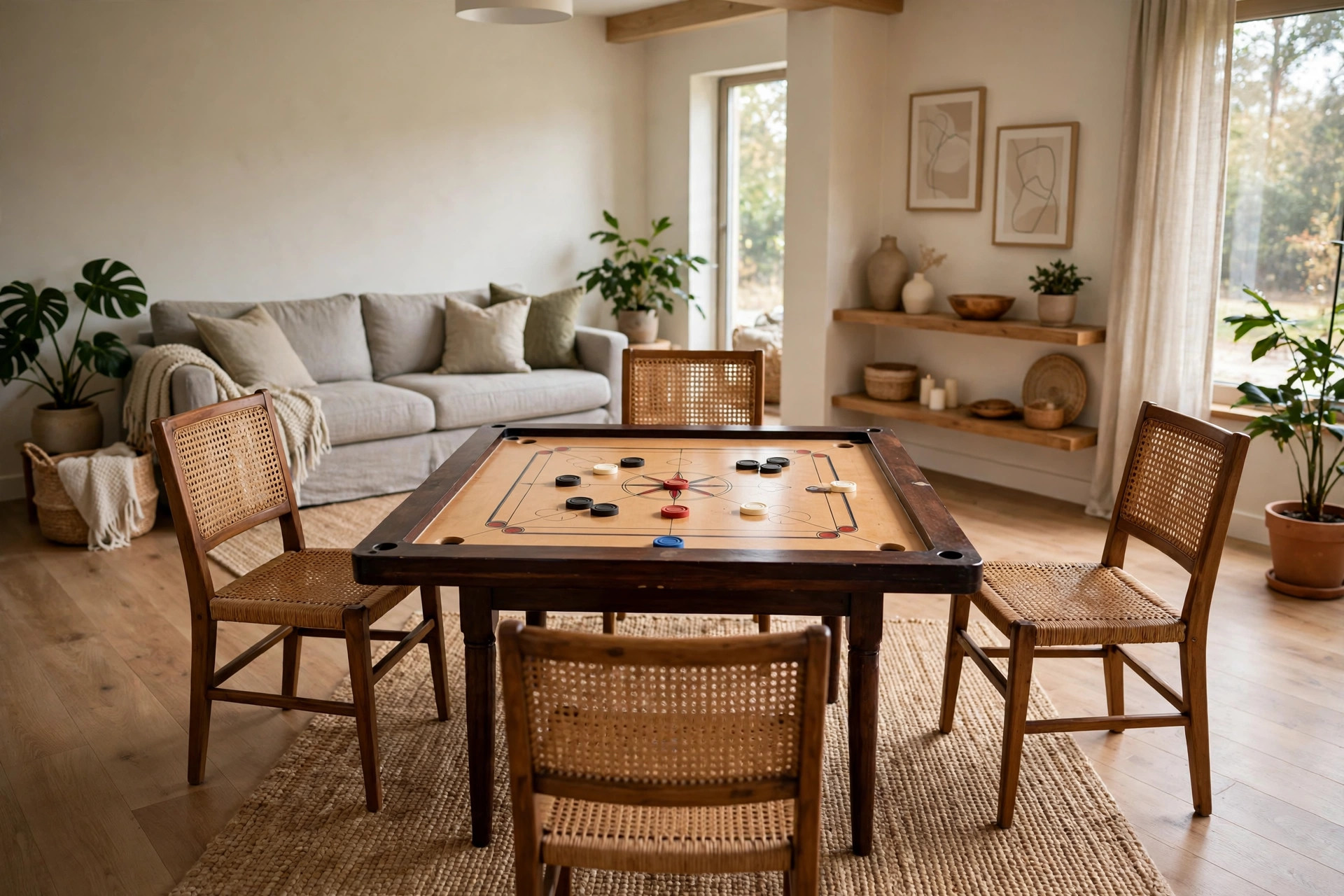
The board is only the middle of the space question. Players sit or stand on all four sides, lean over the frame to shoot, and need room to draw a hand back. As a rule of thumb, allow at least a 5 by 5 foot clear area for a compact board and closer to 6 by 6 feet for a full tournament board. A stand or low table sized to the board helps more than a big dining table, because the board sits at a consistent height with no overhang to bang knees on. Whatever it stands on, the surface must be level and stable; a wobbling board ruins rebounds and pockets alike.
Storage is the other half of the space question. Full-size boards store flat or upright against a wall, and keeping them flat, dry and unstressed is what stops warping, as our guide to carrom board maintenance explains in detail.
Which Carrom Board Size for Home Should You Buy?
Work backwards from your players and your room, in that order. If adults play regularly and you have the space, the standard carrom board size of 29 inches is the buy-once answer: it plays the true game and never needs upgrading. Our guide to the best carrom boards focuses on boards built to that standard and the club sizes just below it. If the board is mainly for family nights with children under ten, a 26 inch home board is the smarter purchase. The kids can reach, the games stay lively, and you can always move up later. Short on space entirely? A club-size board on a folding stand gives you near-standard play that disappears into a closet after the game, which beats a tournament board that permanently eats a room nobody can spare.
Frequently Asked Questions
What is the standard carrom board size?
The standard carrom board size, set by the International Carrom Federation for tournament play, is a 29 inch playing surface, about 74 cm square. With the frame included, the whole board measures roughly 32 to 33 inches across. Club, home and kids boards scale down from that standard.
What are the dimensions of a carrom board for home use?
Most home boards have a playing surface of about 26 to 28 inches, with an overall size of roughly 29 to 32 inches including the frame. That range keeps the game close to standard while fitting on a dining table and storing against a wall or in a closet.
Does carrom board size affect how the game plays?
Yes. A larger surface lengthens every shot, slows rebounds and rewards precise aim and power control. A smaller board shortens distances, quickens the game and forgives weaker shots, which is why compact boards suit families and beginners while full-size boards suit experienced and competitive players.
How much space do I need around a carrom board?
Plan for at least a 5 by 5 foot clear area for a compact board and about 6 by 6 feet for a full tournament board. Players need to sit or stand on all four sides with room to lean in and draw a hand back, so the board’s own size is only part of the footprint.
Is a bigger carrom board always better?
No. Bigger is better only when the players and the room suit it. A tournament board frustrates young children who cannot reach the centre and dominates a small room. A slightly smaller board that gets played every week is a better purchase than a full-size board that stays in storage.
Final Thoughts
Carrom board size is a ladder, not a mystery: 29 inches for the true tournament game, 28 for club play, 26 for family homes, and 20 or below for kids and travel. Measure your room, be honest about your players, and buy the largest board both can handle. Get the size right and everything else about the game, the shots, the rebounds, the arguments about the queen, falls into place.

How to Play Carrom – 6 Easy Steps

How to Fix a Slow or Sticky Carrom Board Surface
