
Deck Shuffleboard Rules for Cruise Ships, Parks and Backyards10 min read
Deck shuffleboard rules confuse first-time players for exactly one reason: the game looks simple right up until someone asks why a disc sitting on a line scores nothing. Whether you meet the game on a cruise ship deck, at a park court or on a backyard court of your own, the rules are the same, and they take about five minutes to learn. This guide covers the standard deck shuffleboard rules used on shared courts: the court layout, the equipment, shooting order, the scoring triangle, fouls, and the etiquette that keeps a public court friendly. Learn these once and you can walk onto almost any court and play a proper game.
The Court: Layout and Deck Shuffleboard Court Dimensions
A regulation court is 52 feet long and 6 feet wide, with a scoring triangle painted at each end. Players stand in the base area at one end and shoot toward the far triangle, which is why the game works on long, narrow spaces like ship decks.
The deck shuffleboard court dimensions that matter while you play are simple:
- The scoring triangle sits at each end, point facing the shooter.
- The 10 OFF area sits directly behind the triangle, separated by a line.
- A foul line crosses the court in front of the triangle, and a disc must cross it completely to be in play.
- The baseline at each end marks where your feet stay while you shoot.
Resort and backyard courts are sometimes shorter, and painted lines wear thin, so agree on the boundaries before the first disc if anything looks unclear. Our full guide to shuffleboard dimensions covers court and table measurements in detail.
Equipment: Cues, Discs and Scorekeeping
You need very little to play, which is part of the game’s appeal on ships and in parks:
- Cues, also called tangs: one per player, a long shaft with a U-shaped fork at the end that cradles the disc for the push shot.
- Discs, also called biscuits: eight in total, four per side, in two colours, traditionally yellow and black, each about 6 inches across.
- A scoreboard or chalkboard: most shared courts have one at the side; on a backyard court, a simple pad works fine.
The shot is a smooth push, not a hit: rest the disc in the fork, aim, and slide it forward in one motion. Jerky shots spin the disc and send it wandering.
How to Play Deck Shuffleboard: Shooting Order and Turns
Here is how to play deck shuffleboard round by round:
- Yellow shoots first in the opening round. After that, the winner of each round shoots first in the next one.
- Players alternate shots, one disc at a time, until all eight discs are played. That completes a round, sometimes called a frame or half.
- Shoot every disc from behind your baseline, toward the far triangle.
- A disc that fails to cross the foul line completely is out of play and removed.
- When the round ends, walk to the far end, score the discs as they lie, then shoot back toward the other triangle.
Knocking an opponent’s disc out of a scoring zone, or knocking your own disc deeper into the triangle, is legal and is the heart of the strategy. Expect your best disc to be targeted every round.
Deck Shuffleboard Scoring: Reading the Triangle
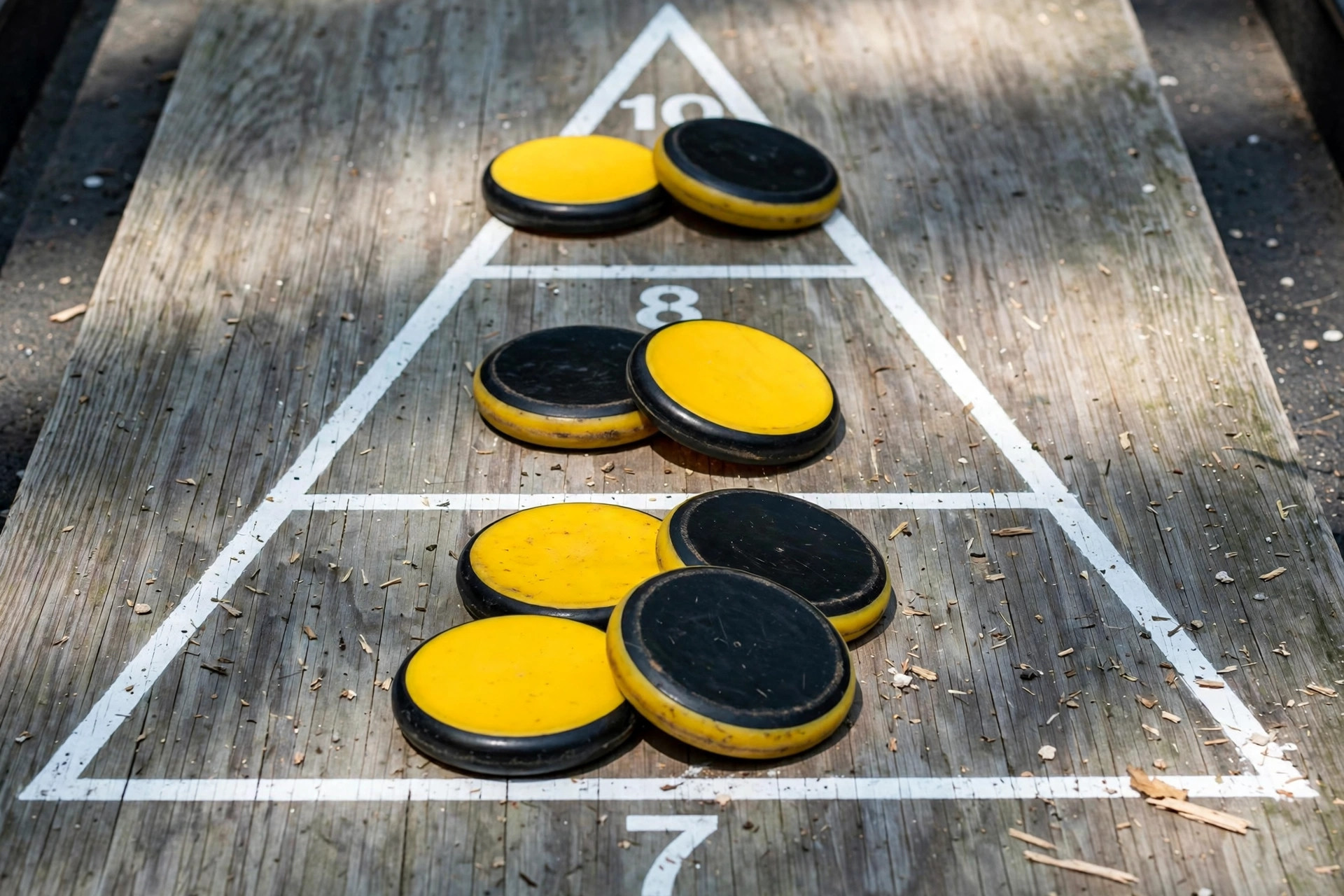
Only discs that come to rest completely inside a zone, without touching any line, score.
Deck shuffleboard scoring zones, from the point of the triangle back toward the shooter:
| Zone | Points | What Counts |
|---|---|---|
| 10 | 10 points | Disc fully inside the 10 area at the point of the triangle |
| 8 | 8 points | Disc fully inside either of the two 8 areas |
| 7 | 7 points | Disc fully inside either of the two 7 areas |
| 10 OFF | Minus 10 points | Disc fully inside the 10 OFF area behind the triangle |
| Touching any line | 0 points | A disc on a line scores nothing, even if most of it is in a zone. |
Two scoring habits prevent most arguments. First, score only after all eight discs are played, because the last shot can change everything. Second, judge line calls together: if both sides cannot agree a disc is fully in, the friendly custom on shared courts is that it does not score.
Deck Shuffleboard Fouls and Penalties
Deck shuffleboard fouls are mostly about feet, order and touching discs in play:
- Stepping on or over the baseline while shooting.
- Shooting out of turn, or shooting an opponent’s disc by mistake.
- Touching or moving a disc before the round is scored.
- Shooting while a player is still standing in the court at the far end.
Penalties vary by court. In organized tournament play, fouls can cost points, commonly 10, or the offending disc plus one more. On cruise and park courts, the usual friendly fix is simpler: remove the disc involved and carry on. Agree on the approach before a competitive game.
Deck Shuffleboard Rules for Singles vs Doubles: What Changes
The rules stay the same, but the flow of the game changes a lot:
- Singles: two players, four discs each; you shoot from one end, walk to the other end to score, then shoot back, so games take longer.
- Doubles: four players in two teams; partners station themselves at opposite ends and stay there, each shooting their team’s discs from their own end; games move faster, partners can quietly advise on angles, and doubles is the standard format on busy cruise courts.
Doubles also suits mixed-ability groups, because a new player is only ever shooting from one end and can copy a partner’s line.
Game Length: First to 75, and Variations You Will Meet
Under standard deck shuffleboard rules, a singles game is played to 75 points. The catch: the game can only end at the completion of a round, so both players finish the round in which someone passes 75, and scores often end above the target.
Variations you will meet on shared courts include:
- Doubles games to 75, or shortened to 50 when courts are busy.
- Frame games, where you play a set number of rounds and the highest score wins, common in organized ship activities.
- Win-by-two rules at some clubs, which are house rules rather than standard.
When in doubt, ask the players wrapping up before you. Every shared court has a local habit, and matching it keeps things friendly.
Etiquette on Shared Courts: Cruise Ships, Parks and Resorts
The written rules get you through a game. Etiquette gets you invited into the next one:
- On cruise ships, sign up or queue visibly at busy times, and keep games to a reasonable length when others are waiting.
- Stand well clear of the shooting lane and the far triangle while anyone is shooting, and never cross the court in front of a player lining up a shot.
- Retrieve discs promptly after scoring, and hand cues over clean and ready.
- Call your own fouls and line discs honestly; shared courts run on trust.
- Congratulate good shots, including your opponent’s, because on a small deck you will meet them at dinner.

Deck Shuffleboard vs Table Shuffleboard: The Short Version
If you know one version, you nearly know the other: the triangle, the line rule and the 10 OFF penalty all come from the deck game. Our side-by-side of shuffleboard court vs table shuffleboard explains the differences in equipment, space and cost, and if the table version wins you over, our guide to the best shuffleboard tables covers the home options.
Frequently Asked Questions
How many points is a deck shuffleboard game played to?
A standard singles game is played to 75 points, and the game ends only when a full round is complete, so final scores often pass 75. Doubles games are also commonly played to 75, though busy courts often shorten them to 50.
What happens if a disc lands on a line in deck shuffleboard?
It scores nothing. A disc must rest completely inside a scoring zone without touching any line to count, including the lines around the 10 OFF area. When players disagree on a close call, the shared-court custom is that it does not count.
Can you knock your opponent’s discs out in deck shuffleboard?
Yes, and you should. Knocking an opponent’s disc out of a scoring zone, pushing your own disc further into the triangle, or sending an opponent’s disc into the 10 OFF area are all legal and central to the strategy. It is why the last shot of a round, called the hammer, is so valuable.
How long is a deck shuffleboard court?
A regulation court is 52 feet long and 6 feet wide, with a scoring triangle at each end and the shooting baselines behind them. Park, resort and backyard courts are sometimes a little shorter, which plays fine as long as both ends match and players agree the boundaries before starting.
What is the 10 OFF in deck shuffleboard?
The 10 OFF is the penalty area directly behind the scoring triangle. A disc that comes to rest completely inside it, without touching a line, subtracts 10 points from that player’s score for the round. It punishes shots hit too hard, which is why controlled speed matters more than power in this game.
Final Thoughts
Deck shuffleboard rewards touch, patience and a little gamesmanship, and deck shuffleboard rules fit on an index card: alternate shots, cross the foul line, score only fully inside a zone, avoid the 10 OFF, play to 75. Learn those, respect the court’s etiquette, and you are ready for any court afloat or ashore.

Shuffleboard Dimensions: How Long is a Shuffleboard Table & Court?

How to Play Crazy Eights on a Shuffleboard Table
